
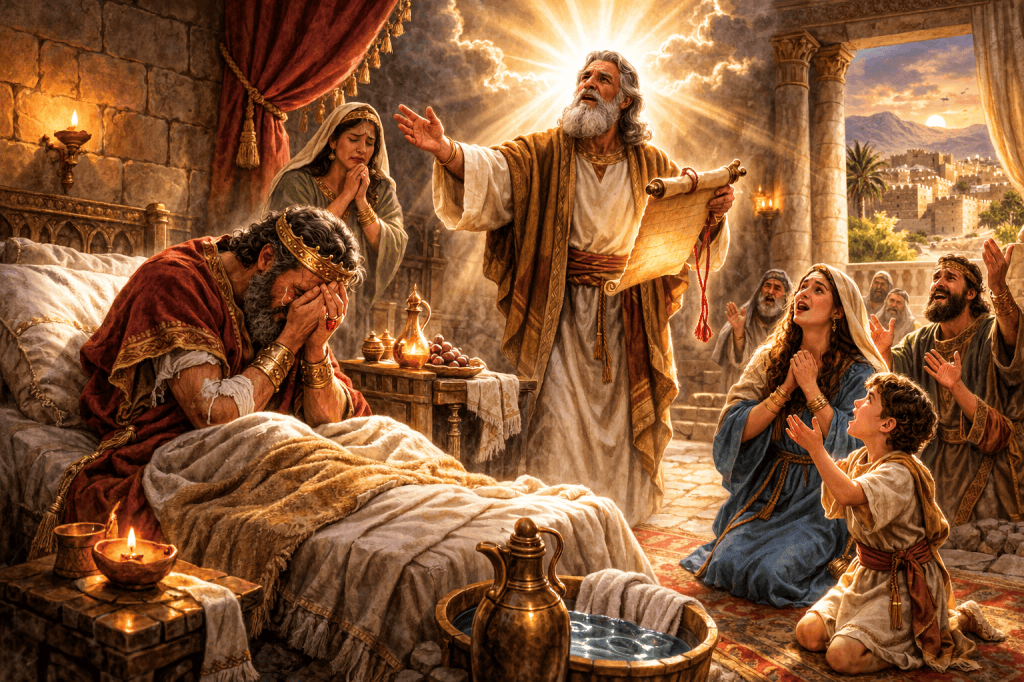
📖 Scripture Reading : Isaiah 38:1–22
✨
— Martin Luther
“Prayer is not overcoming God’s reluctance, but laying hold of His willingness.”
⏳ Background:
Hezekiah was not a reckless king. Scripture records that he trusted in the LORD, cleansed the temple, and led reforms in Judah (2 Kings 18:3–6). Yet faithfulness did not exempt him from crisis.
Isaiah 38:1 opens without softness: “In those days Hezekiah became sick and was at the point of death.” The prophet Isaiah came with a direct message from God: “Set your house in order, for you shall die; you shall not recover.”
This was not speculation. It was a divine verdict.
For a king in the prime of leadership, with no heir yet secured for the throne, the implications were devastating. National stability was at risk. Personal legacy seemed unfinished. His reforms could unravel. The promise to David’s line appeared fragile.
Emotionally, Hezekiah was shattered. Verse 2 says, “Then Hezekiah turned his face to the wall.” That is the posture of private anguish. No audience. No strategy. No advisors. Just a man facing mortality.
He prayed, “Remember how I have walked before You in faithfulness and with a whole heart” (Isaiah 38:3). And Scripture says, “Hezekiah wept bitterly.” These were not ceremonial tears; they were the grief of a man confronting irreversible loss.
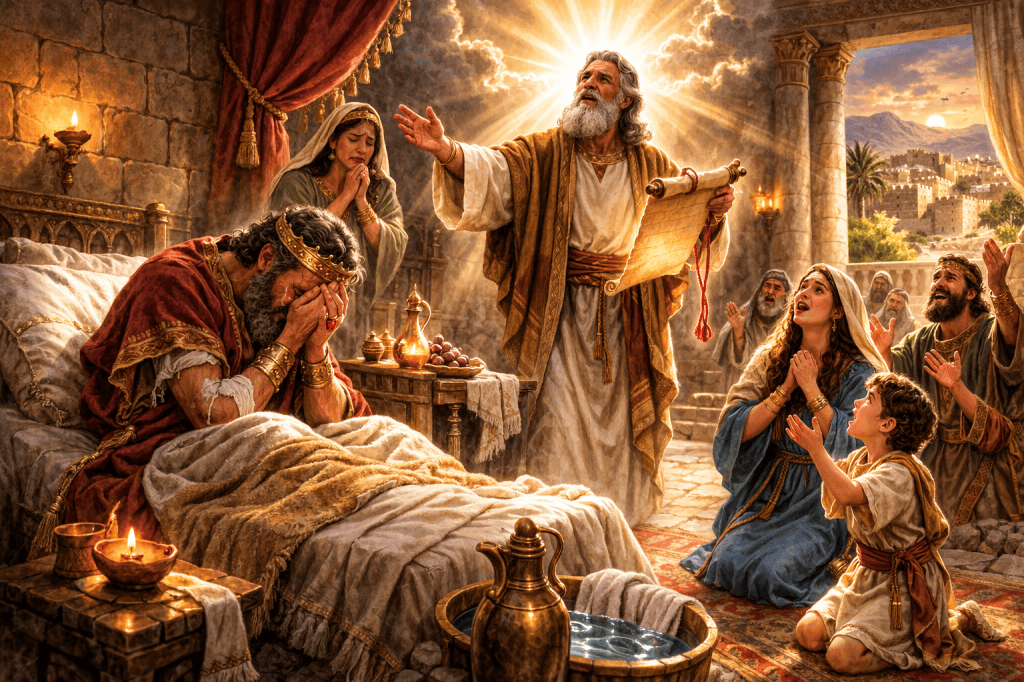
Human limitation was complete. No medicine could reverse the decree. No alliance could negotiate with death.
🔥 Turning Point:
Before Isaiah had even left the middle court, the word of the LORD came again (Isaiah 38:4). Heaven interrupted its own sentence.
“Go and say to Hezekiah… I have heard your prayer; I have seen your tears. Behold, I will add fifteen years to your life” (Isaiah 38:5). The same God who announced death now declared extension.
Notice what changed the narrative: God responded. God heard. God saw. God added.
He also promised deliverance from the king of Assyria (v.6), securing both personal and national preservation. As confirmation, God gave a sign — the shadow on the steps of Ahaz moved backward ten steps (Isaiah 38:7–8). Time itself seemed to reverse, symbolizing that the One who governs creation governs our days.
The decisive act was not Hezekiah’s tears; it was God’s mercy.
🌿 Transformation:
Hezekiah recovered. A poultice of figs was applied as instructed (Isaiah 38:21), blending divine promise with practical obedience. Fifteen additional years were granted — measurable grace.
During those extended years, an heir was born: Manasseh (2 Kings 21:1). The Davidic line continued. The covenant promise remained intact.
Hezekiah composed a psalm of reflection (Isaiah 38:9–20). He moved from despair — “I am deprived of the rest of my years” (v.10) — to renewed testimony — “The living, the living, he thanks You, as I do this day” (v.19). His theology deepened. He recognized, “In love You have delivered my life from the pit of destruction” (v.17).
The change was not merely physical survival. It was spiritual clarity. Hezekiah emerged with gratitude, humility, and renewed dependence. Even in later failures (Isaiah 39), the extension of life remained evidence that God governs endings and beginnings.
The death sentence did not have the final word.
🕊️ Spiritual Reflection:
Hezekiah’s story forces us to wrestle with divine sovereignty. God announced death — and then extended life. This does not imply instability in God’s character but reveals that prayer is woven into His providential design. The decree drove Hezekiah to the wall; the wall became the doorway to mercy.

Defeat often precedes transformation because it dismantles illusions of control. A king accustomed to authority discovered he could not command one more breath. In that helplessness, he encountered a God who listens.

God’s ability to redeem extends even to terminal pronouncements. Whether He alters circumstances or sustains us through them, His purposes are never thwarted by human limitation. Sometimes victory is reversal; sometimes it is resilience. In Hezekiah’s case, it was both.

Throughout Scripture, God responds to desperate cries — from Hannah’s barrenness (1 Samuel 1) to Nineveh’s repentance (Jonah 3). The consistent witness is that divine judgment and mercy are not contradictory but coordinated under God’s redemptive will.

Ultimately, the greatest reversal is found in Christ. Jesus faced a death sentence not reversed but fulfilled. Yet through resurrection, death itself was overturned. Hezekiah received fifteen more years; in Christ, we receive eternal life. The cross declares that even when death seems final, God writes a greater ending.
No diagnosis, failure, or verdict stands above His authority.
💬 Closing Encouragement:
There are seasons when we receive news that feels final — a diagnosis, a broken relationship, a lost opportunity, a door permanently closed. We know what it is to turn our faces to the wall and weep where no one sees. We feel the weight of unfinished dreams and fragile futures. Yet Hezekiah’s story calls us to bring our unfiltered grief before God rather than surrender to despair. We may not control outcomes, but we can cry out. We can trust that the One who numbers our days also hears our prayers. Whether He grants reversal or sustaining grace, He remains sovereign and compassionate. Let us keep praying, keep trusting, keep hoping. Our story is not finished while God is still speaking. Do not give up.
🙏 Prayer:
Lord of our days, when verdicts feel final, turn our hearts toward You.Hear our cries and steady us in weakness. Teach us to trust Your mercy beyond our fear. Whether by reversal or endurance, glorify Yourself in us. Hold our lives securely in Your hands.


Leave a comment