📖 Scripture Reading : Joshua 2:1–24; 6:22–25
✨
— Charles Spurgeon
“God is more ready to pardon than we are to sin.”
⏳ Background:
Jericho was a fortified city, its walls thick and imposing (Joshua 2:15). But beneath its strength was dread. Rahab herself confessed, “Terror has fallen upon us…for the LORD your God, He is God in the heavens above and on the earth beneath” (Joshua 2:9,11).
Rahab lived on that wall — physically attached to a doomed system. Scripture identifies her plainly as a prostitute (Joshua 2:1). Her livelihood, reputation, and social standing were inseparable from a city under divine judgment. When Jericho fell, she would fall with it. No treaty protected her. No moral résumé defended her.
Her situation held multiple layers of hopelessness:
• National destruction was imminent.
• Her profession carried shame.
• Her past offered no leverage for mercy.
• Her future appeared sealed within condemned walls.
She was not merely in danger externally; she bore internal awareness that her people stood opposed to the living God. Humanly speaking, there was no escape route. Jericho’s gates were shut (Joshua 6:1). The city was “shut up inside and outside.” That included Rahab.
🔥 Turning Point:
Then two Israelite spies arrived (Joshua 2:1). Their coming was not random; it was providence. God brought opportunity to her doorstep.
Rahab hid them at great personal risk (Joshua 2:4–6). If discovered, execution would have been certain. Her confession in Joshua 2:11 is the true turning point: “The LORD your God, He is God.” She aligned her heart with the God of Israel before she saw a single wall fall.
She pleaded for mercy: “Swear to me by the LORD that…you will save alive my father and mother, my brothers and sisters” (Joshua 2:12–13). This was not bargaining; it was faith reaching outward for covenant protection.
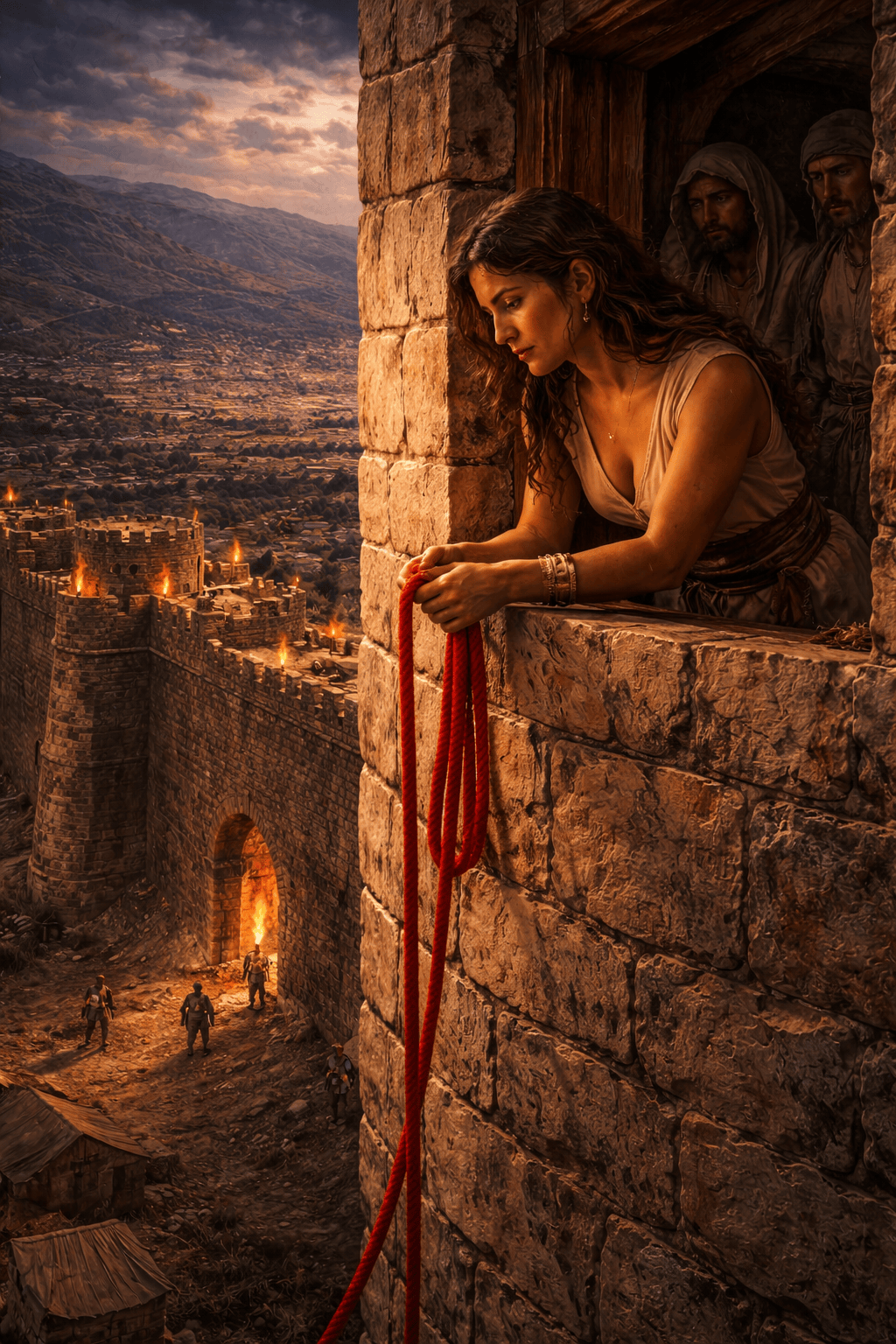
The spies instructed her to tie a scarlet cord in the window (Joshua 2:18). That cord became her visible sign of trust. She obeyed immediately: “She tied the scarlet cord in the window” (Joshua 2:21).
Before victory came, obedience came. Before walls collapsed, faith was anchored.
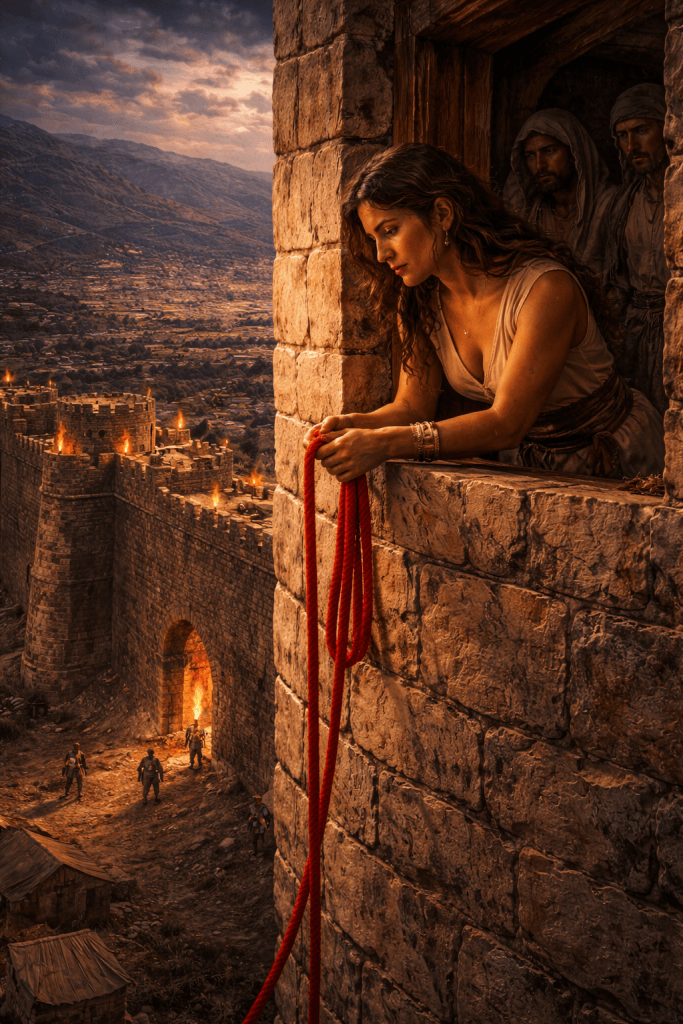
The decisive act was not the falling of Jericho’s walls — it was God honoring a believing heart within them.
🌿 Transformation:
Joshua 6 records the dramatic collapse. The walls fell flat (Joshua 6:20). The city was devoted to destruction. But Joshua commanded, “Go into the prostitute’s house and bring out from there the woman and all who belong to her” (Joshua 6:22).
Scripture records fulfillment precisely: “So they brought out Rahab and her father and mother and brothers and all who belonged to her” (Joshua 6:23). Not one was lost.
Verse 25 states, “Rahab the prostitute and her father’s household and all who belonged to her, Joshua saved alive. And she has lived in Israel to this day.” Her identity shifted:
• From prostitute to covenant member
• From condemned citizen to preserved witness
• From outsider to participant in God’s redemptive plan
The transformation did not end there. Rahab later married Salmon (Matthew 1:5). She became the mother of Boaz, the great-grandmother of King David, and is named in the genealogy of Jesus Christ. Her name appears in Hebrews 11:31 among the faithful and in James 2:25 as an example of living faith.
From a condemned wall in Jericho to the lineage of the Messiah — only God can rewrite a story like that.
🕊️ Spiritual Reflection:
Rahab’s story declares that God’s sovereignty extends beyond moral history and cultural boundaries. Jericho was marked for judgment, yet mercy operated within its walls. Divine justice and divine grace met at a scarlet cord.

Her past did not intimidate God. Her profession did not cancel possibility. Faith, even when small and trembling, becomes the instrument of divine reversal. Rahab did not clean herself up before believing; she believed, and God redefined her future.

Defeat often precedes transformation because it exposes our false securities. Jericho’s walls symbolized human strength, but they could not withstand God’s purpose. Rahab transferred her trust from collapsing systems to the living God.

Throughout Scripture, God rescues unlikely people — foreigners, widows, outcasts — weaving them into His covenant story. The scarlet cord echoes the Passover blood in Exodus 12, where judgment passed over marked houses.

The scarlet thread anticipates the blood of Christ. Just as Rahab was spared by a visible sign of covenant mercy, so we are saved through the redemptive work of Jesus. In Him, shame is not merely covered but replaced with adoption. The condemned become heirs.

God does not merely spare; He restores. He does not merely rescue; He repositions.
💬 Closing Encouragement:
There are moments when we feel trapped inside our own Jericho — surrounded by consequences, shame, or systems we helped build. We know what it is to feel attached to a crumbling wall, uncertain whether mercy is possible for us. Yet Rahab’s story reminds us that faith, even when surrounded by collapse, can anchor us to God’s covenant. We may not control the falling walls, but we can choose where our trust rests. Let us cling to the scarlet thread of Christ’s mercy, obey even before outcomes appear, and entrust our families, futures, and failures to Him. God is still rewriting destinies. Do not give up.
🙏 Prayer:
Lord God,when we feel condemned by our past, remind us of Your mercy. Give us courage to trust You before circumstances change. Anchor our hearts to the saving work of Christ. Turn our shame into testimony and our fear into faith. Rewrite our story for Your glory.


Leave a comment