
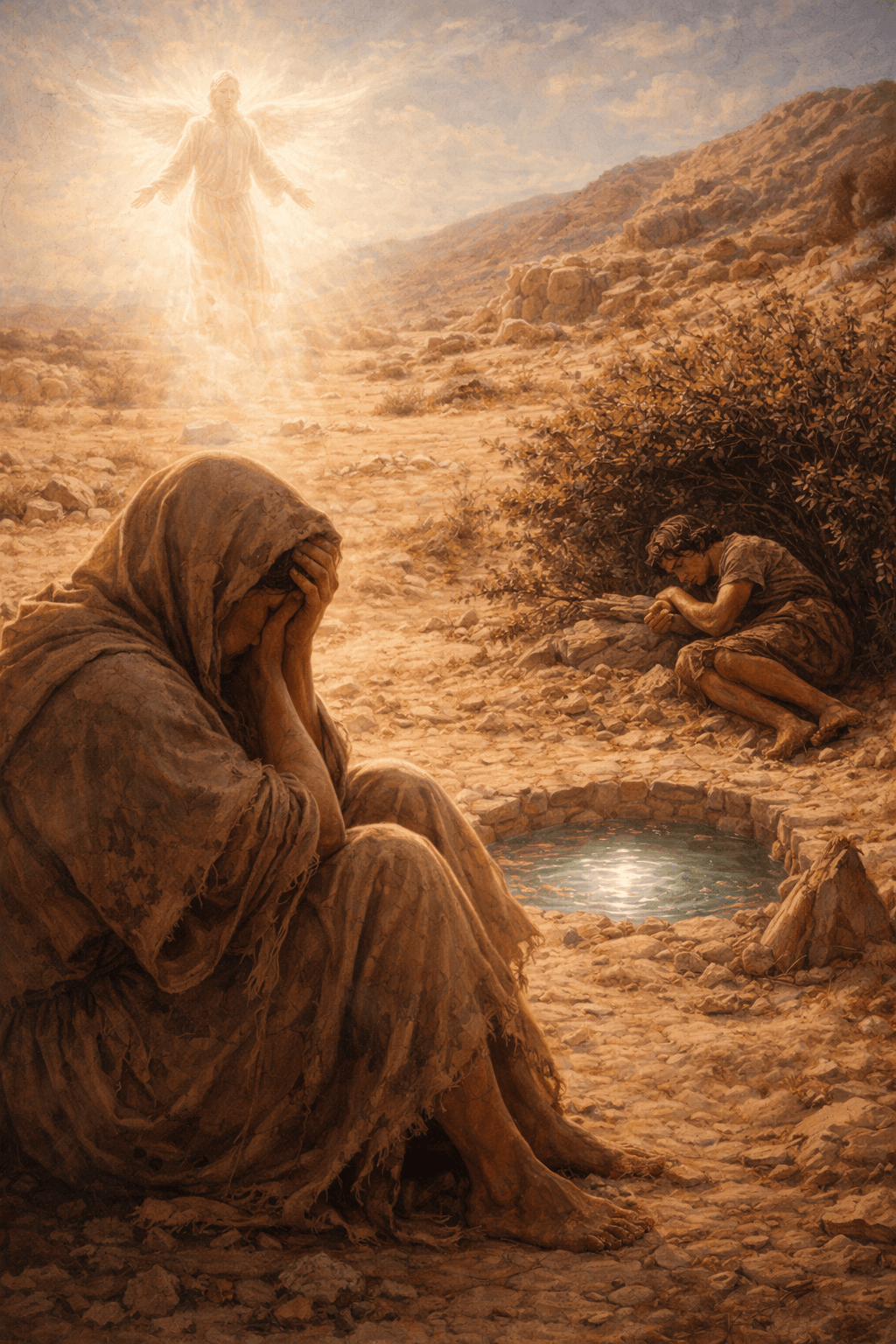
📖 Scripture Reading : Genesis 21:8–21
✨
— George Müller
“Faith begins where man’s power ends.”
⏳ Background:
Hagar was not the matriarch of promise. She was an Egyptian servant (Genesis 16:1), a foreigner in Abraham’s household, drawn into a family crisis not of her own making. When Sarah could not conceive, Hagar became a surrogate solution. What began as human strategy became relational fracture.
After Isaac was born, tension deepened. Scripture says Sarah saw Ishmael “laughing” (Genesis 21:9), and fear rose within her heart. She demanded that Abraham send Hagar and her son away. Abraham was distressed (Genesis 21:11), yet God permitted the separation for His redemptive purposes.
Hagar was given bread and a skin of water and sent into the wilderness of Beersheba (Genesis 21:14). No caravan. No map. No inheritance. Just a mother and her son walking into heat and uncertainty.
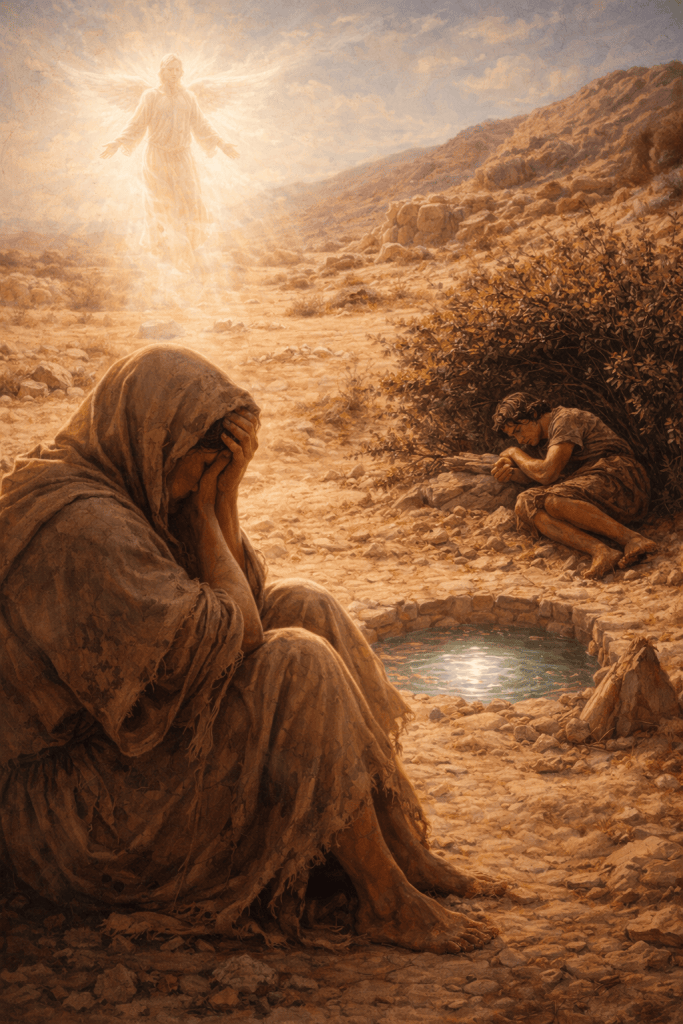
When the water was gone, the desert revealed its cruelty. “She put the child under one of the bushes. Then she went and sat down opposite him…for she said, ‘Let me not look on the death of the child’” (Genesis 21:15–16). This is not dramatic exaggeration; it is maternal despair. She expected death. She wept loudly (v.16). Ishmael cried. There were no resources left, no options, no visible rescue.
Human limitation was absolute. No strength, no water, no future.
🔥 Turning Point:
Then Scripture says something breathtaking: “God heard the voice of the boy” (Genesis 21:17).
Heaven responded to wilderness tears.
The angel of God called to Hagar from heaven and asked, “What troubles you, Hagar? Fear not, for God has heard the voice of the boy where he is” (v.17). Notice the tenderness — where he is. God did not require relocation, performance, or worthiness. He met them in their collapse.
Then God reaffirmed His promise: “I will make him into a great nation” (v.18). The future was not erased by the desert.
“And God opened her eyes, and she saw a well of water” (v.19). The well was not newly created; it was newly revealed. Divine intervention did not always change geography first — it changed sight. God acted. God spoke. God opened. God provided.
🌿 Transformation:
Hagar rose, filled the skin with water, and gave the boy a drink (Genesis 21:19). Immediate survival replaced imminent death.
Verse 20 says, “God was with the boy.” That phrase carries covenant weight. Ishmael grew, lived in the wilderness, and became an expert with the bow. He did not perish under the bush; he matured under God’s watch.
The status shifted:
• From rejected to sustained
• From abandoned to accompanied
• From certain death to growing strength
Hagar once named God “El Roi” — “the God who sees me” (Genesis 16:13). In Genesis 21, that revelation became lived reality. The desert did not define her story; divine sight did.
The crisis did not remove hardship entirely, but it replaced despair with promise. The unseen became seen by God.
🕊️ Spiritual Reflection:
Hagar’s story reveals that God’s sovereignty operates even within human failure. Abraham’s household dysfunction, Sarah’s jealousy, and cultural compromise created this crisis — yet none of it escaped God’s redemptive authority. Divine purposes were not derailed by flawed decisions.

Defeat often precedes transformation because it strips illusion. In the wilderness, Hagar had no leverage, no strategy, no control. That is precisely where revelation came. When our resources empty, we discover whether God is sufficient.

God does not overlook secondary characters. He is not only the God of covenant heirs but also of cast-out servants. Theologically, this demonstrates divine compassion beyond ethnic and covenant boundaries. God’s providence extends to the marginalized and forgotten.

From Genesis onward, Scripture reveals a God who hears cries in bondage (Exodus 2:24), sees affliction (Exodus 3:7), and rescues the helpless. The wilderness repeatedly becomes a theater for divine revelation.

In Christ, we see the ultimate fulfillment of “God who sees.” Jesus noticed the unseen, touched the untouchable, and cried out for the forsaken. At the cross, He entered ultimate abandonment so that we would never be truly abandoned. Resurrection proves that apparent defeat is never final in God’s economy.

The desert is not the end of the story. It is often the doorway to revelation.
💬 Closing Encouragement:
There are seasons when we feel dismissed, overlooked, and exhausted by circumstances we did not choose. We may sit beneath our own “bush,” emotionally spent, expecting loss instead of rescue. We know what it is to run out of strength and options. Yet Hagar’s story invites us to believe that heaven still hears, that God still sees us exactly where we are, and that wells may exist where we see only sand. Even when outcomes are unclear, we can trust that God is present and at work beyond our vision. Let us choose surrender over despair, obedience over bitterness, and perseverance over retreat. Our wilderness is not proof of abandonment. Do not give up.
🙏 Prayer:
Father, in our deserts, when hope feels dry, remind us that You see us. Open our eyes to the wells You have already prepared. Give us strength when we feel we cannot go on. Teach us to trust Your presence in barren places. Turn our despair into testimony and our loss into victory.


Leave a comment