
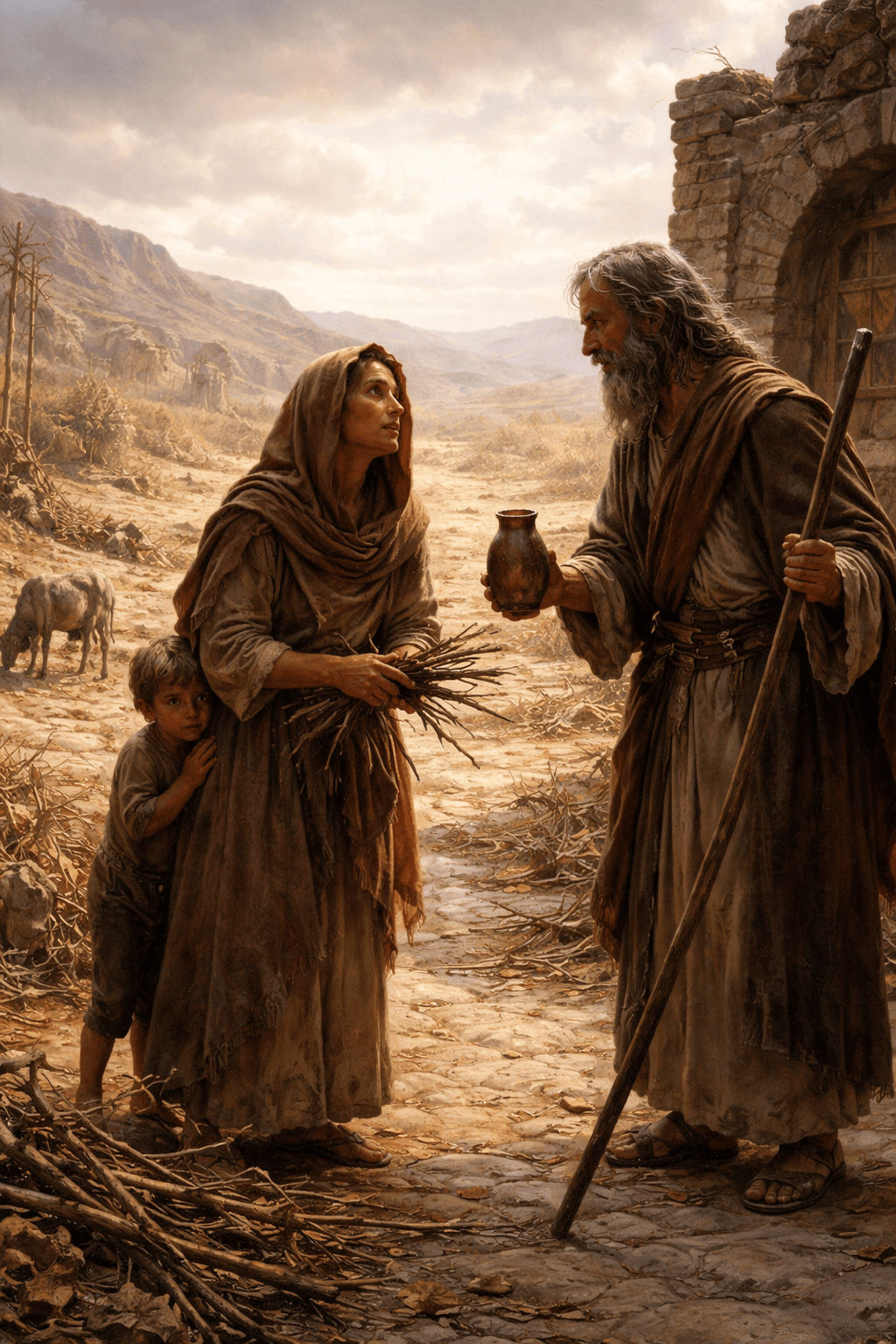
📖 Scripture Reading :1 Kings 17:8–16
✨
— Augustine of Hippo
“Faith is to believe what you do not see; the reward of this faith is to see what you believe.”
⏳ Background:
The famine in 1 Kings 17 was not mild inconvenience; it was national catastrophe. The heavens had been shut by God’s command (1 Kings 17:1). Crops failed. Streams dried. Livestock died. The land of Zarephath, a region outside Israel, was not spared. Hunger does not recognize borders.
At the city gate stood a widow—anonymous, unprotected, economically powerless. In the ancient world, widowhood meant vulnerability. No husband. No steady provision. No security. She was gathering a few sticks—just enough for one small fire.
When the prophet Elijah approached her and asked for water and bread, her response was painfully honest: “As the LORD your God lives, I have nothing baked, only a handful of flour in a jar and a little oil in a jug” (1 Kings 17:12). She was not exaggerating. She had calculated it. One final meal. Then she and her son would eat it—“that we may eat it and die.”
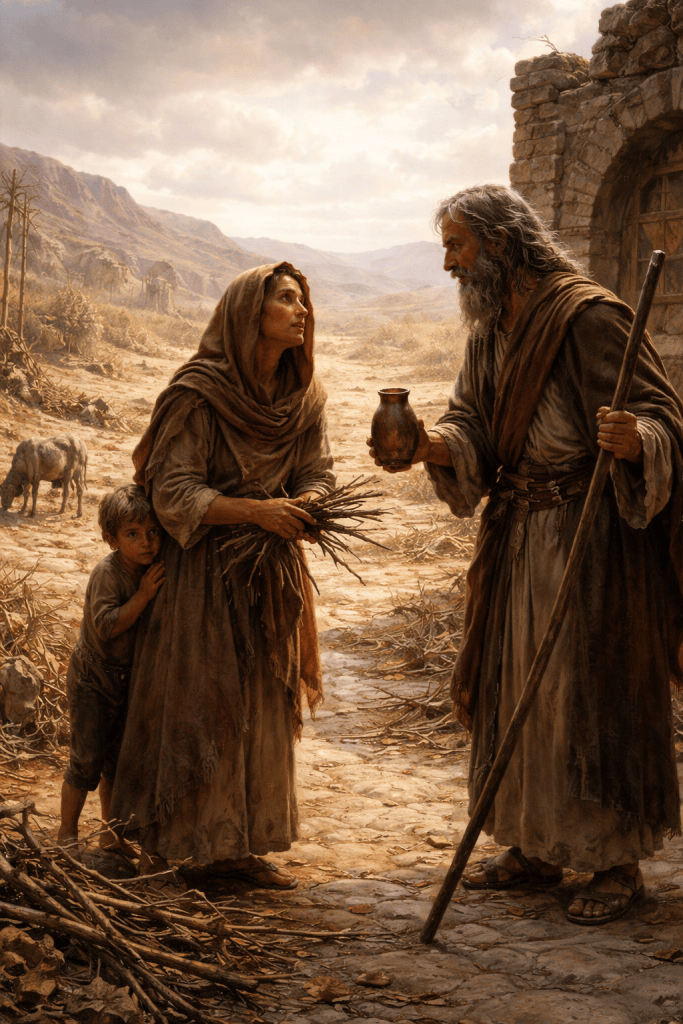
This is not dramatic language; it is resignation. She had moved from fear to acceptance of death. No miracle was expected. No rescue anticipated. Just the slow closing of hope. Her problem was not merely hunger; it was finality. The jar was almost empty. The future was completely empty.
Human limitation was absolute. She had no network, no savings, no alternative. She could not manufacture rain. She could not command heaven. She could not stretch flour beyond its measure. She was at the end.
🔥 Turning Point:
Into that final moment, God spoke—not to her first, but to Elijah. “Arise, go to Zarephath… behold, I have commanded a widow there to feed you” (1 Kings 17:9). Before she knew it, heaven had already moved. God had arranged provision in the very house that seemed most empty.
Elijah’s command sounded unreasonable: “Do not fear… first make me a little cake of it and bring it to me” (1 Kings 17:13). Give first. In famine. From the last handful.
But the heart of the turning point was not Elijah’s request—it was God’s promise: “The jar of flour shall not be spent, and the jug of oil shall not be empty, until the day that the LORD sends rain” (1 Kings 17:14).
This was the moment of decision. She could cling to the last visible security, or she could trust an invisible word. Scripture says simply, “And she went and did as Elijah said” (1 Kings 17:15). No long speech. No recorded prayer. Just obedience.
God acted not by dropping bread from heaven, but by sustaining the ordinary jar. The miracle was quiet, daily, persistent. Each time she reached in—there was enough. Each morning—provision. Each evening—sustenance. Heaven upheld the household through hidden multiplication.
🌿 Transformation:
The result? “The jar of flour was not spent, neither did the jug of oil become empty” (1 Kings 17:16). Day after day. Meal after meal. Not abundance stored in barns, but sufficiency renewed.
Her circumstances shifted from certain starvation to sustained life. Her son lived. She lived. The prophet was fed. One act of obedience became the channel of provision for an entire household.
But something deeper changed. She moved from fatalism to faith. From preparing to die to living under promise. Later in the chapter (1 Kings 17:24), she would confess, “Now I know that you are a man of God, and that the word of the LORD in your mouth is truth.” Famine became the classroom of trust.
The jar did not look impressive. The oil jug did not overflow publicly. Yet the unseen hand of God had turned impending death into ongoing life. The external famine did not end immediately—but inside her house, heaven had already reversed the verdict.
🕊️ Spiritual Reflection:
This story reveals a profound truth: God’s sovereignty is not limited by visible scarcity. The widow’s resources were objectively insufficient. Her calculations were correct—apart from God. Defeat often precedes divine demonstration because God waits until human strength is exhausted.

The turning point came through obedience before evidence. She acted on promise, not proof. In Scripture, God frequently chooses the place of emptiness as the stage for revelation. An empty jar is not an obstacle to Him; it is an invitation.

Loss does not cancel God’s plan. Failure does not exhaust His supply. Even when the broader famine continues, God can create sustaining provision within our personal crisis. He may not remove the drought immediately, but He sustains us in it. That sustaining grace is itself victory.

Hopelessness says, “This is the end.” God says, “Watch what I will do with what you have left.” He does not always give surplus; sometimes He gives daily bread. But daily bread, sustained by divine promise, is proof that heaven has intervened.
💬 Closing Encouragement:
There are seasons when we stand with only a handful left—emotionally drained, financially strained, spiritually tired, ashamed of past decisions, and quietly preparing for disappointment. We know what it feels like to calculate the end and brace ourselves for loss. Yet we are invited to trust when the jar looks empty, to obey when it feels risky, and to surrender what little remains into God’s hands. We may not see immediate overflow, but we can trust that God sustains what we place before Him. He has not abandoned us in famine; He is able to reverse our story completely. Let us hold fast, choose obedience, and refuse to give up.
🙏 Prayer:
Lord, when our jars feel empty and our strength is gone, teach us to trust Your promise more than our fear.Give us courage to obey in seasons of scarcity.Sustain us daily by Your unseen hand. Turn our famine into testimony and our loss into victory.Amen.


Leave a comment