
📖 Scripture Reading :Acts 9:1–22
✨
— Billy Graham
“God is more interested in your future than your past.”
⏳ Background:
Saul of Tarsus was not spiritually indifferent—he was fiercely convinced he was right.
Acts 9 opens with chilling words: “Saul, still breathing threats and murder against the disciples of the Lord…” (Acts 9:1). His identity was built on religious precision, zeal for the law, and loyalty to ancestral traditions (Philippians 3:5–6). He believed he was defending God.
He obtained letters from the high priest to arrest followers of “the Way” in Damascus (Acts 9:2). Families would be torn apart. Believers dragged in chains. Fear followed his name.
Yet beneath the confidence was a man spiritually blind. He had witnessed Stephen’s martyrdom (Acts 7:58–60). He heard Stephen pray for forgiveness over his killers. Still, Saul hardened his heart.
His entire identity rested on being right, respected, and religiously superior. If Christ were truly Lord, everything Saul believed about himself would collapse.
And that is precisely what happened.
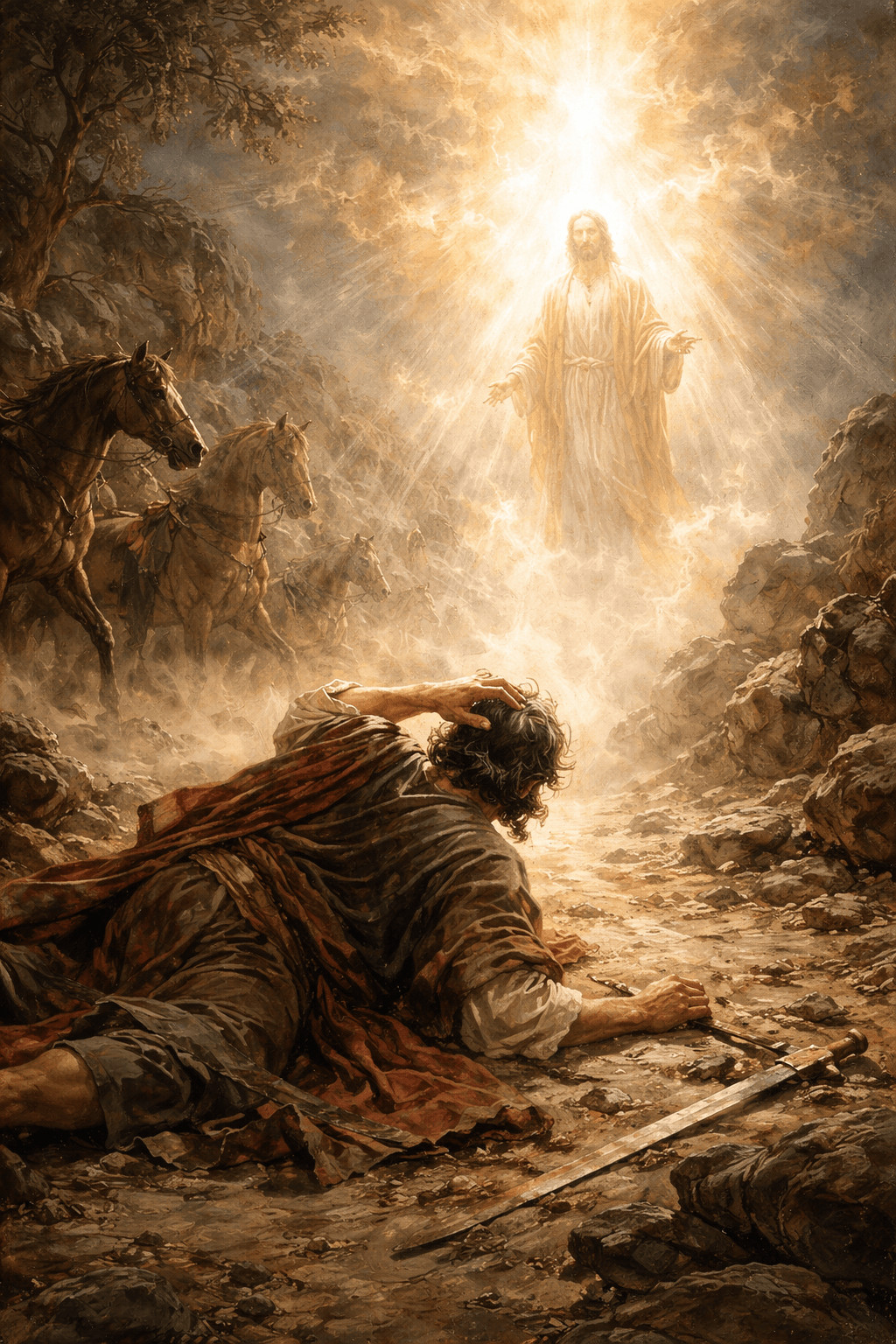
On the road to Damascus, at the height of his mission, a light from heaven suddenly flashed around him (Acts 9:3). He fell to the ground. The persecutor was now powerless in the dust.
“Saul, Saul, why are you persecuting Me?” (Acts 9:4).
He answered, trembling, “Who are You, Lord?” (Acts 9:5).
The reply shattered him: “I am Jesus, whom you are persecuting.”
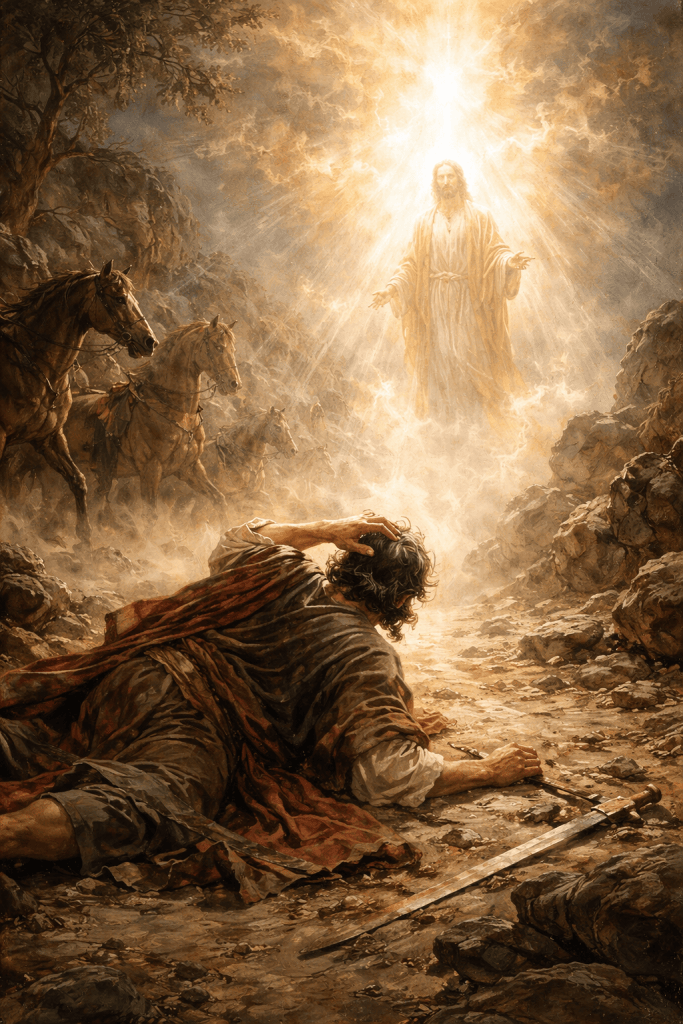
In one sentence, his theology, pride, and purpose crumbled. The Jesus he rejected was alive. The enemy he fought was Lord.
Saul rose from the ground—but “when his eyes were opened, he saw nothing” (Acts 9:8). The strong man had to be led by the hand into Damascus. For three days he was blind. He neither ate nor drank (Acts 9:9).
This was more than physical blindness. It was the death of identity. The persecutor had become helpless. The confident Pharisee sat in darkness, fasting and broken.
🔥 Turning Point:
The turning point was not Saul’s remorse—it was God’s initiative.
While Saul sat blind, the Lord spoke in a vision to a disciple named Ananias (Acts 9:10). Ananias hesitated, knowing Saul’s reputation. But God declared, “He is a chosen instrument of Mine to carry My name before the Gentiles and kings and the children of Israel” (Acts 9:15).
God had already rewritten Saul’s future.
Ananias obeyed. He entered the house, laid hands on Saul, and said, “Brother Saul, the Lord Jesus… has sent me so that you may regain your sight and be filled with the Holy Spirit” (Acts 9:17).
Immediately, something like scales fell from Saul’s eyes (Acts 9:18). He regained his sight. He arose and was baptized.
Notice what God did:
• He confronted Saul personally.
• He stopped him mid-journey.
• He blinded him to open his true sight.
• He sent a fearful disciple to welcome him as brother.
• He filled him with the Holy Spirit.
The persecutor did not reform himself. Christ intercepted him.
🌿 Transformation:
The transformation was immediate and undeniable.
Acts 9:20 declares, “Immediately he proclaimed Jesus in the synagogues, saying, ‘He is the Son of God.’” The very synagogues where he planned arrests became pulpits of proclamation.
The crowd was astonished: “Is not this the man who made havoc in Jerusalem?” (Acts 9:21). His past was public. His conversion was public.
Verse 22 says, “Saul increased all the more in strength… proving that Jesus was the Christ.”
The one who destroyed churches would later plant them.
The one who imprisoned believers would endure prison for Christ (2 Corinthians 11:23–27).
The enemy became the apostle to the nations.
Through his ministry, countless Gentiles believed. Cities across Asia Minor and Europe heard the gospel. Letters he wrote from prison now shape the faith of millions.
His blindness became vision.
His brokenness became calling.
His collapse became commissioning.
God did not merely forgive Saul—He transformed him into Paul.
🕊️ Spiritual Reflection:
Saul’s story reminds us that God’s sovereignty is not limited by our rebellion, ignorance, or hostility. No one is beyond divine interruption.

Sometimes God must dismantle our false identities before He reveals our true calling. Saul’s blindness was mercy. His three days in darkness were preparation. The loss of reputation and certainty cleared space for grace.

Defeat often precedes transformation because pride must fall before purpose rises. God does not waste opposition; He redeems it. He takes enemies and makes them emissaries. He takes destructive passion and redirects it for holy mission.

If God can turn a persecutor into an apostle, no past is too stained, no failure too severe, no season too hopeless.

The same Lord who met Saul on the road still meets us in ours.
💬 Closing Encouragement:
We know what it feels like when our identity collapses, when plans shatter, when the future we were certain about suddenly goes dark. We know the fear of sitting in our own blindness, unsure of what comes next. Yet Saul’s story assures us that even when we are undone, God is not. When we feel exposed, confused, or ashamed of who we have been, Christ is still able to interrupt, forgive, and redirect us. Our worst decisions, misplaced zeal, or seasons of rebellion do not cancel God’s sovereign purposes. If we surrender in the darkness, He can restore sight, reshape our calling, and use our very past as testimony. Let us trust Him in the breaking. Let us obey in the uncertainty. Let us refuse to give up—because God can turn any situation completely upside down into victory.
🙏 Prayer:
Lord Jesus, Meet us in our blindness and confusion. Break what must be broken, but do not leave us there. Give us new sight, new purpose, and new courage. Turn our past into testimony and our weakness into strength. We trust You for complete reversal and victory. Amen.


Leave a comment