
📖 Scripture Reading:Jonah 1–4
✨
— Elisabeth Elliot
“God never wastes a wound.”
⏳ Background:
Jonah was not an atheist. He was a prophet — a man who had heard the voice of God before. Yet when the word of the Lord came to him to go to Nineveh, he ran in the opposite direction (Jonah 1:1–3). Nineveh was violent, cruel, and oppressive. Assyria was Israel’s enemy. Jonah did not fear failure — he feared God’s mercy.
He boarded a ship to Tarshish, paying his fare to escape “from the presence of the LORD.” That phrase reveals the tragedy. This was not mere travel; it was spiritual withdrawal.
Then the storm came (Jonah 1:4).
The seasoned sailors panicked. Cargo was thrown overboard. Prayers were lifted to powerless gods. Meanwhile, Jonah slept in the hold of the ship — not peaceful rest, but spiritual numbness (1:5). Avoidance often masquerades as calm.
When the lot exposed him, Jonah did not defend himself. He confessed: “I fear the LORD… who made the sea and the dry land” (1:9). Yet confession did not remove consequences. He told them to throw him into the sea.
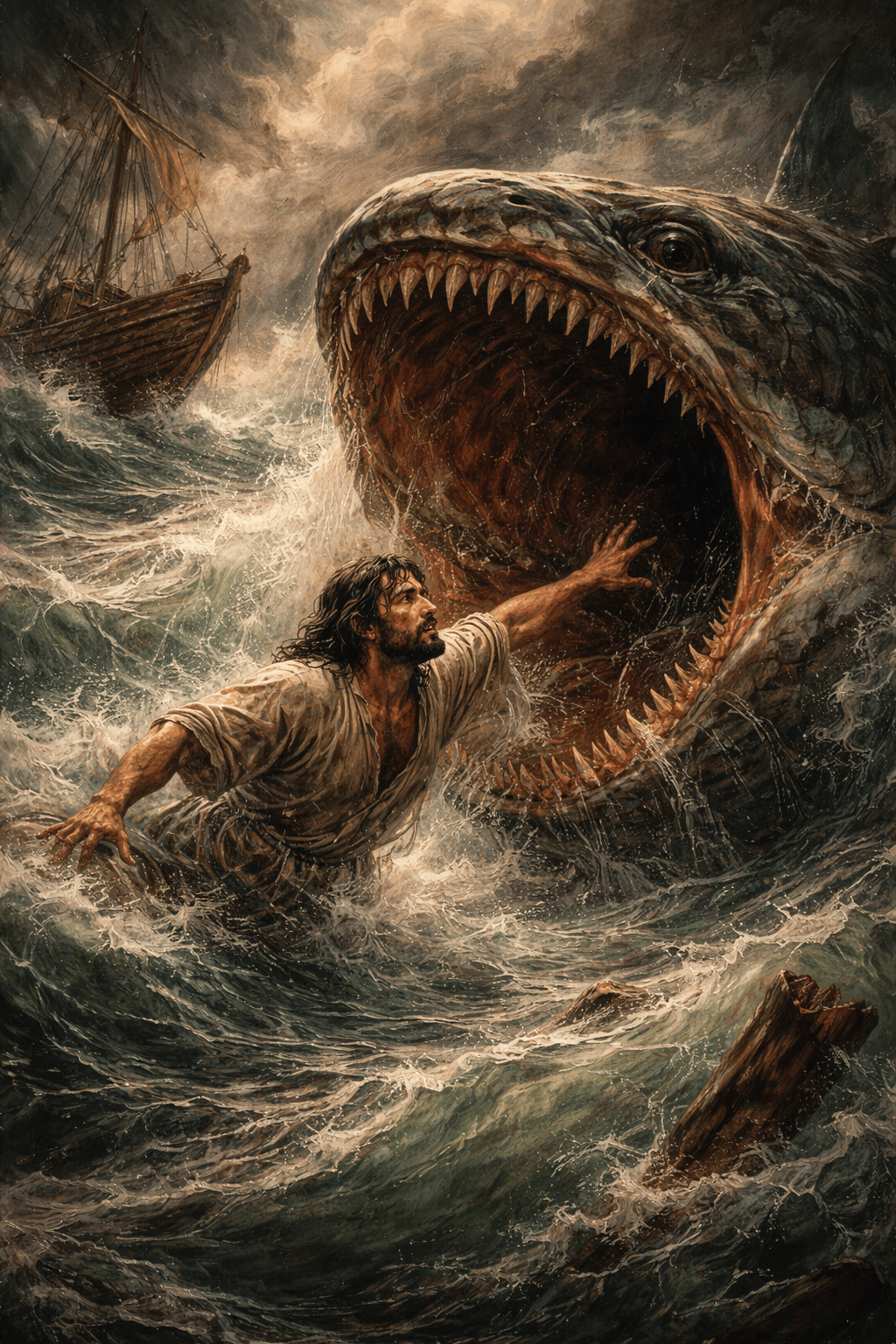
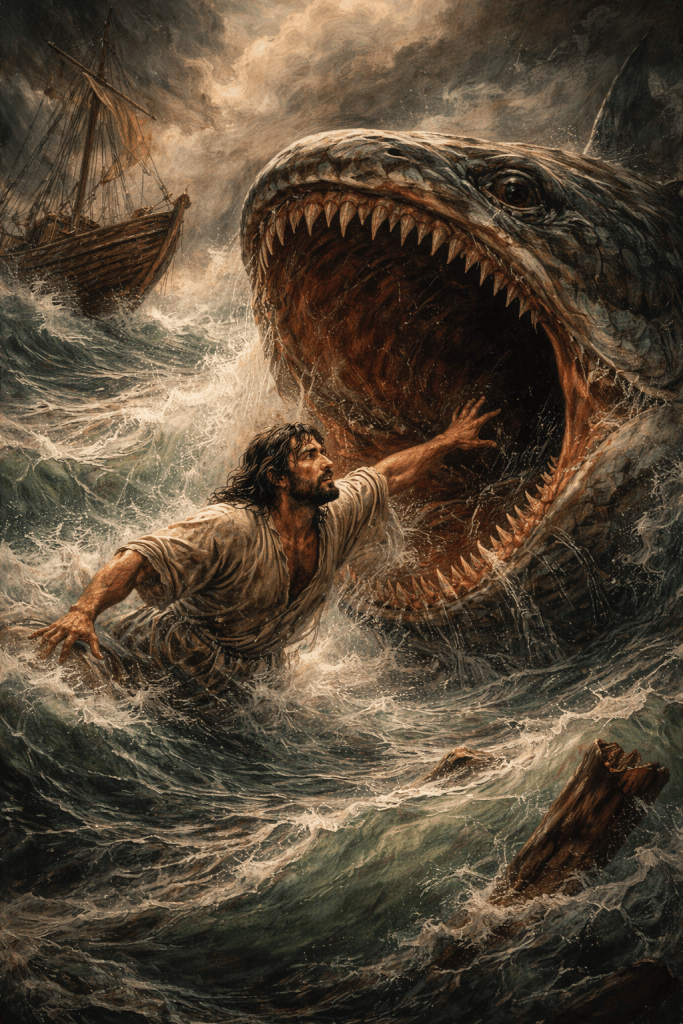
Imagine the moment: the splash, the silence, the sinking. Salt water filling lungs. No control. No strength. No more running.
“And the LORD appointed a great fish to swallow up Jonah” (1:17).
This was not rescue that felt like rescue. It was darkness. Seaweed wrapped around his head (2:5). He described it as descending to “the land whose bars closed upon me forever” (2:6). Three days inside a living grave.
Rebellion had led to isolation. Disobedience had led to near death. Jonah had reached the end of himself.
🔥 Turning Point:
The turning point did not begin with deliverance. It began with prayer.
“Then Jonah prayed to the LORD his God from the belly of the fish” (2:1).
Notice the phrase: his God. Even in discipline, the covenant remained intact.
From inside suffocating darkness, Jonah remembered Scripture. His prayer echoes the Psalms. He declared, “Salvation belongs to the LORD!” (2:9). That confession is the theological center of the book.
God had appointed the storm (1:4).
God had appointed the fish (1:17).
God would appoint a plant, a worm, and a scorching wind (4:6–8).
This is not random chaos. This is sovereign mercy.
“And the LORD spoke to the fish, and it vomited Jonah out upon the dry land” (2:10).
The word of the Lord came to Jonah a second time (3:1).
That phrase is grace.
God did not replace him. God recommissioned him.
🌿 Transformation:
Jonah went to Nineveh (3:3). The city was massive — a three-day journey in breadth. His message was short and severe: “Yet forty days, and Nineveh shall be overthrown!” (3:4).
Then the unthinkable happened.
“The people of Nineveh believed God” (3:5).
From the greatest to the least:
• They fasted.
• They wore sackcloth.
• Even the king rose from his throne, covered himself with sackcloth, and sat in ashes (3:6).
• A decree of repentance was issued citywide.
“And when God saw what they did… God relented of the disaster” (3:10).
A pagan empire bowed in repentance. A violent culture humbled itself before God.
This is revival on a national scale.
Yet Jonah struggled. He was angry at mercy (4:1). God had changed the city — but He was still changing the prophet. Through the plant and the worm, God exposed Jonah’s misplaced compassion and narrow heart.
The true victory was not only Nineveh’s repentance. It was God’s patient pursuit of a stubborn prophet.
Mercy outran rebellion.
🕊️ Spiritual Reflection:
Jonah teaches that failure does not disqualify us from God’s purposes; it often becomes the pathway through which those purposes unfold. Divine sovereignty is not threatened by our disobedience. God does not abandon His mission because of our weakness. Instead, He weaves even our rebellion into His redemptive design.

The storm was not punishment alone — it was direction. The fish was not destruction — it was preservation. The delay was not cancellation — it was preparation.

Defeat frequently precedes transformation because pride must collapse before obedience can mature. God’s mercy is not fragile. It is relentless. He pursues us into the depths, not to crush us, but to reclaim us.

No depth is too deep. No failure too final. No detour beyond His reach.

Salvation — and restoration — belongs to the Lord.
💬 Closing Encouragement:
There are seasons when we know we have run, resisted, delayed obedience, or made decisions that have led us into storms of our own making. We feel the weight of consequences, the shame of exposure, the fear that we have forfeited our calling. Yet the same God who appointed the storm also appoints mercy. When we finally pray from the depths, when we confess that salvation belongs to the Lord, we discover that failure is not the end of our story. Even in discipline, we are still His. Even in darkness, He is working. Therefore, we must not give up. If God can turn a sinking prophet into the instrument of a citywide revival, He can turn our lowest moment into unexpected victory.
🙏 Prayer:
Father, when we run, pursue us with mercy. When we sink, meet us in the depths. Give us courage to pray from dark places. Restore what failure has shaken. Teach us that salvation belongs to You alone.


Leave a comment