
📖 ✝️ Scripture Reading:Luke 19:41–44
“Compassion is to look beyond our own pain, to see the pain of others.”
— Dietrich Bonhoeffer
💒 🕊️ ✨ Context ( Story ) :
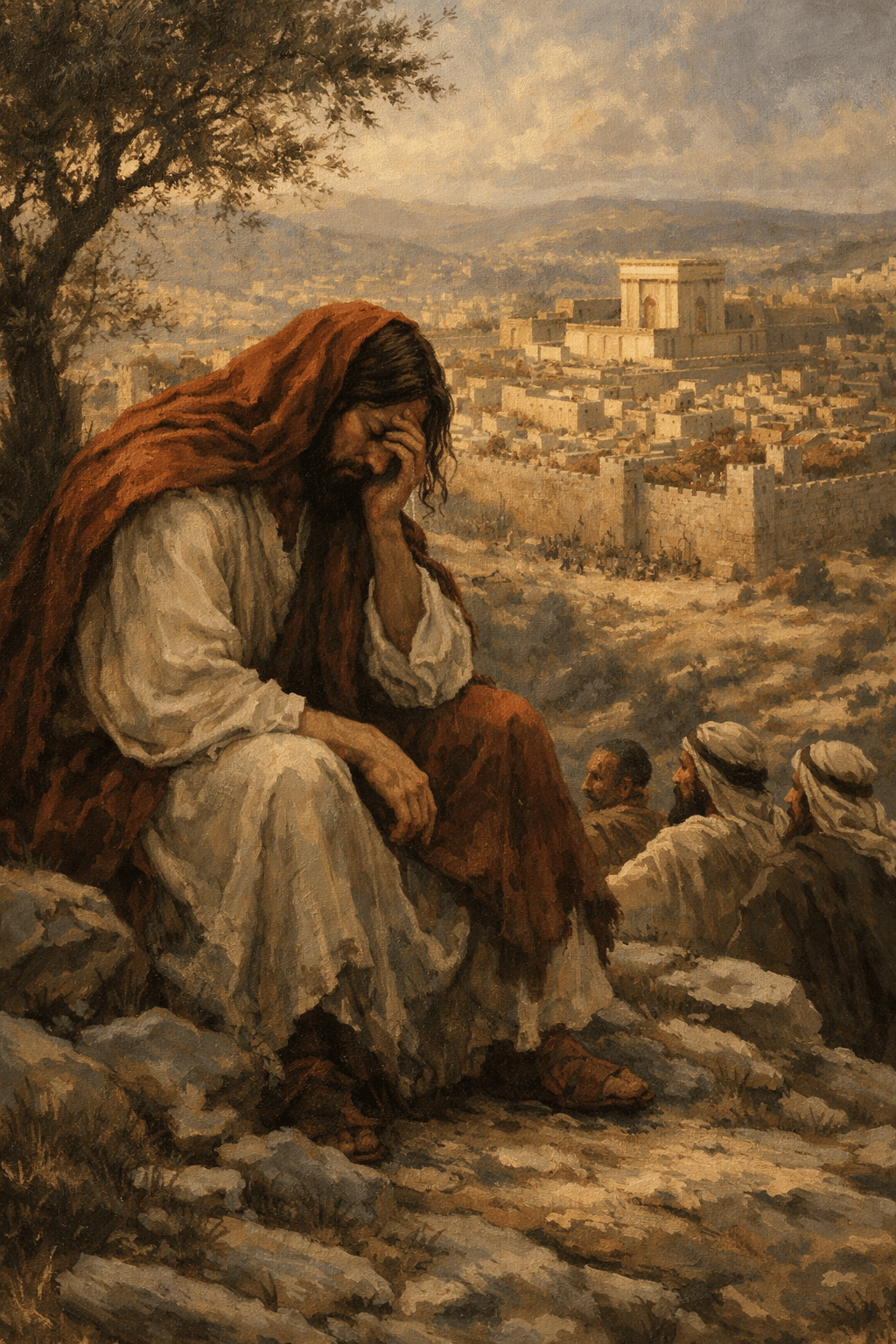
The road from the Mount of Olives descends gently toward the holy city of Jerusalem. For Jewish pilgrims arriving during Passover, this moment was unforgettable. The temple—one of the grandest religious structures in the ancient world—rose magnificently above the city walls.
Yet behind the beauty lay deep tension. Judea lived under the rule of the Roman Empire, and many Jews longed for a Messiah who would overthrow Roman power and restore Israel’s independence.
Just moments earlier, crowds had welcomed Jesus Christ with joy. They shouted praise, waved palm branches, and celebrated His arrival as a king. Their excitement echoed ancient hopes tied to the throne of King David.
But as Jesus approached the city, the Gospel of Luke records a striking moment.
He stopped.
Looking at Jerusalem spread out before Him, He wept.
Luke uses the Greek verb “ἐκλαυσεν” (eklausen), meaning deep, audible weeping. This was not a quiet tear slipping down His face. It was the cry of a heart overwhelmed with sorrow.
The city before Him represented centuries of divine history. It was the place of the temple, sacrifices, prophets, and covenant promises. Yet it was also the city that repeatedly rejected God’s messengers.
Jesus spoke words filled with both grief and longing: “If thou hadst known, even thou, at least in this thy day, the things which belong unto thy peace!”
The word “peace” (Greek: eirēnē) reflects the rich Hebrew idea of shalom—complete reconciliation with God. Jesus Himself was bringing that peace, yet the city failed to recognize it.
He then spoke of a coming tragedy. Enemies would surround Jerusalem, build siege works against it, and devastate the city. The destruction would be so thorough that “they shall not leave in thee one stone upon another.”
This prophecy would be fulfilled decades later during the Siege of Jerusalem, when Roman forces led by Titus destroyed the temple.
But on that day, the tragedy had not yet occurred.
What filled the moment was not anger—but tears.
The crowd celebrated a political king, yet Jesus saw a deeper spiritual reality. The city did not recognize “the time of thy visitation.”
In biblical language, a “visitation” refers to a decisive moment when God draws near to His people with salvation or judgment. In Jesus, God Himself had come to visit His people.
Yet the city remained blind.
The triumphal entry therefore carries a paradox. The King arrives amid praise, but His heart breaks for the very city celebrating Him.
And soon, that same city would lead Him to the cross.
🤔 🪞 💡 Reflection Thought :
The tears of Jesus reveal the heart of God more clearly than words alone ever could.

Christ does not approach human rebellion with cold detachment. He looks upon lost humanity with compassion and sorrow. Even when people resist His grace, His heart longs for their restoration.

Jerusalem had immense spiritual privilege. It possessed the temple, the Scriptures, and centuries of prophetic revelation. Yet familiarity with religious tradition did not produce spiritual understanding.

This exposes a profound truth: religious activity does not guarantee spiritual awareness.

The city that studied Scripture failed to recognize the One to whom Scripture pointed.

Theologically, this passage reveals both divine love and human responsibility. God offers peace through Christ, but people must respond to that invitation. When hearts remain hardened, the consequences are devastating.

Yet the tone of Jesus’ prophecy is remarkable. His warning flows from grief, not hostility.

The King who weeps over Jerusalem is the same King who will soon offer His life for it.

In the wider biblical narrative, this moment echoes the sorrow of prophets like Jeremiah, who lamented the spiritual condition of the nation. But Jesus is more than a prophet. He is the Messiah whose coming fulfills the hopes of the Book of Isaiah and the promises of redemption throughout Scripture.

His tears point toward the cross, where divine compassion and divine justice meet.
🎬🔛 Historical True Story :
A Pastor Who Wept for His City – Charles Finney in Rochester (1830)
In 1830, evangelist Charles Grandison Finney visited the city of Rochester, New York.
At the time, the city was known for business growth but also for spiritual indifference. Churches struggled, and many residents had little interest in faith.
Finney spent days walking through the streets praying for the people of Rochester. Witnesses recorded that he often wept as he prayed, deeply burdened for the spiritual condition of the city.
Those prayers were followed by a powerful awakening. During the revival of 1830–1831, thousands of people in Rochester turned to Christ. Businesses closed during prayer meetings, and churches were filled with people seeking God.
Finney later wrote that the transformation of Rochester showed what could happen when believers carried a genuine burden for the salvation of others.
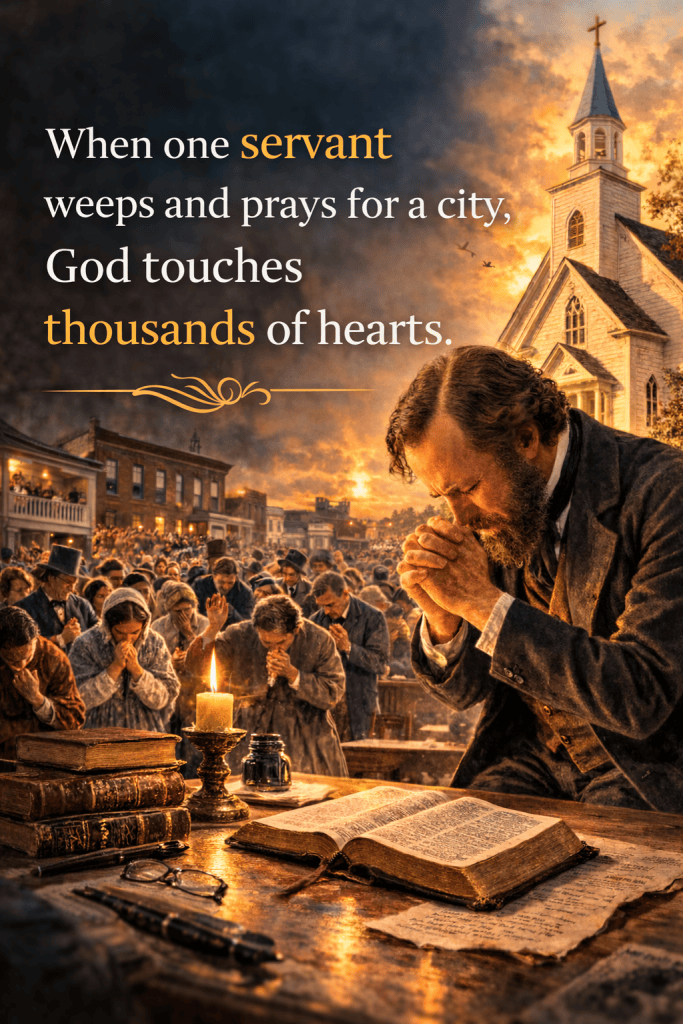
His tears for the city reflected the same compassion that Jesus showed when He looked upon Jerusalem.
🔗 Source:
https://www.britannica.com/biography/Charles-Grandison-Finney
⚒️🎯 Personal Application :
This passage challenges us to examine our own spiritual awareness. Like Jerusalem, we can be surrounded by spiritual truth yet remain blind to God’s work in our lives. Jesus still looks at our cities, communities, and families with deep compassion. As followers of Christ, we are called to share His heart—praying for the lost, caring for those far from God, and recognizing the moments when God is inviting us to respond to His grace.
🙏 🕯️Prayer:
Lord Jesus, give us Your compassionate heart. Help us see our cities and communities through Your eyes. Break our hearts for those who do not yet know You. Teach us to respond faithfully to the moments when You draw near. Amen.


Leave a comment