📖 ✝️ Scripture Reading: Matthew 21:1–11
“Christ entered Jerusalem to die; therefore we must enter His kingdom by dying to ourselves.”
— Dietrich Bonhoeffer
💒 🕊️ ✨ Context ( Story ) :
The road to Jerusalem was alive with anticipation.
Passover week had arrived. Jewish pilgrims from distant regions were streaming into the holy city. Under the shadow of Roman rule, Jerusalem carried a tense atmosphere. Roman soldiers watched the crowds carefully. Any uprising during such a nationalistic festival could ignite rebellion.
For centuries, the Jewish people had longed for the Messiah—the promised son of David who would restore Israel’s kingdom. Many imagined a warrior king who would overthrow Rome and bring political freedom.
But the King who was approaching Jerusalem had a very different mission.
Jesus had just come from Bethany, where He had raised Lazarus from the dead days earlier. That miracle had spread throughout the region and intensified public curiosity. Now, as Jesus approached the villages of Bethphage and Bethany on the Mount of Olives, He paused and sent two disciples ahead with precise instructions.
They were to enter the nearby village and would immediately find a donkey tied there, with her colt beside her. They were to untie them and bring them to Him. If anyone questioned their actions, they were to simply say, “The Lord needs them.”
The Greek expression here — “ὁ κύριος αὐτῶν χρείαν ἔχει” (ho kyrios autōn chreian echei) — carries authority. It means “The Lord has need of it.” The statement reveals Jesus’ sovereign awareness and control over the unfolding events. Even the smallest detail had already been divinely arranged.
When the disciples arrived, everything was exactly as Jesus had said.
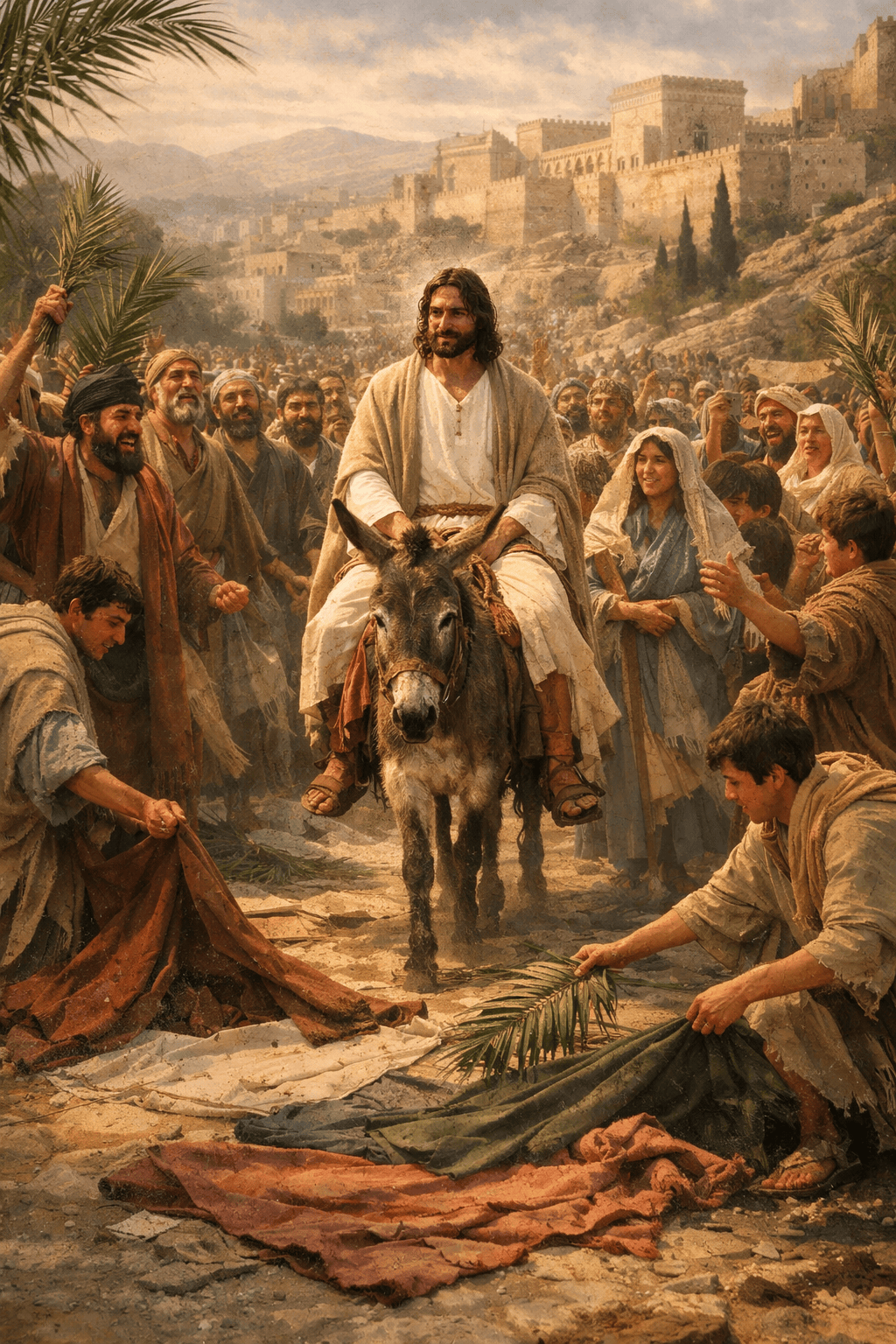
They brought the animals and placed their cloaks upon them, creating a simple saddle. Jesus mounted the young donkey and began descending the slope of the Mount of Olives toward Jerusalem.
At first glance, the scene appeared simple.
But the symbolism was profound.
Centuries earlier, the prophet Zechariah had written:
“Rejoice greatly, Daughter Zion!
See, your king comes to you,
righteous and victorious,
lowly and riding on a donkey.”
(Zechariah 9:9)
In the ancient Near East, kings rode war horses when entering cities in triumph after battle. But when a king came in peace, he rode a donkey.
Jesus was intentionally revealing the nature of His kingship.
He was indeed the promised Messiah—but His kingdom would not advance through violence or political power. His victory would come through humility and sacrifice.
As Jesus continued along the road, excitement spread through the crowd.
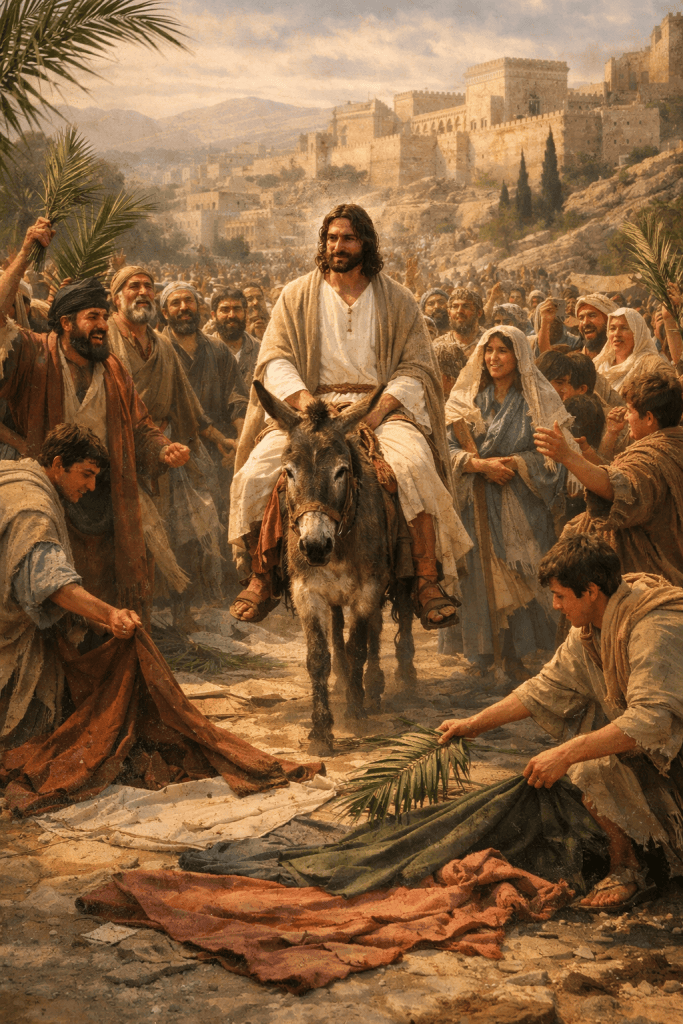
People began laying their cloaks on the road before Him. In ancient Jewish culture, this was a powerful symbol of honoring a king and submitting to his authority. A similar act had taken place when Jehu was proclaimed king in 2 Kings 9:13.
Others cut palm branches and spread them across the path. Palm branches were symbols of victory and national hope. The people believed that the long-awaited deliverer had finally arrived.
The crowd began shouting loudly:
“Hosanna to the Son of David!
Blessed is He who comes in the name of the Lord!
Hosanna in the highest!”
The word “Hosanna” comes from the Hebrew phrase “hoshi‘ah na”, which means “Save us now, we pray.”
Originally found in Psalm 118:25–26, it had become both a prayer and a declaration of praise. The people were crying out for salvation—but many were hoping for political rescue rather than spiritual redemption.
As Jesus entered Jerusalem, Matthew describes the entire city as being “stirred.”
The Greek word used is “ἐσείσθη” (eseisthē), meaning to shake or quake like an earthquake. The arrival of Jesus caused a deep disturbance in the city.
People began asking urgently,
“Who is this?”
The crowds responded,
“This is Jesus, the prophet from Nazareth of Galilee.”
Their answer revealed both recognition and misunderstanding.
They acknowledged Jesus as a prophet—but they had not yet fully grasped that He was the Messiah, the Son of God, the King who came to save the world.
The irony of the moment is striking.
The same voices shouting “Hosanna!” would soon hear religious leaders shouting “Crucify Him!”
Yet Jesus rode forward calmly.
He knew exactly where this road would lead.
Not to a throne.
But to a cross.
And through that cross, to salvation for the world.
🤔 🪞 💡 Reflection Thought :
This passage reveals the profound contrast between human expectations and God’s redemptive plan.

Jesus enters Jerusalem not with military force but with quiet authority and humility. His deliberate choice of a donkey demonstrates that the kingdom of God operates by entirely different values. True kingship is not expressed through domination but through sacrificial love.

Human hearts often respond to Jesus with excitement when He appears to meet our expectations. The crowds praised Him enthusiastically because they believed He would restore Israel’s political power. Yet when His mission moved toward suffering and sacrifice, many would turn away. This reminds us how easily faith can become conditional—welcoming Christ when He fulfills our hopes, yet resisting Him when His path requires surrender.

Spiritual blindness frequently arises from misunderstanding the nature of God’s kingdom. Many people in the crowd recognized Jesus as a prophet, but only a few understood that He was the promised Messiah. The same danger exists today when we admire Jesus as a teacher or miracle worker but fail to surrender to Him as Lord.

This passage also exposes attitudes that must be examined in our own hearts. The crowd’s shifting loyalty warns us against superficial faith that praises Christ outwardly but lacks deep commitment. True devotion requires more than emotional celebration; it requires steadfast trust even when God’s plans differ from ours.

Yet there is also a beautiful assurance here. Every detail of this moment unfolded according to God’s sovereign design. The prophecy of Zechariah was fulfilled precisely, reminding us that God’s promises never fail. The King who entered Jerusalem in humility would ultimately accomplish salvation through His death and resurrection.

The disciples provide a quiet but powerful example of obedience. They followed Jesus’ instructions without fully understanding the significance of their actions. Their willingness allowed God’s prophetic purposes to unfold. Faithful obedience often means trusting Christ before we see the whole picture.

Above all, this event reveals the character of God. The King of heaven did not come demanding power or glory. He came gently, riding on a donkey, moving steadily toward the cross. The kingdom of God is built not through force but through sacrificial love that redeems humanity.

Key learnings
	•	God’s plans often unfold differently than human expectations.
	•	True faith remains steadfast even when Christ’s path leads through sacrifice.
	•	Jesus deserves not only admiration but complete surrender as King.
	•	God faithfully fulfills every promise spoken in Scripture.
	•	The humility of Christ reveals the heart of God’s kingdom.
🎬🔛 Historical True Story :
A King Greater Than the Empire
Emperor Haile Selassie’s Faith in Christ – Ethiopia, 1936
In 1936, Ethiopia faced invasion from Fascist Italy under Benito Mussolini. The nation’s emperor, Haile Selassie, was forced into exile as Italian forces occupied the country.
Many leaders would have responded with anger or revenge. But Selassie openly declared that his ultimate trust was not in military strength but in God.
While speaking before the League of Nations in Geneva, he warned the world about injustice and oppression, yet he also testified to his Christian faith. During exile, he spent long hours reading the Bible and praying for his people.
Years later, when he returned to Ethiopia after liberation, Selassie famously declared:
“Without Christ, I am nothing.”
Rather than ruling through cruelty or revenge, he encouraged reconciliation and rebuilding.
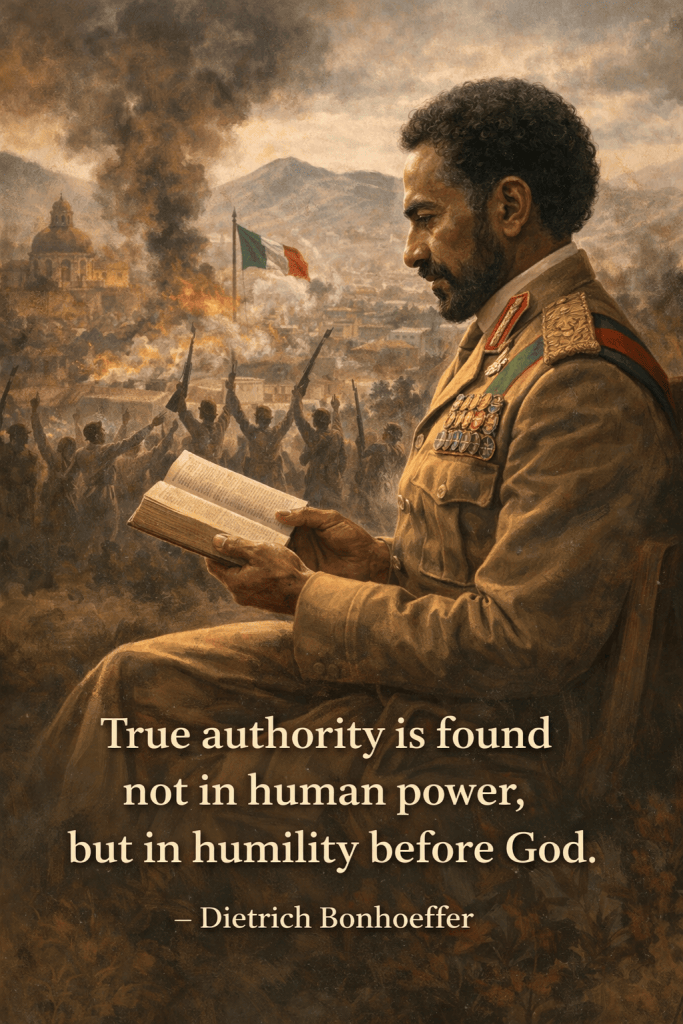
Like the King who entered Jerusalem on a donkey, Selassie understood that true authority is rooted not in power but in humility before God.
🔗 Source:
https://www.britannica.com/biography/Haile-Selassie-I
⚒️🎯 Personal Application :
This passage invites us to examine how we truly respond to Jesus. Like the crowds, we may celebrate Him when life seems hopeful and blessings are visible. Yet the call of Christ is deeper than admiration. He invites us to surrender our expectations and trust His purposes, even when His path leads through humility and sacrifice. When we recognize Jesus as our true King, we learn to follow Him not only in moments of celebration but also in daily obedience and faith.
🙏 🕯️Prayer:
Lord Jesus, You are the humble King who came to save the world. Forgive us when our faith becomes shallow or self-centered. Teach us to follow You with sincere hearts and faithful obedience. Help us honor You not only with our words but with our lives. Amen.


Leave a comment