

💼 When Valuable Resources Remain Underused
Every workplace contains assets that may be overlooked: equipment, meeting rooms, technical knowledge, customer relationships, professional networks, unused capacity, and the influence of experienced employees. Possessing these resources does not automatically create value. Wise stewardship asks a better question: how can what is already available be used responsibly to serve people, strengthen the mission, and honour Christ?
📖 Jesus Taught from Peter’s Boat
Main Passage: Luke 5:1–3
Key Verse:
“And he entered into one of the ships, which was Simon’s, and prayed him that he would thrust out a little from the land. And he sat down, and taught the people out of the ship.”
— Luke 5:3, KJV
As the crowd pressed around Jesus to hear God’s Word, He entered Simon Peter’s boat and asked him to move it slightly from shore. The fishing vessel became a teaching platform from which Jesus addressed the people.
🌊 An Ordinary Asset Under Christ’s Authority
Jesus is not merely a creative communicator who discovered an unusual platform. He is the Son of God, Messiah, and Lord, proclaiming God’s Word. Yet His use of Peter’s boat offers a responsible workplace application: an ordinary resource can serve a purpose beyond its usual function when placed wisely at Christ’s disposal.
The boat was designed for fishing. In Jesus’ hands, it temporarily became a place of instruction and influence. Its usefulness did not depend upon luxury, public status, or advanced technology. What mattered was that it was available, suitable, and used purposefully.

Professionals may complain about resources they do not possess while neglecting those already entrusted to them. A workshop may have idle capacity. A senior employee may possess knowledge that has never been transferred. A company vehicle, digital system, classroom, customer database, or professional network may be poorly used.
Asset stewardship does not give permission to misuse company property or redirect resources without authority. Christian professionals must respect ownership, safety, confidentiality, budgets, and organisational purpose. Stewardship means creating meaningful value within responsible boundaries.
Influence is also an asset. A position, skill, relationship, or reputation can open opportunities to teach, encourage, solve problems, and protect others. Because Christ is Lord, we should ask not only, “What do I control?” but also, “How can what I have been entrusted with serve His purposes and my neighbour’s good?”
🧭 See Possibility in What Is Available
Wise resource use begins with accurate observation. Identify what is available, who owns it, what restrictions apply, and which genuine need it could meet.
Creativity must work with integrity. Before repurposing an asset, obtain approval, assess risk, define the expected value, and measure the outcome. Faithful stewardship combines initiative with accountability.
🎯 Put Existing Assets to Better Use
- Identify one underused workplace resource and define a legitimate use for it.
- Ask permission before redirecting equipment, information, time, or facilities.
- Use one area of professional influence to teach or encourage a colleague.
💬 Ordinary Work Can Honour God
“What you do in your house is worth as much as if you did it up in heaven for our Lord God.”
— Martin Luther
Luther’s words remind us that ordinary responsibilities can be sacred service when they flow from faith and obedience rather than the pursuit of status.
🏭 When Business Influence Served the Community
Arthur Guinness began brewing at Leixlip around 1755 with capital connected to a £100 bequest. In 1759, he secured a disused brewery at St. James’s Gate in Dublin and gradually developed a successful enterprise.
Historical Christian accounts describe Guinness as an active Church of Ireland member who supported social welfare. He served in leadership connected with Meath Hospital, promoted Sunday-school education, contributed to charities, and participated in efforts opposing duelling. These activities extended influence beyond commercial production toward education, healthcare, and community responsibility.
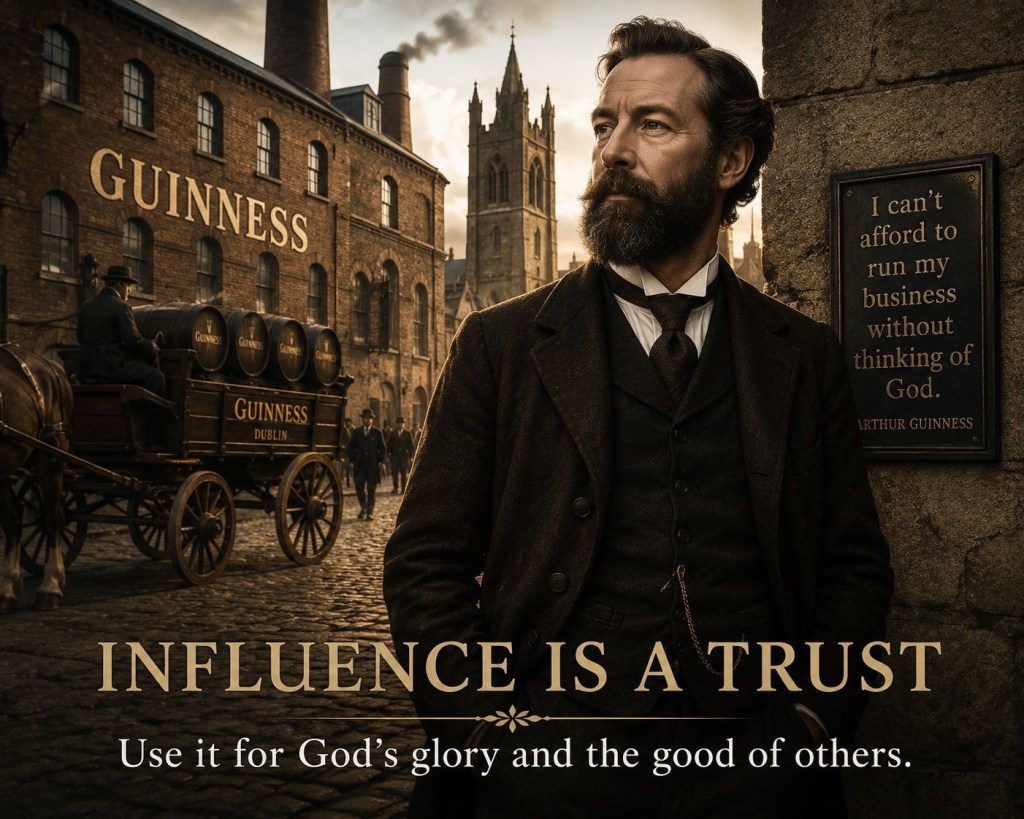
His story should not be used to promote alcohol or claim that financial growth proves divine approval. The relevant lesson is that commercial influence carries social responsibility.
Practical Takeaway: Treat assets as entrusted resources that should create value beyond private gain.
Further Reading:
Arthur Guinness—Dictionary of Irish Biography [dib.ie]
🏢 Carry Stewardship Into Your Workplace
- List three resources under your care and review how each is currently used.
- Select one underused asset and propose a measurable, authorised improvement.
- Share one valuable skill or insight with a colleague this week.
🤔 Examine What Has Been Entrusted
- Which available resource am I neglecting while asking for something more?
- Does my influence create value for others or mainly increase my importance?
🙏 Lord, Teach Me Faithful Stewardship
Lord Jesus, thank You for every ability, opportunity, relationship, and resource entrusted to me. Give me wisdom to recognise their proper use, creativity to serve meaningful needs, and integrity to respect rightful boundaries. Guard me from waste, selfish ambition, carelessness, and misuse of influence. Teach me to seek permission, remain accountable, and create value that benefits others. May everything under my care honour Your lordship and serve my neighbour faithfully. Amen.


Leave a comment