
📖 Scripture Anchor
“And he saith unto them, Follow me, and I will make you fishers of men.”
— Matthew 4:19, KJV
Jesus called working fishermen to follow Him and promised to form them for a new purpose. His words remind leaders that people are not finished products; under Christ, teachable people can grow through instruction, correction, responsibility, and faithful service.
✨ More Than a Famous Department Store
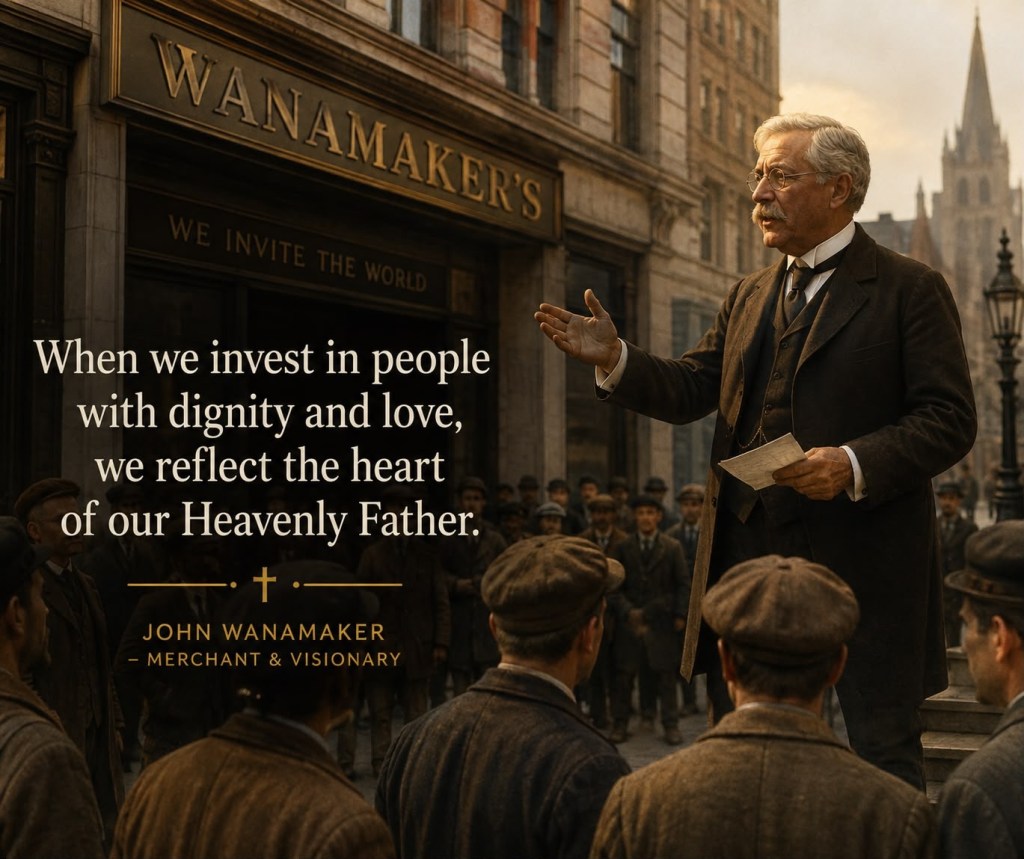
John Wanamaker became a prominent Philadelphia merchant and retail innovator. Yet his historical significance extends beyond buildings, advertisements, and commercial growth.
He invested in religious education, community service, employee relations, and practices intended to strengthen trust. His story invites Christian leaders to consider whether they merely use people’s abilities or help people develop.
🏙️ Faith Before Commercial Influence
Born in Philadelphia in 1838, Wanamaker entered employment while still young. Before opening a store, he worked with the Young Men’s Christian Association and became deeply involved in Sunday-school ministry. In 1859, he founded Bethany Sunday School, which later grew into a major religious and community institution.
In 1861, Wanamaker and his brother-in-law, Nathan Brown, opened Oak Hall, a men’s clothing business. The Civil War began only days later, creating an uncertain environment for the new enterprise. After Brown’s death, Wanamaker continued developing the company. He later opened the Grand Depot in a former railroad facility during Philadelphia’s 1876 Centennial period.
His work grew from modest beginnings, but Christian service and organizational responsibility were already shaping his view of leadership.
🤝 Commerce Became a Place to Form People
Wanamaker did not treat Christian commitment as something restricted to Sunday. Historical studies describe him as integrating religious convictions with the public life of his stores. He sought to connect commerce with moral responsibility, employee formation, and community service.
This approach was imperfect and belonged to its particular historical setting. Nevertheless, it illustrates an important turning point: a workplace could be understood as more than a location for transactions. It could also become a place where people learned responsibility, discipline, cooperation, and service.
Wanamaker’s leadership included attention to employee relations, an area specifically represented in the extensive archival collection maintained by the Historical Society of Pennsylvania. Later historical analysis also documents training programs and character-development efforts among employees.
His faith-shaped vision challenged the idea that workers should be valued only for immediate output.
🏬 Trust Extended to Customers and Employees
Wanamaker became associated with retail practices such as fixed prices and returnable goods. These policies reduced uncertainty for customers and supported a more consistent standard of commercial dealing.
His influence also extended beyond retail. He remained active in Sunday schools, churches, YMCA work, philanthropy, and civic service. The Historical Society of Pennsylvania describes him as a religious and philanthropic leader who also advanced merchandising, advertising, and employee relations.
Commercial growth should not be interpreted as proof of God’s approval. The more responsible lesson is that increasing influence creates increasing obligations. Leaders must consider the dignity, character, development, and welfare of those placed within their care.
🔎 Source and Historical Verification
Primary Source:
John Wanamaker Collection, Historical Society of Pennsylvania
https://www2.hsp.org/collections/manuscripts/w/Wanamaker2188.html
Additional Source:
John Wanamaker, Pennsylvania Center for the Book
https://pabook.libraries.psu.edu/literary-cultural-heritage-map-pa/bios/wanamaker__john
💬 The Store as a Place of Influence
“The store will be my pulpit.”
— John Wanamaker
Historian Nicole C. Kirk cites this statement when explaining how Wanamaker viewed his commercial and religious interests as mutually connected rather than belonging to separate worlds.
🕊️ Build People, Not Merely Positions
Jesus called disciples whom He intended to form. Christian leaders similarly receive people, not merely units of labor.
A teachable employee may not possess the most impressive résumé, but patient coaching can develop competence. Leadership shaped by Christ sets clear standards while respecting human dignity. It corrects without humiliation, trains without controlling, and assigns responsibility without treating people as disposable.
Key Lessons:
- Look for teachability alongside technical competence.
- Treat coaching as leadership work, not an interruption.
- Develop people for service, character, and responsibility.
💙 Your Team Is More Than Its Output
Your deadlines matter, but so do the people carrying them. Ask Christ to help you recognize potential, correct patiently, and assign responsibility wisely. You may not control every person’s response, but you can create a workplace where growth, dignity, truth, and faithful service are valued.
🙏 Lord, Teach Me to Develop People
Lord Jesus, give me discernment to recognize teachable and trustworthy people. Guard me from valuing workers only for their output. Make me patient in coaching, truthful in correction, and generous in sharing responsibility. Help me protect human dignity, develop competence, and lead without pride. May every person entrusted to me experience integrity, fairness, encouragement, and servant-hearted leadership. Amen.


Leave a comment