
📖 Scripture Anchor
“Then saith Jesus unto him, Get thee hence, Satan: for it is written, Thou shalt worship the Lord thy God, and him only shalt thou serve.”
— Matthew 4:10, KJV
Jesus rejected the promise of authority obtained through false worship. His response shows that no opportunity, advantage, or visible success is worth gaining through disobedience. Loyalty to God must govern both our goals and our methods.
✨ When Integrity Threatens Your Opportunity
Professionals sometimes face choices that appear financially obvious but morally dangerous. A customer expects an improper favour. A manager encourages silence. A contract depends on a hidden payment.
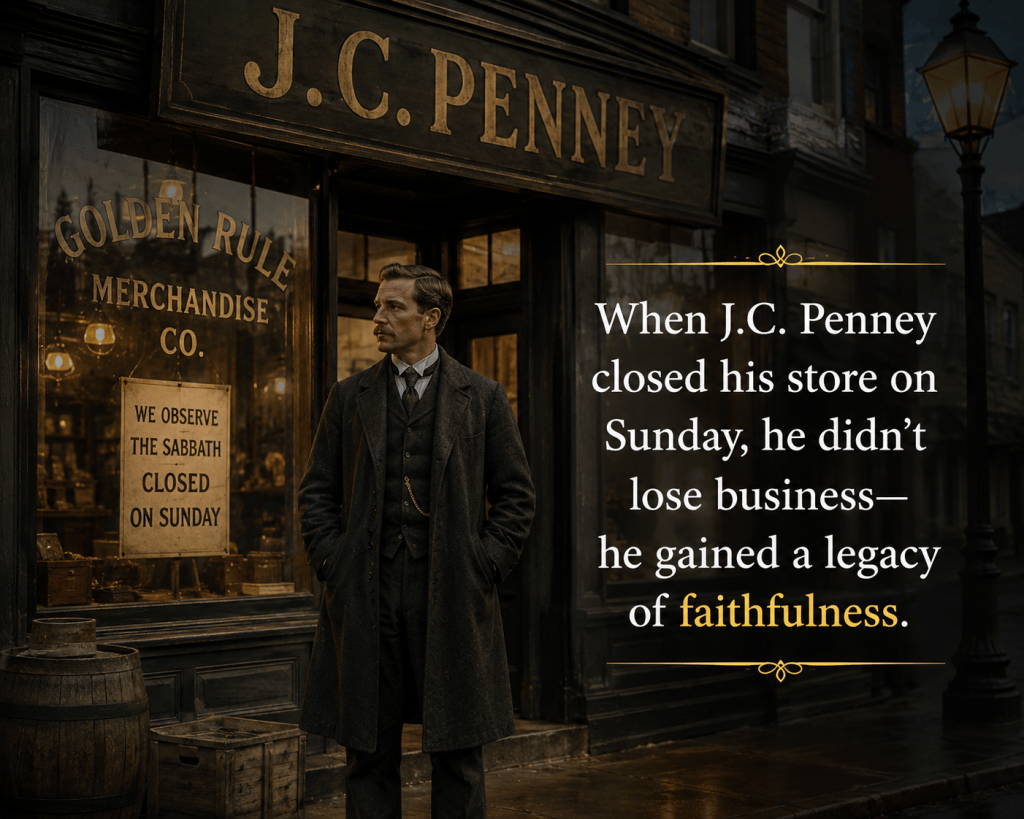
J. C. Penney confronted such a decision before he became a successful retailer. His refusal did not preserve his first business—it helped close it.
🥩 A Young Merchant’s Costly Compromise
James Cash Penney moved from Missouri to Colorado in the late 1890s, partly for health reasons. In Longmont, he invested roughly $300—described by local accounts as his life savings—in a butcher shop on Main Street. He later bought his partner’s interest and operated the James C. Penney Meat Market.
A prominent local hotel became an important customer. However, its cook expected a weekly bottle of bourbon as a condition for continuing the business relationship. Penney reportedly provided one bottle before reconsidering the arrangement. The payment violated the moral principles he had learned from his Baptist family. He resolved not to provide another bottle.
The hotel withdrew its trade, and the meat market closed within the year. Penney’s refusal did not immediately reward him; it cost him his first business.
🛡️ When Conscience Became More Valuable Than Profit
Penney’s turning point was not a clever commercial strategy. It was a decision to stop participating in an improper arrangement, although an important customer could walk away.
The choice illustrates ethical resistance: recognizing that a profitable opportunity has become morally compromised and refusing to continue. Penney could not control the hotel’s response, but he could decide what kind of businessman he would become.
His Christian upbringing had taught him that business conduct could not be separated from moral responsibility. Continuing the kickback might have preserved short-term revenue, but it would have trained his conscience to accept compromise whenever pressure became strong enough.
Faithfulness did not protect him from loss. Instead, it gave him a reason to choose conscience over immediate advantage. Integrity became more important than keeping one customer or rescuing one failing enterprise.
🏬 From Failed Butcher to Golden Rule Merchant
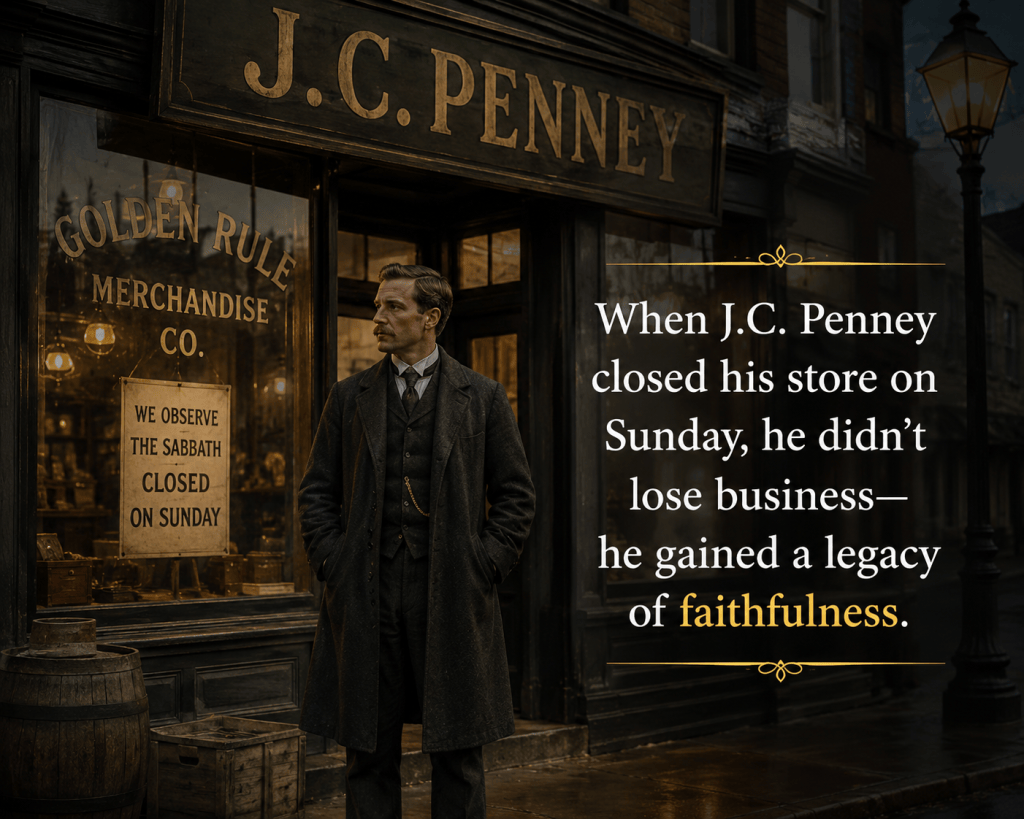
After the butcher shop closed, Penney went to work for Tom Callahan’s Golden Rule dry-goods business in Longmont. His diligence led to opportunities in Wyoming, and in 1902 he became a partner in a Golden Rule store in Kemmerer.
Penney’s retail approach emphasized quality goods, fair prices, service, and ethical dealing. The growing stores eventually became the J. C. Penney Company. His later success should not be treated as a guaranteed reward for one ethical decision. Nevertheless, the principles behind his refusal continued influencing his approach to business.
The failed butcher shop did not define his future, but it exposed the kind of character that future responsibility would require.
🔎 Source and Historical Verification
Primary Source:
In the Liberal Tradition: James Cash Penney Jr.
https://www.acton.org/religion-liberty/volume-30-number-2/liberal-tradition-james-cash-jc-penney-jr
Additional Source:
Longmont History: J. C. Penney Gets His Start
https://www.visitlongmont.org/blog/stories/post/who-is-jc-penney/
💬 The Lesson Penney Remembered
“I lost everything I had, but I learned never to compromise.”
— J. C. Penney
Penney connected this lesson to the failure of his Longmont butcher shop. His words emphasize that financial loss can be endured, but deliberately training the conscience to accept wrongdoing creates a deeper danger.
🕊️ Integrity Belongs to Christ
Jesus refused every wilderness shortcut because worship and obedience belonged to God alone. Christian integrity begins with the same allegiance: Christ is worth more than any contract, promotion, customer, or advantage.
An unethical opportunity does not become acceptable because refusing it is expensive. Losing business may hurt, but compromise can reshape our character.
Key Lessons:
- Decide ethical boundaries before pressure arrives.
- Refuse profit that requires dishonesty or improper influence.
- Entrust the consequences of obedience to Christ.
💙 A Closed Door Is Not the End
If obedience has cost you an opportunity, do not assume you made the wrong decision. Bring the loss to Christ and continue walking faithfully. He does not promise an easier replacement, but He gives grace to preserve your conscience and serve without shame.
🙏 Lord, Keep My Conscience Faithful
Lord Jesus, give me discernment to recognize compromise beneath attractive opportunities. Strengthen me to reject dishonesty, bribery, concealment, and manipulation, even when obedience is costly. Guard me from fear and self-justification. Make me truthful, courageous, humble, and accountable. Help me protect those affected by my decisions and serve You faithfully in every workplace choice. Amen.


Leave a comment