
📖 Scripture Anchor
“And Jesus increased in wisdom and stature, and in favour with God and man.”
— Luke 2:52, KJV
Luke’s brief statement describes real growth before Jesus began His public ministry. It reminds us that quiet development is not wasted when wisdom, maturity, obedience, and readiness are being formed under God’s patient direction.
✨ Preparation Without Applause
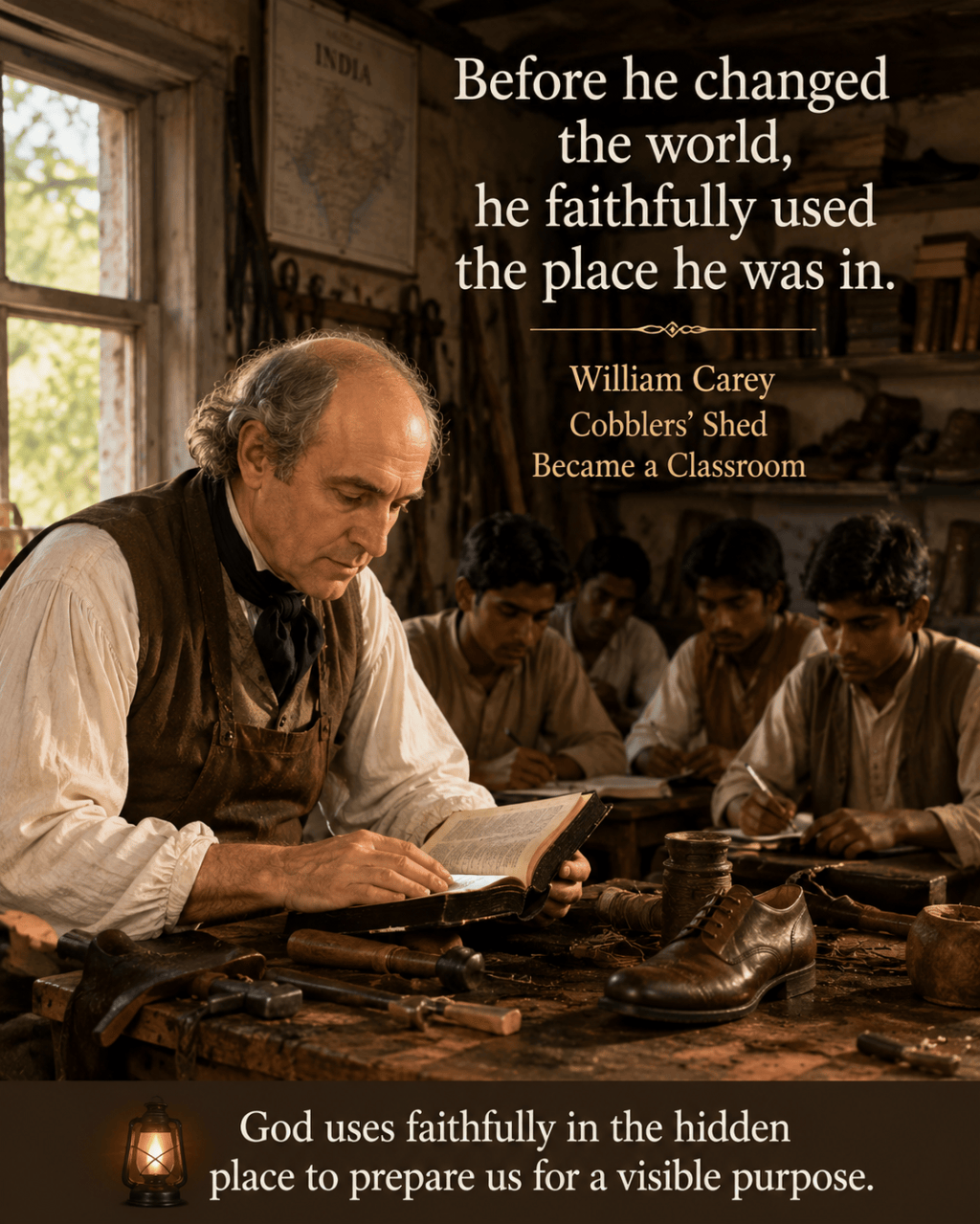
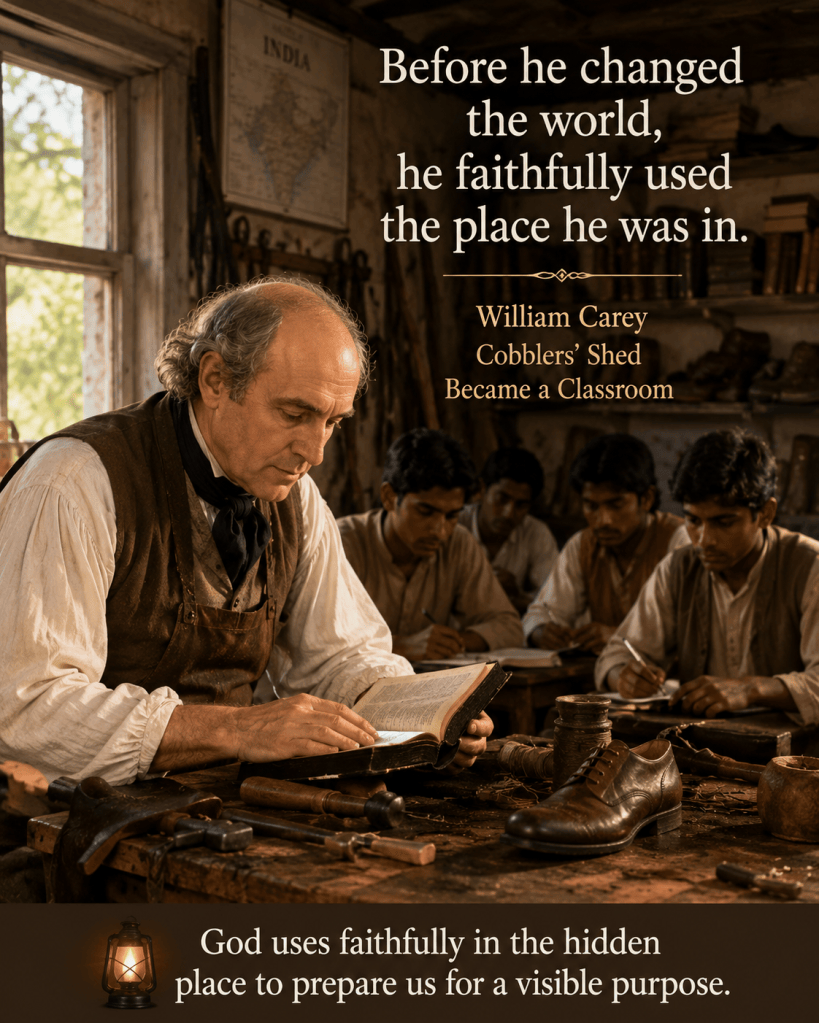
William Carey is remembered as a missionary, translator, educator, and pastor. Before those visible responsibilities, however, he spent years repairing shoes, studying Scripture, learning languages, teaching, and serving in relative obscurity.
His story encourages believers whose present work seems disconnected from their future calling. Hidden preparation can become an important school of faithfulness.
👞 A Poor Shoemaker Who Kept Learning
Carey was born in Paulerspury, Northamptonshire, England, on August 17, 1761. At fourteen, he was apprenticed to a shoemaker and later continued the trade while supporting his household under difficult financial conditions.
His formal education was limited, but his appetite for learning was not. While working as a cobbler, Carey studied Scripture, geography, and languages. George Smith’s biography describes his workshop as “Carey’s College,” reporting that he pursued Latin, Greek, Hebrew, Dutch, and French.
These years included poverty, illness, family loss, pastoral duties, and long hours of ordinary labor. Yet Carey continued studying. His workshop offered no impressive title or public platform, but it became a place where discipline, knowledge, endurance, and Christian conviction developed together.
📚 A Growing Burden for the Nations
Carey’s preparation gained direction as he studied the Bible and learned about peoples beyond England. He became convinced that Christ’s command to make disciples required active obedience from the church. While serving as a pastor and supplementing his limited income through shoemaking and teaching, he continued developing his missionary convictions.
In 1792, Carey published An Enquiry into the Obligations of Christians to Use Means for the Conversion of the Heathens. That year he also helped form the Particular Baptist Society for Propagating the Gospel among the Heathen, later known as the Baptist Missionary Society. In 1793, Carey sailed for India.
The move did not produce immediate ease or recognition. His early years in India involved financial pressure, employment outside formal mission work, and sustained language study. The same patient habits developed in England continued serving him abroad.
🌿 From Workshop Discipline to Lifelong Service
Carey eventually settled at Serampore, where he worked with Joshua Marshman and William Ward. His responsibilities included preaching, education, printing, linguistic study, and Bible translation. He later taught Bengali, Sanskrit, and Marathi at Fort William College and helped establish Serampore College.
Carey’s influence should not be separated from his years of quiet preparation. The languages studied near his shoemaker’s bench became foundations for later translation and educational work.
Christ did not make humble work meaningless while Carey waited for something greater. Rather, ordinary obligations became a setting in which perseverance, competence, conviction, and readiness were gradually formed.
🔎 Source and Historical Verification
Primary Source:
The Life of William Carey, Shoemaker and Missionary
https://ccel.org/ccel/smith_geo/carey/carey.iii.html
Additional Source:
William Carey: British Missionary and India Pioneer
https://www.britannica.com/biography/William-Carey
💬 The Perseverance of a Plodder
“If he give me credit for being a plodder he will describe me justly.… I can plod. I can persevere in any definite pursuit. To this I owe everything.”
— William Carey
Carey wanted perseverance, not brilliance, to explain his work. His words honour steady faithfulness through long preparation.
🕊️ God Forms People in Hidden Places
Carey’s life does not promise that persistent effort will always produce recognition. It demonstrates that overlooked seasons can develop abilities needed for faithful service.
Your present assignment may feel small, repetitive, or unrelated to your hopes. Yet Christ can use ordinary responsibilities to expose pride, deepen patience, strengthen competence, and teach endurance. Instead of forcing visibility, receive today’s work as an opportunity for formation.
Key Lessons:
- Develop capability before pursuing recognition.
- Let ordinary responsibilities train your character.
- Persevere faithfully without demanding immediate results.
💙 Do Not Despise the Workshop
Your hidden season is not automatically wasted because others cannot see its value. Keep learning, serving, praying, and obeying Christ. Ask Him to mature your motives as He strengthens your abilities. Recognition may come or remain absent, but faithful formation always matters before the Lord.
🙏 Lord, Form Me in the Hidden Years
Lord Jesus, teach me to value maturity more than visibility. Give me patience in ordinary work, diligence in learning, humility under correction, and courage when progress feels slow. Guard me from pride and premature ambition. Form integrity, wisdom, endurance, and servant-hearted competence within me. Help me use every hidden season to prepare faithfully for whatever service You appoint. Amen.


Leave a comment