“And whatsoever ye do, do it heartily, as to the Lord, and not unto men;” — Colossians 3:23, KJV
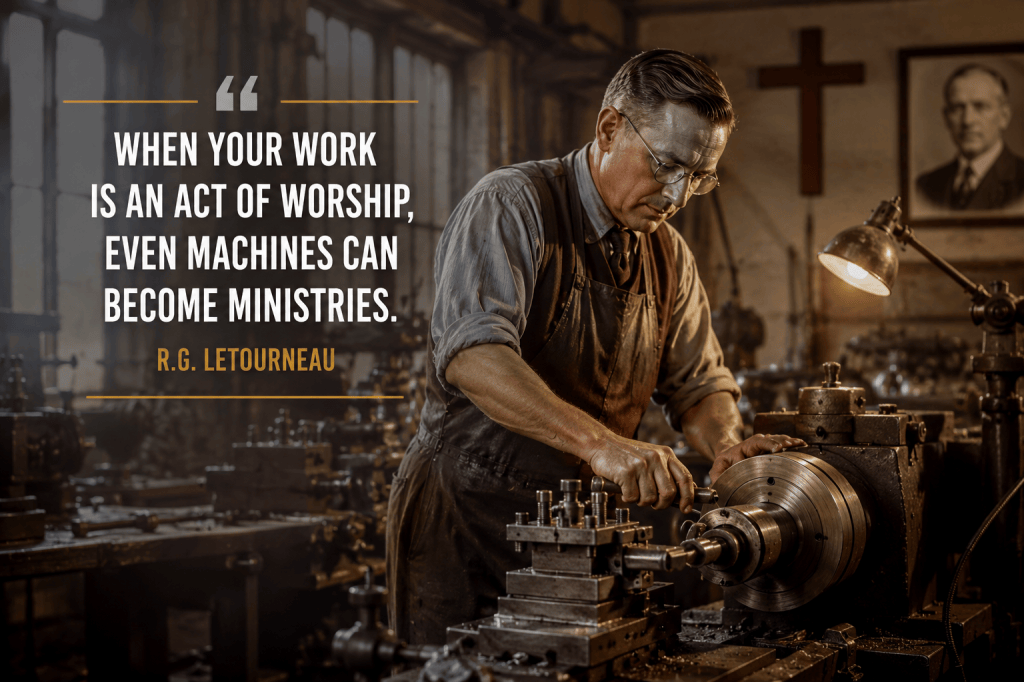
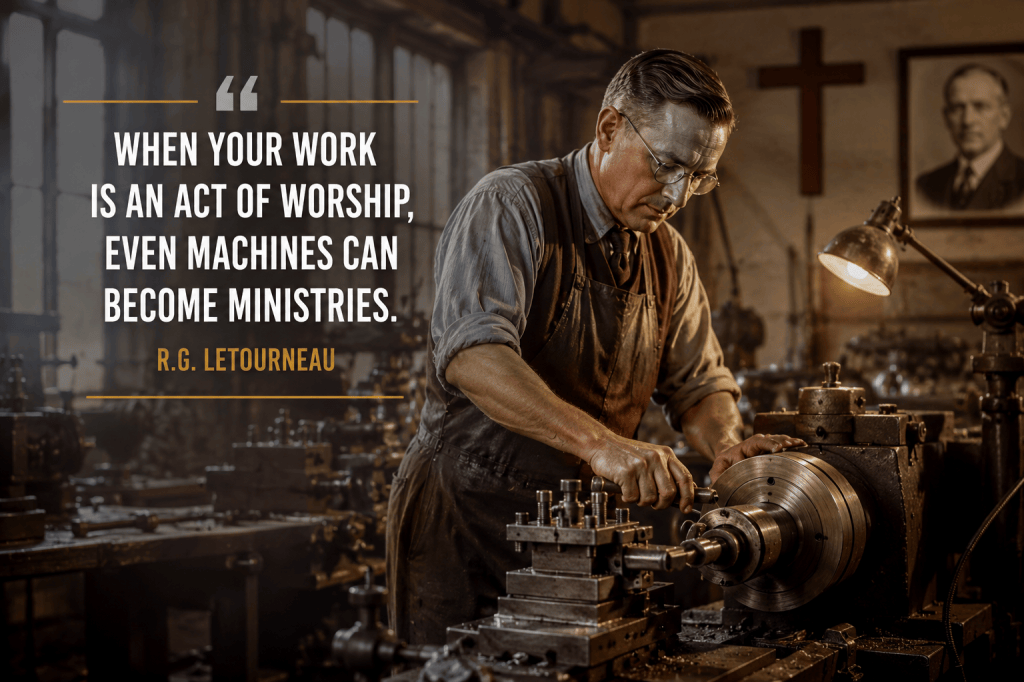
Paul’s instruction places everyday responsibilities under Christ’s authority. LeTourneau’s testimony illustrates how engineering, manufacturing, leadership, and business can become faithful stewardship when professional ability is exercised for the Lord rather than merely for recognition.
✨ Short Introduction
R. G. LeTourneau became an influential inventor of earthmoving machinery, but his journey included limited education, injury, failed business ventures, debt, and demanding manual work.
His testimony encourages believers to see professional ability as a trust from God—something to develop faithfully and use in service to Christ and others.
🔧 Background: Learning Through Work and Failure
Robert Gilmore LeTourneau was born in Richford, Vermont, in 1888 and spent much of his childhood in Duluth, Minnesota. School was difficult for him, and he left formal education at fourteen to work.
His early experience included ironworks, foundry work, battery repair, welding, machinery, and an unsuccessful garage and automobile dealership. A racing accident left him with a broken neck, and illness later brought further hardship to his family.
When LeTourneau returned to Stockton, California, his failing business had left him in debt and without secure employment. Repairing a farmer’s tractor revealed his aptitude for heavy machinery. Yet practical ability alone did not provide direction. He possessed useful skills, but still needed a purpose greater than professional survival. [letu.edu], [letu.edu]
🙏 Turning Point: Becoming God’s Businessman
LeTourneau had professed faith in Christ as a young man, but the official university account describes a later period of renewed spiritual conviction. His missionary sister challenged his lukewarmness, prompting him to seek God more earnestly and consider how his life could serve the gospel.
When LeTourneau asked whether he should become a missionary, his pastor reminded him that God also needed Christian businesspeople. LeTourneau subsequently resolved to become “God’s businessman.”
At thirty-two, he entered earthmoving work with a used 1915 Holt tractor, a borrowed scraper, and a $1,000 bank loan. This decision did not remove uncertainty or hard labor. Instead, it redirected his mechanical experience toward a Christ-centered vocation. His calling was not to abandon machinery, but to bring his work under God’s authority through stewardship, integrity, faithful witness, and practical service. [letu.edu]
🌿 Transformation: Skill with a New Purpose
LeTourneau began redesigning equipment to move earth more efficiently. Around 1921, he produced a scraper that one person could operate instead of the two previously required. His company was formed in 1929 and nearly failed during the Great Depression before later expanding. [letu.edu]
His innovations eventually included major developments in earthmoving machinery and hundreds of patents. In 1946, R. G. and Evelyn LeTourneau helped establish LeTourneau Technical Institute in Longview, Texas, initially serving returning military veterans. It later became LeTourneau University. His faith increasingly shaped his business, generosity, public witness, and commitment to Christian technical education. [letu.edu]
“For 25 years or more, I’ve been traveling this land of ours and a few foreign countries trying to teach and preach by word of mouth and example, that a Christian businessman owes as much to God as a preacher does.”
— R. G. LeTourneau
His words reject the division between sacred ministry and responsible professional work. [moodypublishers.com]
🕊️ Spiritual Reflection and Lessons
LeTourneau’s testimony does not teach that surrendering work to God guarantees wealth, patents, influence, or professional success. It shows that Christ can reshape our purpose amid failure, debt, learning, responsibility, and demanding work.
Your technical ability is not spiritually insignificant. It can protect people, solve genuine problems, strengthen communities, and demonstrate integrity. Yet skill must remain surrendered to Jesus. Excellence without humility becomes pride; ambition without love can become exploitation.
Key Lessons:
Treat professional ability as stewardship, not status.
Let failure make you teachable rather than dishonest.
Serve Christ through diligence, generosity, accuracy, and integrity.
💙 Closing Encouragement
Your work may currently feel unnoticed, difficult, or unsuccessful. Do not measure God’s faithfulness only by visible results. Bring your abilities, limitations, tools, and decisions to Christ. Ask Him to form your character while you develop your skill, and remain faithful in today’s responsibility.
🙏 Prayer
Lord Jesus, thank You for every ability You have entrusted to me. Give me wisdom to develop it, humility to receive correction, and courage to face failure. Forgive my pride and carelessness. Teach me patience, integrity, discernment, diligence, and servant-hearted leadership. May my work honor Your name, serve others faithfully, and remain surrendered to Your will. Amen.



Leave a comment