
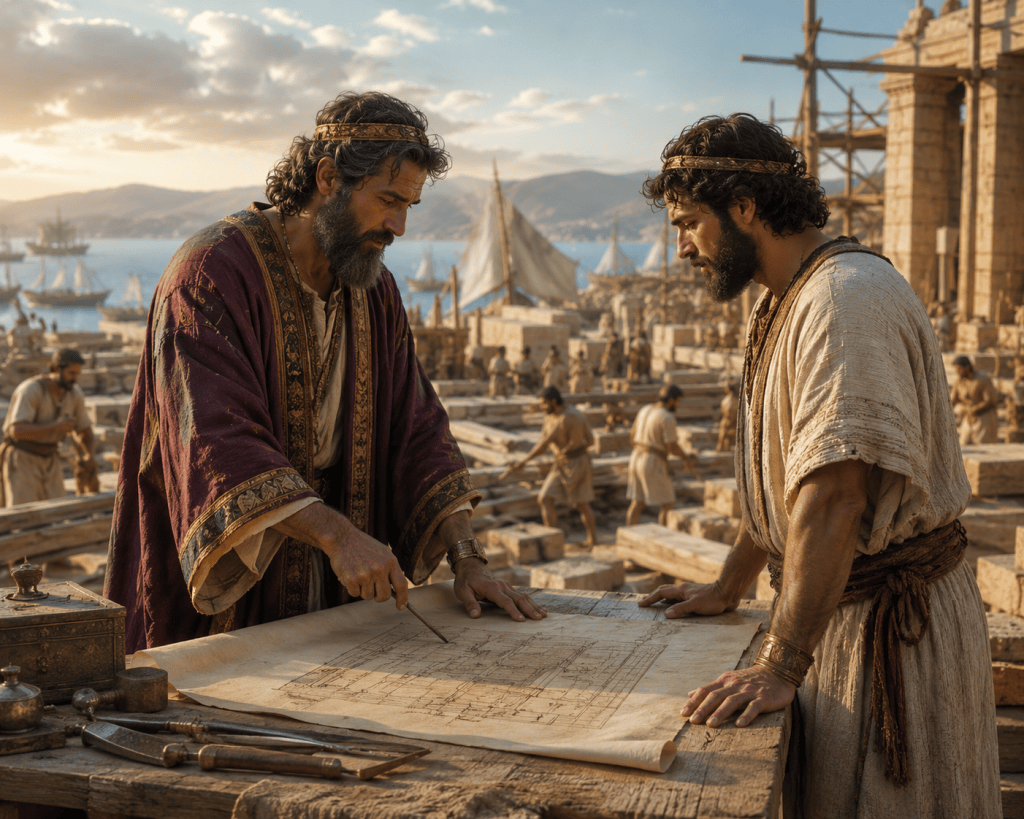
“God is glorified not only in prayer, but in the faithful exercise of every skill He has given.”
— Francis Schaeffer
📖 Scripture Passage (1 Kings 7:13–14)
“And king Solomon sent and fetched Hiram out of Tyre. He was a widow's son of the tribe of Naphtali, and his father was a man of Tyre, a worker in brass: and he was filled with wisdom, and understanding, and cunning to work all works in brass. And he came to king Solomon, and wrought all his work.”
1 Kings 7:13-14 KJV
🏢 Opening workplace connection
In today’s professional environment, technical excellence is highly valued—but it is not always enough. Engineers, technicians, craftsmen, and skilled workers often deliver high-quality work, yet projects still fail due to poor coordination, misalignment, or lack of teamwork.
Many professionals experience frustration when their skills are underutilized or unrecognized. Others struggle with collaboration, feeling that their contribution is either isolated or overlooked.
Sometimes work begins to feel mechanical—detached from purpose and meaning.
This leads to an important question: *Does my technical skill truly matter beyond my task?*
Scripture reminds us that skill is not just for production—it is for purpose.
The life of Hiram of Tyre reveals how God uses technical excellence, creativity, and collaboration to accomplish His greater plan.
👨💼 A Skilled Craftsman Empowered by Wisdom
Hiram of Tyre was a master craftsman known for his expertise in bronze work.
He was not a king, prophet, or priest—but a highly skilled professional. His work required precision, patience, creativity, and deep technical knowledge.
Scripture highlights his strengths:
* Filled with wisdom
* Full of understanding
* Skilled in detailed craftsmanship
He specialized in:
* Bronze casting
* Structural and artistic design
* Fine detailing and finishing
Hiram’s excellence came not just from talent—but from discipline and developed skill.
His work required both creativity and engineering precision.
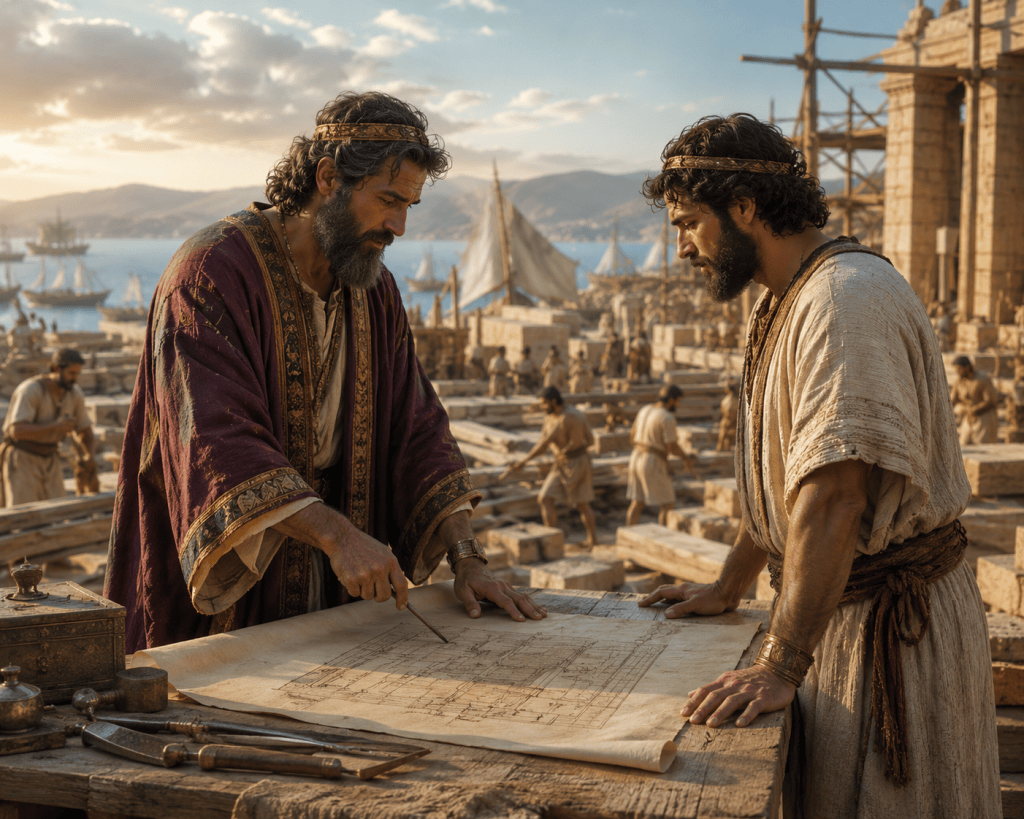
Most importantly, he worked in collaboration—aligning his expertise with King Solomon’s vision.
His life shows that professional excellence becomes powerful when it serves a greater purpose.
📜 Skill in Service: Building God’s Temple Together
Hiram’s work took place during the reign of King Solomon, around the 10th century BC—a time marked by peace, prosperity, and large construction projects in Israel.
The Temple in Jerusalem was the central place of worship. It represented God’s presence among His people. Its construction required skilled workers, international partnerships, and careful planning.
In 1 Kings 5–7, we see the detailed process of building the Temple. Solomon partners with the king of Tyre, forming an alliance that brings together resources and expertise.
Within this context, Hiram is introduced.
He was chosen specifically because of his proven skill.
He was responsible for:
* Casting large bronze pillars (Jachin and Boaz)
* Creating decorative elements
* Producing functional Temple furnishings
The phrase *“filled with wisdom”* reflects the Hebrew idea of ḥokmah, which includes skill, craftsmanship, and practical ability—not just intellectual knowledge.
This connects with Exodus 31:3, where Bezalel was also filled with God’s Spirit for craftsmanship.
The Temple was not built by one person:
* Solomon provided leadership and vision
* Laborers executed the work
* Hiram provided technical mastery
Each role was essential.
God uses human skill as part of His divine purpose. Excellence in craftsmanship becomes an act of service to Him.
Hiram’s work became part of a sacred space where God’s presence would dwell.
His hands contributed to something eternal.
🌍 Thomas Newcomen: Faithful Engineering that Enabled Industry (England, 1712)
Thomas Newcomen was an English engineer and blacksmith in the early 18th century. He did not have the advantages of formal engineering education but developed his skills through practical experience and disciplined work.
The problem of his time was serious—coal mines were constantly flooded with water, making work dangerous and inefficient. This affected entire communities that depended on mining for survival.
Instead of ignoring the problem, Newcomen chose to apply his skill.
As a committed Christian and lay preacher, he believed that his work could serve a greater purpose beyond personal benefit.

He brought together:
* Practical engineering knowledge
* Careful experimentation
* Collaboration with craftsmen and workers
Newcomen did not work alone. He partnered with metalworkers, mechanics, and laborers to develop a solution.
In 1712, he created the first practical steam engine, designed to pump water out of mines.
This invention required:
* Patience in testing
* Precision in design
* Team collaboration
It was not a sudden breakthrough—but a result of consistent effort.
His work made mining:
* Safer
* More efficient
* More sustainable
Though not widely celebrated in his time, his engine became foundational for future industrial advancements.
Newcomen did not seek recognition—he remained faithful in applying his skill for the benefit of others.
Takeaway:
Technical skill, when used with humility, collaboration, and purpose, can create impact far beyond immediate recognition.
🏭 Workplace lessons for today
Hiram and Thomas Newcomen teach us:
* Develop your technical skills intentionally
* Excellence requires discipline and patience
* Collaboration increases impact
* Use your abilities to solve real problems
* Work toward a higher purpose—not just personal success
No matter your profession—your skill is part of your calling.
🔥 Spiritual Insights
Skill is a gift from God and a responsibility to steward.
Work becomes worship when done with excellence and dedication.
God uses ordinary professions to accomplish extraordinary purposes.
The Holy Spirit empowers not only preaching—but also engineering, craftsmanship, and problem-solving.
Success is not measured by recognition—but by faithfulness. When your work aligns with God’s purpose, it gains eternal value.
🤔 Reflection questions
1. Am I developing my skills with discipline and excellence?
2. Do I collaborate effectively with others in my work?
3. How can I use my expertise to serve God’s greater purpose?
🙏 Prayer:
Lord, thank You for the skills You have given me. Help me to develop them with excellence and use them for Your glory. Teach me to work faithfully, collaborate humbly, and serve purposefully. Let my work reflect Your wisdom. In Jesus’ name, Amen.


Leave a comment