
“Wisdom is the power to see and the inclination to choose the best and highest goal.”
— J.I. Packer
📖 Main Scripture Passage
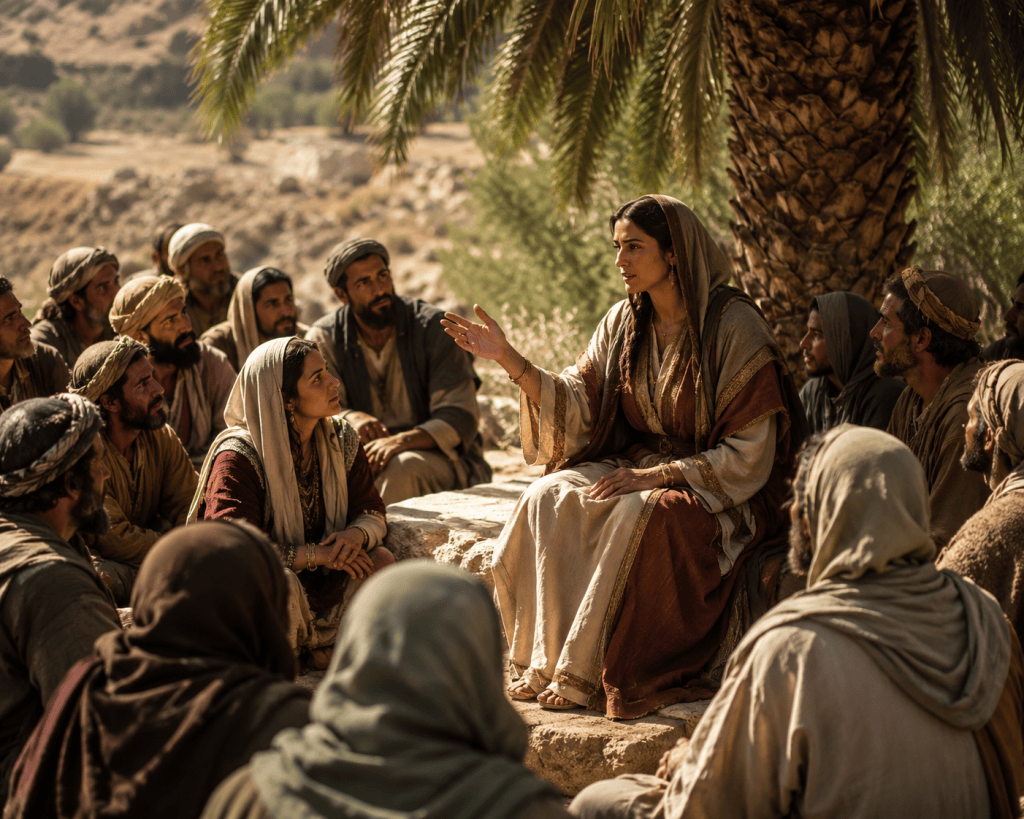
“And Deborah, a prophetess, the wife of Lapidoth, she judged Israel at that time.
And she dwelt under the palm tree of Deborah between Ramah and Bethel in mount Ephraim: and the children of Israel came up to her for judgment.” Judges 4:4–5 (KJV)
🏢 Wisdom Under Pressure
Modern workplaces often reward speed more than wisdom. Leaders are expected to make quick decisions, manage constant pressure, resolve conflicts, maintain productivity, and navigate uncertainty without hesitation. Engineers carry safety responsibilities. Healthcare workers make life-impacting decisions. Business owners balance ethics with profitability. Government officials manage public trust. Teachers and ministry leaders influence lives daily.
Yet many professionals quietly struggle beneath the surface. Emotional exhaustion, decision fatigue, office politics, financial pressure, and fear of failure can cloud judgment. Some leaders feel isolated because everyone expects them to remain strong while carrying overwhelming responsibility.
In such moments, organizations do not merely need talented individuals — they need discerning leaders. They need people who can think clearly, act courageously, and lead wisely under pressure.
Deborah’s story reminds us that God often raises spiritually grounded leaders during unstable seasons. Her wisdom did not simply solve problems temporarily; it brought peace and stability to an entire nation. Her life shows that godly discernment remains one of the greatest leadership gifts in both ministry and professional life.
👩⚖️ Deborah: A Leader Shaped by Wisdom
Deborah stands as one of the most remarkable leaders in the Old Testament. During the chaotic era of the Judges, Israel repeatedly drifted away from God, resulting in political instability and oppression from surrounding nations. Yet in the middle of national confusion, Deborah emerged as a trusted voice of wisdom and justice.
Scripture describes her as both a prophetess and a judge. The Hebrew word shaphat means “to govern, administer justice, and lead.” Deborah’s leadership was not based on military strength or royal position. People sought her because they trusted her discernment.
Professionally, Deborah demonstrated qualities essential for modern leadership:
• Wise judgment
• Emotional stability
• Courageous decision-making
• Spiritual discernment
• Strategic thinking
• Integrity
• Public trust
She listened carefully before speaking. She guided people fairly. She understood that leadership required both wisdom and courage.
Deborah also reveals an important biblical principle: spiritual maturity and professional excellence are not separate realities. Godly leadership involves character, responsibility, and faithful stewardship of influence. God empowered Deborah with wisdom, but she still had to lead diligently and courageously.
Her life reminds us that leadership influence is often built quietly through consistency, integrity, and discernment long before public victories appear.
🌄 Under the Palm Tree of Judgment
The book of Judges records one of the darkest periods in Israel’s history, likely between 1200–1050 BC. Politically, Israel lacked centralized leadership. Tribes operated independently, and neighboring nations constantly threatened them. Spiritually, the people repeatedly abandoned covenant faithfulness.
Judges 4 begins with a familiar tragedy: “And the children of Israel again did evil in the sight of the LORD.” Because of Israel’s rebellion, God allowed King Jabin of Canaan to oppress them through his military commander Sisera, who controlled nine hundred iron chariots — terrifying military technology in the ancient world.
For twenty years, Israel suffered.
Into this fearful atmosphere stepped Deborah.
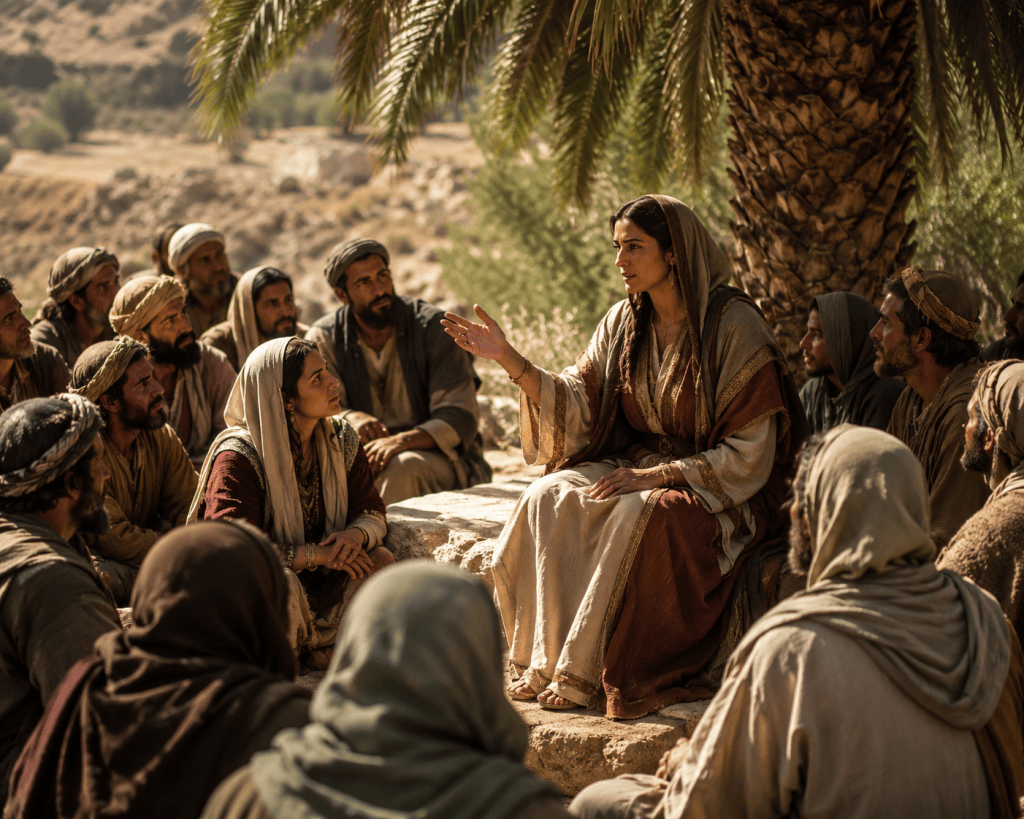
Unlike many rulers of the ancient Near East, Deborah did not sit inside a palace surrounded by political power. She sat beneath a palm tree between Ramah and Bethel, and people came voluntarily to seek judgment and counsel. This setting is deeply significant. Her authority rested not on intimidation but on credibility and wisdom.
Imagine the emotional tension surrounding her leadership. Families feared violence. Tribal leaders lacked direction. Economic hardship spread across the land. Fear and uncertainty shaped national life. Yet under the palm tree sat a woman whose discernment brought stability.
Literarily, Deborah’s story interrupts the downward spiral of Judges with unusual clarity and faithfulness. While many leaders in Judges reveal compromise or moral weakness, Deborah stands out as spiritually steady and wise.
When Deborah summoned Barak and commanded him to gather troops against Sisera, Barak hesitated. His response exposed the fear gripping the nation: “If thou wilt go with me, then I will go.” Deborah agreed, but she also prophetically declared that the final honor would go to a woman.
Theologically, Deborah’s story reveals profound truths about God’s character and kingdom:
• God raises leaders during seasons of instability.
• Wisdom is meant to serve communities, not elevate ego.
• Spiritual discernment strengthens public leadership.
• Courageous leadership often inspires fearful people to act faithfully.
The Hebrew understanding of wisdom throughout Scripture refers not merely to intelligence but to skillful living under God’s authority. Proverbs repeatedly connects wisdom with reverence for God: “The fear of the LORD is the beginning of wisdom.”
Deborah embodied this principle.
Canonically, Deborah’s leadership points forward to Christ, the ultimate righteous Judge who delivers His people perfectly. Jesus fulfills what every earthly leader can only reflect partially — perfect wisdom, justice, courage, and peace.
After Sisera’s defeat, Deborah and Barak sang a victory song recorded in Judges 5. The result of wise leadership and God’s deliverance was remarkable: “And the land had rest forty years.”
Wise leadership brought peace.
That truth remains deeply relevant today. Many crises in workplaces, organizations, ministries, and families are prevented quietly through wise judgment long before public disaster appears.
🌍 Truett Cathy: Faithful Leadership Behind Chick-fil-A
In 1946, S. Truett Cathy opened a small restaurant in Hapeville, Georgia, after serving in the military during World War II. Like many entrepreneurs, he faced uncertainty, financial pressure, competition, and exhausting work demands. Yet Cathy believed business leadership was more than building profit — it was about honoring God through wise and faithful decisions.
As his company eventually grew into Chick-fil-A, Cathy became known for unusual leadership choices shaped by biblical conviction. One of the most criticized decisions was closing all Chick-fil-A restaurants on Sundays. Financial experts warned that the company would lose massive revenue opportunities by shutting down one full day each week.
Yet Cathy believed employees needed time for worship, rest, and family life. He chose long-term values over short-term financial pressure.
His leadership reflected remarkable discernment. Rather than viewing workers merely as business assets, he invested deeply in employee development, scholarships, mentoring, and healthy workplace culture. He emphasized integrity, hospitality, and servant leadership.
Many competitors focused primarily on aggressive expansion and profit margins. Cathy focused on sustainable leadership built on trust and character. Over time, this wisdom created extraordinary loyalty among employees and customers alike.

Like Deborah, Truett Cathy demonstrated that wise leadership creates stability even during competitive and high-pressure environments. His decisions were not always popular, but they reflected conviction, discernment, and long-term thinking.
Professionals today can learn an important lesson from his story: godly wisdom sometimes requires choosing principles over immediate rewards. Wise leadership considers spiritual, ethical, and human impact alongside productivity and success.
Faithful decisions made quietly over years can shape organizations, communities, and future generations.
🏭 Workplace Lessons for Today
Deborah’s story reminds us that wisdom is essential in every profession. Organizations may value technical skill, but long-term stability depends on discernment, integrity, and trustworthy leadership.
Engineers must make responsible safety decisions. Healthcare professionals must combine compassion with judgment. Teachers shape future generations. Government leaders influence justice and infrastructure. Business professionals make decisions that affect employees, customers, and communities.
Wise leadership includes:
• Listening carefully before reacting
• Making ethical decisions under pressure
• Remaining calm during uncertainty
• Balancing courage with humility
• Building trust through consistency
• Seeking God’s direction before major decisions
Deborah and Truett Cathy both demonstrate that faithful leadership creates peace, stability, and long-term influence. God often works through wise professionals who quietly serve with integrity.
🔥 Spiritual Insight
Deborah’s life teaches us that wisdom is spiritual stewardship. The Holy Spirit forms discernment within believers so they can reflect God’s character in daily responsibilities.
Many people pursue success while neglecting character. Yet Scripture consistently teaches that wisdom protects both leadership and calling. Skill without integrity becomes dangerous. Influence without humility eventually collapses.
Christ is called “the wisdom of God” in 1 Corinthians 1:24. Therefore, true wisdom begins with surrender to Him. As believers grow closer to Christ, their leadership increasingly reflects truth, courage, compassion, and righteousness.
Your workplace is not separate from God’s kingdom purposes. Whether you work in engineering, healthcare, education, ministry, business, government service, or skilled trades, God can use your wisdom to bring stability and hope to others.
Faithful leadership is not always loud. Sometimes it looks like daily integrity, careful decisions, courageous restraint, and steady obedience.
🤔 Reflection Questions
1. Where do I currently need God’s wisdom in my professional life?
2. Do my decisions prioritize integrity or short-term success?
3. How can I become a stabilizing influence in my workplace this week?
🙏 Prayer
Lord, give me wisdom like Deborah to lead with discernment, courage, and integrity. Help me make decisions that honor You and bless others. Strengthen my character, guide my judgment, and use my work to bring peace, stability, and hope wherever You place me. In Jesus’ name, Amen.


Leave a comment