

“God prospers us not to raise our standard of living, but our standard of giving.”
— Randy Alcorn
📖 Main Scripture Passage
“And a certain woman named Lydia, a seller of purple, of the city of Thyatira, which worshipped God, heard us: whose heart the Lord opened, that she attended unto the things which were spoken of Paul. And when she was baptized, and her household, she besought us, saying, If ye have judged me to be faithful to the Lord, come into my house, and abide there. And she constrained us.”
Acts 16:14-15 KJV
These verses reveal how God used Lydia’s business influence, hospitality, and obedient heart to strengthen the early church.
🏢 When Success Feels Meaningless Without Purpose
Many professionals today work tirelessly to build careers, businesses, and financial security. Entrepreneurs manage employees, customers, competition, rising expenses, and uncertain markets while carrying the pressure to succeed constantly.
Some business owners quietly wonder whether their work has any spiritual significance beyond earning income.
Modern culture often defines success only through profit, status, expansion, and public recognition. Yet even financially successful people sometimes experience emptiness because achievement without eternal purpose cannot fully satisfy the human heart.
Others fear that business environments naturally lead toward greed, compromise, or self-centered ambition.
The life of Lydia speaks directly into these struggles.
Lydia demonstrates that business success, influence, and financial resources can become powerful tools for God’s Kingdom when surrendered fully to Christ. God can use open hearts, skilled leadership, and generous stewardship to bless many lives.
👩💼 The Businesswoman Who Opened Her Home for the Gospel
Lydia appears in Acts 16 during Paul’s missionary journey into Macedonia. Scripture identifies her as “a seller of purple,” meaning she traded expensive purple cloth highly valued in the Roman world.
Purple dye and luxury fabrics represented wealth, status, and influence because producing them required costly materials and skilled craftsmanship. Lydia likely managed an established commercial network involving suppliers, transportation, finances, and wealthy customers.
She came from Thyatira, a city known for textile trade and skilled dye production. As a businesswoman operating successfully in a male-dominated Roman society, Lydia likely possessed remarkable intelligence, discipline, resilience, and leadership ability.

Yet Lydia’s greatest strength was not merely commercial success.
Scripture says “the Lord opened” her heart.
Lydia combined:
• Business skill
• Financial stewardship
• Spiritual hunger
• Hospitality
• Humility
• Generosity
• Obedient faith
Her life reveals that professional influence becomes spiritually powerful when surrendered to God’s purposes.
Lydia did not separate faith from business. She used her resources, home, and influence to strengthen believers and support Gospel ministry.
📜 A Businesswoman Supporting the Early Church
Acts 16 records a significant turning point in the spread of Christianity into Europe. Paul had received a vision calling him toward Macedonia, and Philippi became one of the first major cities where the Gospel began spreading on European soil.
Philippi itself was a Roman colony marked by military influence, political pride, economic activity, and religious diversity. Public life often revolved around Roman identity and emperor loyalty.
Into this environment came Lydia.
Literarily, Lydia’s story follows Paul’s redirection by the Holy Spirit away from previous ministry regions. This highlights God’s sovereign guidance in advancing the Gospel through unexpected people and places.
Because Philippi apparently lacked a formal synagogue, Lydia gathered with other worshippers near a riverside prayer meeting. There Paul preached concerning Jesus Christ.
The Greek phrase translated “the Lord opened her heart” reveals divine spiritual awakening. Lydia’s conversion was not merely intellectual agreement; God Himself worked within her heart through the Gospel message.
Her response immediately affected her household, relationships, and resources.
After baptism, Lydia invited Paul and his companions into her home. In the ancient world, hospitality carried enormous social and financial significance. Opening one’s home involved trust, sacrifice, provision, and public identification with guests.
This decision carried potential risk.
Christians increasingly faced suspicion, opposition, and persecution throughout the Roman Empire. Yet Lydia willingly used her business success and household influence to support Gospel ministry.
Canonically, Lydia reflects a broader biblical pattern in which God uses financially capable believers to strengthen His people and advance Kingdom purposes. From Old Testament supporters of God’s work to New Testament house churches, Scripture repeatedly shows resources becoming instruments of ministry.
Theologically, Lydia’s life reveals that wealth itself is not evil; rather, the human heart determines whether resources become idols or tools for service.
Her story also demonstrates that conversion transforms stewardship. Lydia no longer viewed her possessions as belonging solely to herself. Her business became connected to God’s mission.
Emotionally, Lydia’s story offers hope for modern professionals who desire deeper spiritual purpose. God did not require Lydia to abandon her profession. Instead, He transformed the purpose behind her success.
Her home likely became one of the earliest meeting places for believers in Philippi, helping establish a church that later became deeply beloved by Paul.
God used one surrendered businesswoman to influence the growth of Christianity in an entire region.
🌍 Madam C.J. Walker: Building Business While Uplifting Others
In the early twentieth century, Madam C.J. Walker became one of America’s most influential businesswomen after overcoming poverty, hardship, and racial discrimination. Born to formerly enslaved parents in Louisiana, she worked difficult labor jobs for very low wages during her early years and struggled to provide for her family.
During that period, many African American women faced limited economic opportunities, poor working conditions, and social injustice. Walker herself experienced personal loss, financial insecurity, and physical exhaustion while trying to survive.
After developing severe scalp and hair problems, she began experimenting with hair-care products and eventually created a successful business focused on serving African American women. Starting with almost no financial resources, she traveled door-to-door demonstrating products, building customer trust, and training other women in business skills.
Her Christian faith strongly influenced her view of success and responsibility.
As her company expanded, Madam C.J. Walker intentionally created employment opportunities for thousands of women who previously had little economic independence. She trained women not only to sell products but also to manage finances, develop confidence, and support their families with dignity.
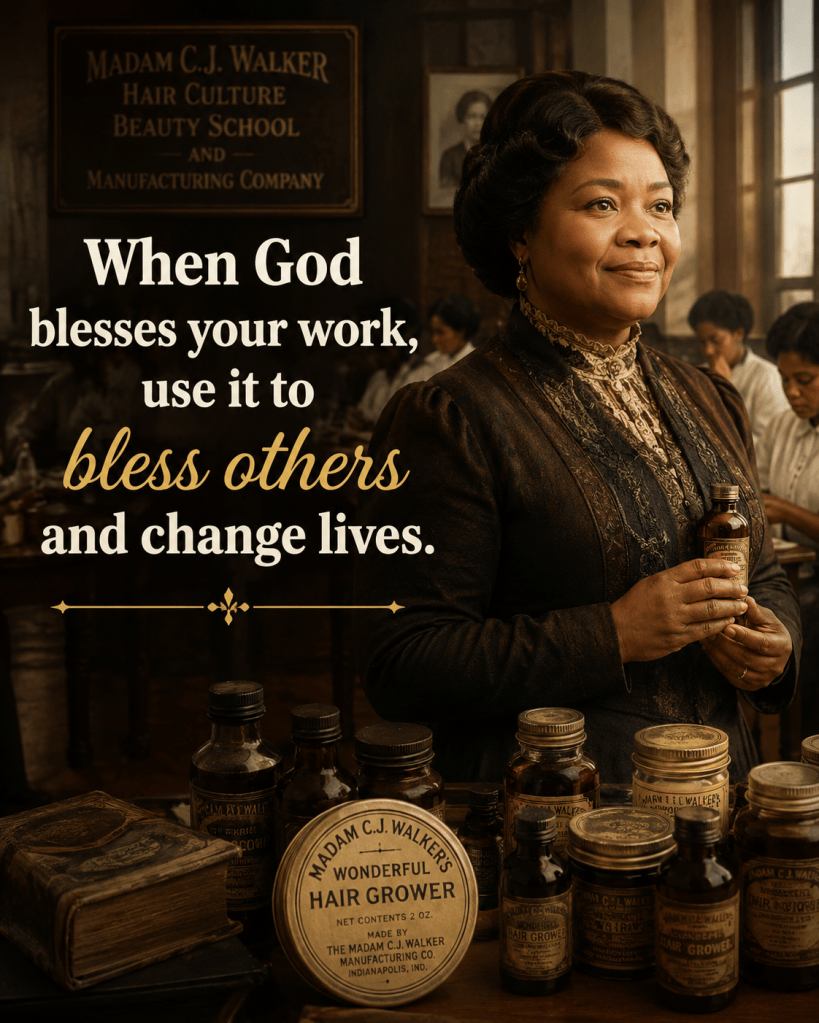
Balancing rapid business growth with social responsibility required courage, discipline, and perseverance. Walker faced competition, prejudice, operational challenges, and public criticism, yet she consistently emphasized generosity and community support.
Over time, her business success funded scholarships, charitable giving, educational programs, and support for churches and social causes. Rather than viewing wealth as personal achievement alone, she believed success should help uplift struggling people and create opportunities for others.
Like Lydia, Madam C.J. Walker used business influence to bless lives beyond financial profit alone. Her story demonstrates that entrepreneurship guided by compassion, stewardship, and purpose can become a powerful instrument for strengthening communities and serving people with dignity.
🏭 Workplace Lessons for Today
Lydia’s life speaks powerfully to entrepreneurs, managers, investors, business owners, and professionals today.
First, business itself can become ministry when guided by biblical values. Ethical leadership, honest stewardship, and generosity create influence beyond financial success alone.
Second, success should deepen dependence upon God rather than pride. Lydia recognized that her opportunities and influence ultimately belonged to the Lord.
Third, hospitality and generosity remain powerful spiritual practices. Opening homes, supporting ministry, helping people financially, and serving others can strengthen God’s Kingdom significantly.
Fourth, God often works through ordinary professional platforms. Businesses, offices, factories, classrooms, hospitals, and marketplaces can all become places of spiritual influence.
Christians should view resources not merely as possessions to protect but as tools entrusted by God for faithful stewardship.
🔥 Spiritual Insight
Lydia’s story reminds believers that God cares deeply about both the heart and stewardship.
The Lord first opened Lydia’s heart before He used her resources. True generosity flows from spiritual transformation rather than outward obligation alone.
Her life also points toward the Gospel itself. Through Jesus Christ, believers receive spiritual riches far greater than earthly wealth. Christ transforms hearts, priorities, relationships, and purpose.
Modern culture often teaches people to build wealth for self-centered security, recognition, or comfort. Lydia demonstrates a different path — using influence and success to serve God and bless others.
The Holy Spirit still uses surrendered professionals to strengthen churches, support ministry, encourage believers, and expand Kingdom influence today.
Success without eternal purpose eventually feels empty, but faithful stewardship carries lasting spiritual significance.
🤔 Reflection Questions
1. Are you viewing your business or profession as part of God’s Kingdom purpose?
2. How can your resources, influence, or workplace become instruments of ministry?
3. Is success drawing you closer to God or deeper into self-dependence?
🙏 Prayer
Heavenly Father, teach me to use my work, influence, and resources faithfully for Your glory. Guard my heart from pride, greed, and selfish ambition. Help me serve others with generosity, wisdom, and humility. Let my success become a blessing that strengthens Your Kingdom and reflects the love of Jesus Christ. Amen.


Leave a comment