

📖 Main Scripture Passage
“It seemed good to me also, having had perfect understanding of all things from the very first, to write unto thee in order, most excellent Theophilus,
That thou mightest know the certainty of those things, wherein thou hast been instructed.”Luke 1:3–4 (KJV)
These verses reveal Luke’s careful investigation, disciplined research, and desire to communicate truth accurately for the strengthening of faith.
🏢 Excellence Matters When People Depend on Your Work
In modern workplaces, small mistakes can create serious consequences. A doctor reviews medical reports late into the night to avoid missing a critical diagnosis. An engineer checks measurements repeatedly before approving a structure. A financial officer examines records carefully because a single oversight may affect hundreds of families. Teachers prepare lessons knowing inaccurate instruction can shape young minds wrongly for years.
Many professionals today work under enormous pressure to perform quickly rather than carefully.
Deadlines, competition, fatigue, staff shortages, and information overload often tempt people toward shortcuts. In fast-moving environments, attention to detail may feel exhausting or even unnecessary. Yet careless work can damage trust, harm people, and weaken long-term influence.
Some workers quietly carry the burden of responsibility every day. They fear making mistakes because others depend upon their accuracy.
The life of Luke speaks directly into this reality.
Luke reminds believers that careful work, compassionate service, and disciplined investigation honor both God and people. Excellence is not merely professional success; it is an expression of stewardship, integrity, and love.
👨⚕️ The Physician Who Carefully Recorded the Gospel
Luke lived during the first century under Roman rule and is identified in Colossians 4:14 (KJV) as “the beloved physician.” He was likely a Gentile believer and a close companion of the apostle Paul during missionary journeys, imprisonments, and seasons of hardship.
Physicians in the ancient world required disciplined observation, detailed record-keeping, and practical knowledge. Medical treatment lacked modern technology, making careful attention especially important.
Luke’s professional background shaped how he approached ministry.
Unlike emotional storytelling or vague reporting, Luke investigated events thoroughly. In Luke 1:1–3, the Greek expression translated “perfect understanding” carries the idea of careful tracing, accurate investigation, and diligent examination.
Luke combined:
• Professional precision
• Compassion for people
• Intellectual discipline
• Historical accuracy
• Spiritual humility
• Faithful service
His Gospel includes remarkable detail regarding people, places, illnesses, emotions, conversations, and historical settings. Luke paid attention because truth mattered deeply.
Yet Luke was not merely a historian collecting facts. He desired people to know “the certainty” of the Gospel message.
His life demonstrates that professional skill becomes powerful when surrendered fully to God’s purposes.
📜 A Doctor Serving the Gospel in Difficult Times
Luke wrote during a period of political tension, Roman control, and growing persecution against early Christians. The church was expanding rapidly across the Roman Empire, yet false teachings, cultural pressures, and opposition created confusion among many believers.
Literarily, Luke’s Gospel fits within the broader biblical narrative by presenting Jesus Christ as Savior not only for Israel but for all nations. Luke especially emphasized compassion toward the poor, sick, marginalized, and brokenhearted.
Before writing his Gospel, Luke carefully gathered eyewitness testimony from those who had personally seen the ministry of Jesus Christ. His opening introduction resembles the structure of disciplined historical investigation common among educated writers of that era.
Yet Luke’s purpose was deeply spiritual.
He wanted believers to possess confidence in the truth of the Gospel.
Throughout his writings, Luke repeatedly highlights Christ’s compassion toward suffering people. He recorded healings, prayers, acts of mercy, and moments others sometimes overlooked. As a physician, Luke likely understood human weakness personally.
One powerful example appears in Luke 8, where he describes the woman suffering from an issue of blood for twelve years. Luke presents not only the physical suffering but also the emotional desperation behind her condition. His writing reflects both medical awareness and spiritual sensitivity.

Luke later continued his careful documentation through the book of Acts, recording the spread of the Gospel after Christ’s resurrection and ascension. Through storms, imprisonments, persecution, shipwrecks, and missionary journeys, Luke remained a faithful observer and servant.
Theologically, Luke’s work reveals that Christianity rests upon trustworthy historical truth rather than myth or imagination. His disciplined research strengthened generations of believers.
Luke’s precision also reflects the character of God Himself. Scripture consistently reveals a God of order, truth, wisdom, and faithfulness.
Canonically, Luke’s Gospel connects Old Testament promises with their fulfillment in Jesus Christ. The birth narratives, prophetic fulfillments, and kingdom teachings demonstrate God’s redemptive plan unfolding across history.
Luke’s life teaches that careful work performed with humility can become part of God’s eternal purposes.
🌍 Dr. Paul Brand and Healing Through Compassionate Precision
During the mid-20th century, Dr. Paul Brand served as an orthopedic surgeon and medical missionary in India among patients suffering from leprosy. At the time, many people with leprosy were feared, isolated, and misunderstood socially and medically.
Working primarily at the Christian Medical College in Vellore, India, Dr. Brand noticed something many doctors had overlooked for years. He discovered that much of the damage experienced by leprosy patients was not caused directly by the disease itself but by the loss of pain sensation. Without pain warnings, patients unknowingly injured their hands and feet repeatedly.
This discovery required extraordinary medical observation, patience, and detailed investigation.
Dr. Brand spent years carefully studying wounds, nerve damage, movement patterns, and daily behaviors among patients. His research demanded precision, disciplined documentation, and compassionate care for people society often rejected.
Many medical professionals initially underestimated the significance of his findings.
Yet Dr. Brand continued faithfully because he believed every patient carried dignity as someone created in the image of God.
Unlike many physicians who focused only on clinical treatment, Dr. Brand personally touched patients others avoided. He repaired damaged hands, developed reconstructive surgical techniques, improved rehabilitation methods, and trained healthcare workers to treat leprosy patients with dignity and compassion.
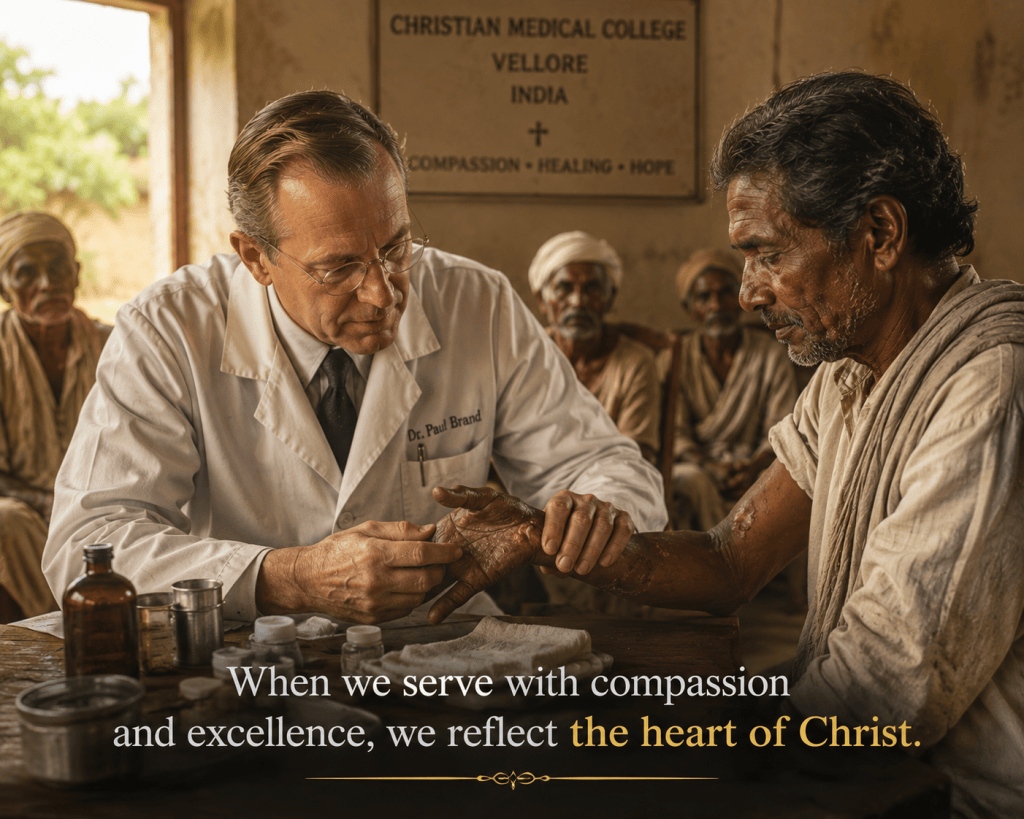
His Christian faith deeply shaped his work.
Dr. Brand often explained that pain itself was actually a gift from God because it protected the human body from greater harm. This perspective later influenced both medical science and Christian teaching worldwide.
Like Luke the Evangelist, Dr. Brand combined careful investigation with deep compassion for suffering people. His attention to detail protected lives, restored dignity, and transformed global understanding of leprosy treatment.
His work eventually influenced medicine internationally and brought hope to countless patients who had once been neglected.
Dr. Brand’s story reminds modern professionals that excellence is not merely technical achievement. True professional greatness combines skill, truth, patience, compassion, and faithful service toward people.
🏭 Workplace Lessons for Today
Luke’s life speaks powerfully to doctors, engineers, teachers, researchers, administrators, ministry leaders, journalists, and business professionals today.
First, accuracy matters because people matter. Careless work can damage trust, safety, and credibility. Attention to detail becomes an act of stewardship.
Second, compassion must accompany competence. Luke combined intellectual precision with genuine care for suffering people. Professionals who balance skill with empathy create lasting influence.
Third, faithful preparation strengthens leadership. Luke investigated thoroughly before communicating publicly. Reliable work requires patience, discipline, and humility.
Fourth, truth deserves careful handling. Whether writing reports, designing systems, treating patients, teaching students, or managing teams, believers honor God when they pursue honesty and excellence faithfully.
God still uses careful, trustworthy professionals to strengthen people, protect lives, and communicate truth clearly in a confused world.
🔥 Spiritual Insight
Luke’s story reminds believers that God values both truth and compassion deeply.
Professional skill itself is not spiritually neutral. When surrendered to God, knowledge becomes ministry, and careful work becomes worship. Excellence reflects respect for both the Creator and the people created in His image.
Luke also points believers toward Jesus Christ, the Great Physician who not only healed physical sickness but offered salvation for sinful humanity. Christ brought truth, grace, compassion, and restoration perfectly together.
In today’s distracted culture, many people value speed more than faithfulness. Luke reminds Christians that careful preparation, truthful communication, and disciplined service still matter greatly in God’s kingdom.
The Holy Spirit often works through ordinary faithfulness rather than public recognition.
Attention to detail may seem unnoticed by people, but it is never unnoticed by God.
🤔 Reflection Questions
1. Do you pursue excellence carefully or merely work quickly under pressure?
2. How can compassion strengthen the way you use your professional skills?
3. Are you handling truth responsibly in your workplace, leadership, and relationships?
🙏 Prayer
Heavenly Father, help me serve others with wisdom, compassion, and faithfulness. Teach me to work carefully, speak truthfully, and honor You through professional excellence. Guard me from carelessness, pride, and compromise. Let my work reflect the character of Jesus Christ and become a blessing to others. Amen.


Leave a comment