
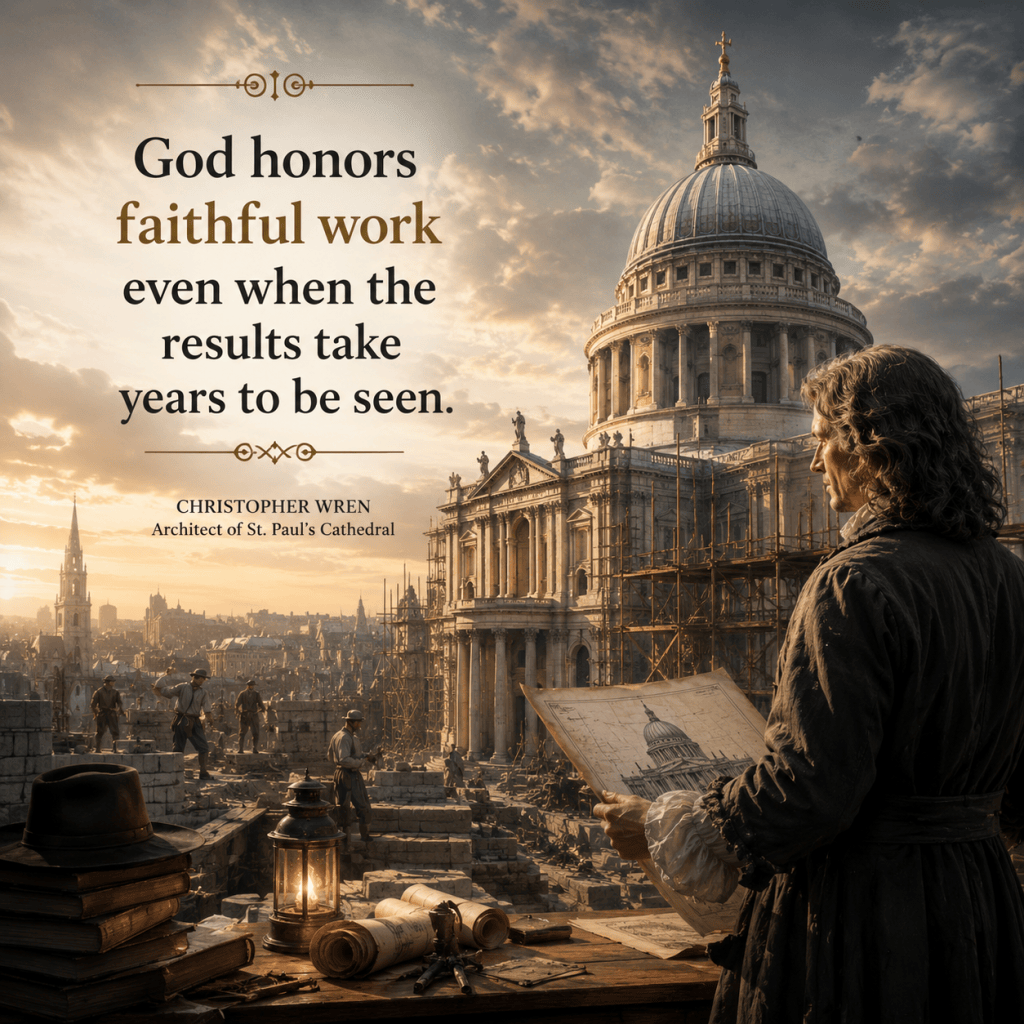
📖 Scripture Anchor : Hebrews 6:10
“For God is not unrighteous to forget your work and labour of love, which ye have shewed toward his name, in that ye have ministered to the saints, and do minister.”
Hebrews 6:10 KJV
✨ Short Introduction
Some works are completed in months. Others require decades of quiet faithfulness. In a world that celebrates instant success, the story of Christopher Wren reminds believers that God often builds lasting things slowly.
His life was not merely about architecture. It was about endurance, vision, patience, and stewardship under pressure. Through disaster, criticism, political resistance, and years of delay, Wren continued building faithfully—trusting that meaningful work requires perseverance beyond personal recognition.
⏳ The City Reduced to Ashes
In September 1666, London experienced one of the most devastating disasters in English history: the Great Fire of London. The fire began in a bakery on Pudding Lane and spread rapidly through tightly packed wooden buildings. Strong winds carried flames across the city for four terrifying days.
Entire neighborhoods disappeared. Thousands lost homes. Churches collapsed. Businesses were destroyed. Smoke filled the skies over London as citizens watched their city burn helplessly.
Among the structures destroyed was the historic St. Paul’s Cathedral, a spiritual landmark that had stood for centuries. Its massive medieval walls cracked under intense heat. The lead roof melted and flowed through the streets “like a river,” according to eyewitness accounts.
England entered a season of uncertainty and rebuilding pressure.
At that time, Christopher Wren was already known as a brilliant scientist and mathematician. Interestingly, architecture was not originally his primary profession. He had studied astronomy, physics, geometry, and engineering. Yet his unusual combination of scientific precision and artistic imagination made him uniquely suited for rebuilding projects.
Wren was eventually entrusted with one of the greatest architectural responsibilities in English history: rebuilding St. Paul’s Cathedral and helping redesign much of London.
But the assignment was far from glamorous.
Political disagreements constantly interrupted progress. Government approvals were delayed repeatedly. Funding problems slowed construction. Religious tensions influenced design debates. Many people publicly criticized Wren’s plans, believing his ideas were too modern or too ambitious.
Construction stretched over decades.
Imagine dedicating your life to a project you might never fully see completed. Imagine working faithfully while critics questioned your vision year after year.
Humanly speaking, the burden was enormous.
Wren could have abandoned the project for easier opportunities or faster recognition. Instead, he remained committed to the work before him. His perseverance reflected something deeper than professional ambition—it revealed long-term stewardship.
Though historical records do not portray Wren as an outspoken evangelist, his writings and worldview reflected deep respect for divine order and creation. He believed architecture should reflect beauty, harmony, and stability—qualities rooted in the wisdom of God Himself.
His work became more than construction. It became an act of faithful endurance.
🔥 Building Through Delay and Criticism
One of the most remarkable aspects of Wren’s story is not the cathedral itself, but his ability to continue building despite prolonged delay.
Construction on the new St. Paul’s Cathedral officially began in 1675. It would not be fully completed until 1710—approximately 35 years later.
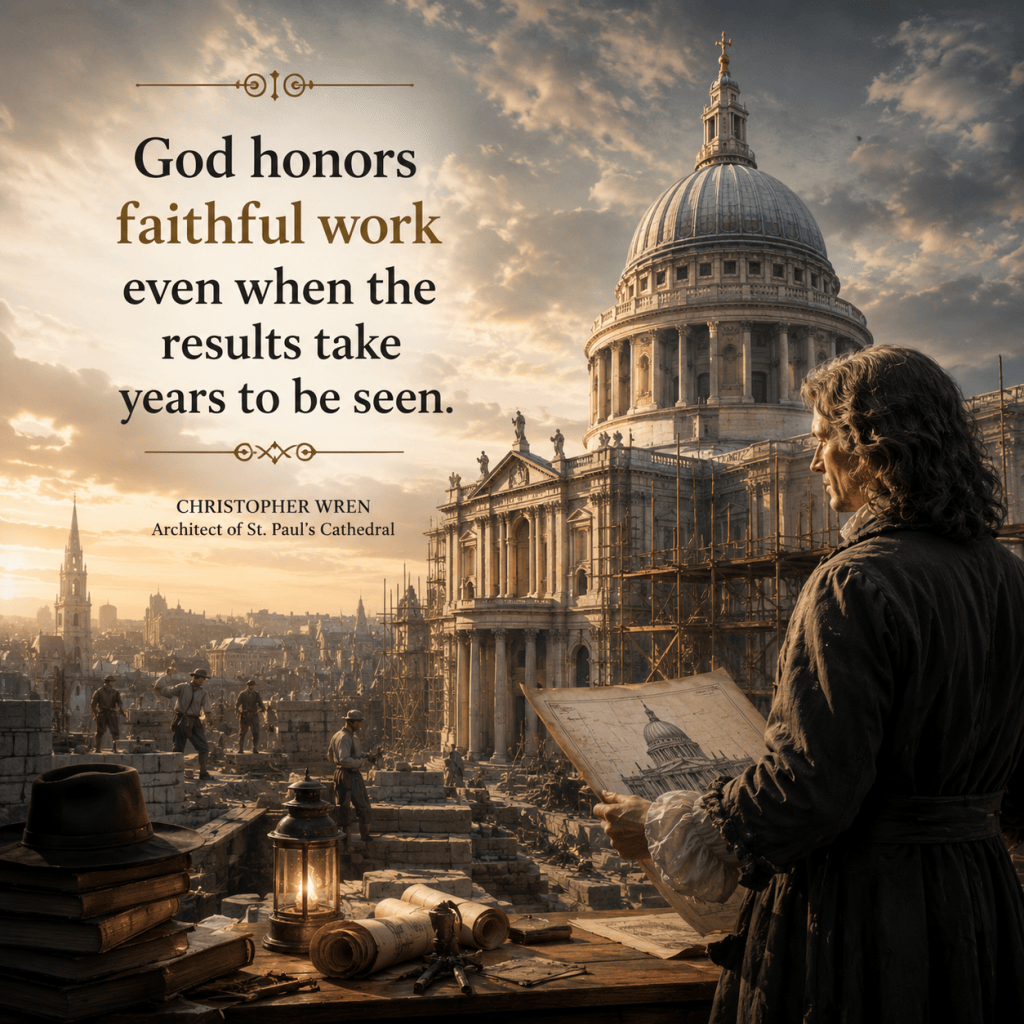
That means an entire generation grew up while the cathedral was still under construction.
During those years, workers carved stone by hand, raised enormous pillars, transported materials through difficult conditions, and assembled one of the greatest domes ever built in Europe. Every stage required patience, coordination, engineering skill, and long-term vision.
Wren personally revised designs multiple times due to political pressures and royal demands. At times he had to compromise certain preferences while still protecting the overall integrity of the structure.
This reflects an important spiritual truth: faithfulness does not always mean perfect conditions. Sometimes obedience means continuing the assignment even when progress feels slow.
There is no evidence that Wren became bitter toward criticism. Instead, he quietly continued the work.
That perseverance mirrors many biblical builders.
Noah built for years before rain came. Nehemiah rebuilt Jerusalem’s walls while facing opposition and mockery. Solomon oversaw the Temple construction through immense organizational pressure.
Great kingdom work often develops slowly and invisibly before its impact becomes visible publicly.
When St. Paul’s Cathedral was finally completed in 1710, it became one of the most iconic buildings in the world. Its dome transformed London’s skyline and stood as a symbol of resilience, beauty, and endurance.
Even centuries later, the cathedral still stands.
Inside the cathedral appears a famous Latin inscription honoring Wren. Translated into English, it says:
“If you seek his monument, look around you.”
The statement carries deep spiritual significance.
Many people spend life chasing temporary applause. Yet faithful builders often leave behind something far greater than recognition—they leave influence, stability, beauty, and blessing for future generations.
Wren’s life reminds believers that some of God’s most meaningful work happens slowly, quietly, and faithfully over time.
🌿 A Legacy Greater Than Recognition
Christopher Wren died in 1723 at the age of 90. By then, his work had shaped the identity of London itself. Yet his greatest achievement was not merely architectural success. It was the endurance to remain faithful over decades.
Modern culture celebrates visibility. Social media rewards immediate results. Professionals are often pressured to produce rapid success, instant growth, and constant recognition.
But kingdom-minded work usually grows differently.
A teacher may spend decades shaping students quietly before seeing lasting fruit. A pastor may labor faithfully through years of unseen service. A parent may pray for years before witnessing transformation in their children. An engineer may build systems that protect lives long after their own career ends.
Faithfulness often outlives fame.
Wren’s story teaches believers that God values perseverance more than applause. Some assignments require years of obedience before their significance becomes visible.
The cathedral that rose from London’s ashes became more than a building. It became a testimony that restoration is possible after devastation.
And in many ways, that reflects the gospel itself.
God rebuilds broken lives patiently. He restores hearts slowly. He forms character through seasons of delay, pressure, and perseverance. His work in believers is often gradual—but deeply lasting.
🕊️ Spiritual Reflection / Lesson
Christopher Wren’s story reminds believers that God is not only present in dramatic miracles but also in decades of steady faithfulness.
Many Christians become discouraged when results seem delayed. Yet Scripture repeatedly shows that God often works progressively, not instantly.
S.P.E.C.K. Insights
S — Sin to Avoid
Impatience, pride, discouragement, and the desire for immediate recognition can weaken long-term faithfulness.
P — Promise to Claim
Hebrews 6:10 reminds believers that God never forgets faithful labor done for His glory.
E — Example to Follow
Wren demonstrated perseverance, discipline, humility, and commitment despite criticism and delay.
C — Command to Obey
Continue serving faithfully even when progress feels slow or unseen.
K — Knowledge About God
God is faithful, patient, and attentive. He sees hidden labor and honors enduring obedience.
Key Learnings
• Great work often requires long seasons of unseen faithfulness.
• Delayed results do not mean God is absent.
• Excellence and perseverance honor God.
• Christian professionals should build with eternal perspective.
• Faithfulness matters more than immediate recognition.
💬 Closing Encouragement
Perhaps you are building something slowly right now—a ministry, career, family, business, or personal calling—and the progress feels painfully delayed.
Do not despise steady faithfulness.
God often accomplishes His deepest work through years of perseverance that others may never fully notice. Continue building with integrity, prayer, humility, and endurance. What feels unseen today may become a testimony of God’s faithfulness tomorrow.
The Lord sees every quiet act of obedience.
🙏 Prayer
Heavenly Father, help me remain faithful in the work You have given me. Strengthen me when progress feels slow and discouragement grows heavy. Teach me to build patiently with integrity, humility, and wisdom. May my work glorify You and bless others long after my own lifetime. In Jesus Christ’s name, Amen.


Leave a comment