
“Knowledge is proud that it knows so much; wisdom is humble that it knows no more.”
— William Cowper
📖 Main Scripture Passage : 1 Kings 3:9–10
“Give therefore thy servant an understanding heart to judge thy people, that I may discern between good and bad… And the speech pleased the Lord, that Solomon had asked this thing.”
1 Kings 3:9–10 (KJV)
🏢 Opening Workplace Connection
Leadership often looks impressive from the outside but exhausting from the inside. Managers carry the burden of difficult decisions. Engineers solve problems under intense deadlines. Healthcare workers face emotional fatigue. Business owners navigate uncertainty and financial pressure. Government officials and administrators make decisions that affect entire communities.
In many workplaces today, intelligence is celebrated more than wisdom. People are rewarded for quick results, confident speech, and visible success. Yet many organizational failures do not happen because leaders lack skill. They happen because leaders lack discernment, humility, and moral clarity.
Professionals today are flooded with information but often struggle to find wisdom.
The Bible introduces us to a young king standing under overwhelming responsibility. Solomon inherited political tension, national expectations, and leadership burdens beyond his natural ability. Yet instead of first asking God for wealth, fame, or military power, Solomon asked for wisdom.
His prayer continues to speak powerfully to every professional responsible for leading others today.
👨💼 Solomon: The Leader Who Asked for Wisdom
Solomon was more than a king. He functioned as a national administrator, judge, strategist, diplomat, architect, and organizational leader. Under his leadership, Israel experienced economic expansion, international influence, infrastructure development, and cultural growth.
What made Solomon exceptional was not merely intelligence but dependence upon God.
In 1 Kings 3, Solomon asked for “an understanding heart.” The Hebrew idea behind this phrase refers to a listening heart capable of discernment and wise judgment. Solomon recognized that leadership requires more than knowledge. It requires spiritual wisdom, humility, and moral clarity.
His strengths included:
• Discernment in decision-making
• Administrative excellence
• Strategic thinking
• Intellectual curiosity
• Emotional humility
• Desire for justice
Yet Scripture also presents Solomon honestly. His later compromises remind believers that wisdom must remain connected to obedience and reverence for God. Great gifting alone cannot sustain a faithful life.
For modern professionals, Solomon demonstrates that true leadership is not built merely on authority or expertise. Lasting influence grows when competence is surrendered to God’s wisdom.
📜 A Young King Under Enormous Pressure
The story of Solomon unfolds during a significant transition in Israel’s history. David had united the kingdom through warfare, worship, and covenant leadership. Yet after David’s death, the responsibility of governing Israel passed to his young son Solomon.
The political atmosphere was fragile. Ancient kingdoms constantly faced threats from surrounding nations, internal rebellion, economic instability, and leadership conflict. A weak ruler could quickly bring national disaster.
Solomon understood the weight of leadership.
First Kings 3 records one of the most important prayers in Scripture. At Gibeon, Solomon worshiped the Lord through sacrifices. During the night, God appeared to him in a dream with a remarkable invitation:
“Ask what I shall give thee.”

The moment carries enormous theological depth. Solomon stood between divine promise and human responsibility. God had promised David that his son would reign, yet Solomon still needed wisdom to govern faithfully.
Instead of requesting military victory, riches, or revenge against enemies, Solomon prayed:
“Give therefore thy servant an understanding heart…”
The Hebrew word associated with “understanding” carries the idea of hearing attentively, perceiving wisely, and discerning correctly. Solomon desired wisdom that could distinguish between right and wrong.
This deeply pleased God.
In the ancient Near East, kings commonly pursued self-glory, conquest, and power. Yet Solomon approached leadership with humility. He openly admitted his limitations, describing himself as “a little child” who did not know “how to go out or come in.” His words reveal emotional honesty and spiritual dependence.
God responded generously by giving Solomon:
• Wisdom
• Discernment
• Honor
• Influence
• National prosperity
Soon afterward, Scripture demonstrates Solomon’s wisdom through the famous judgment involving two women claiming the same baby. Rather than reacting emotionally or politically, Solomon discerned the truth through careful insight. The nation recognized that divine wisdom rested upon him.
Historically, Solomon’s reign became Israel’s golden age. Trade flourished. Massive construction projects developed across the kingdom. The Temple in Jerusalem was built. International leaders traveled great distances to hear Solomon’s wisdom, including Queen of Sheba.
The literary structure of Kings intentionally connects wisdom with covenant faithfulness. Solomon’s wisdom was not given for personal pride but for stewardship under God’s authority.
This theme echoes throughout Scripture. Proverbs repeatedly teaches that “the fear of the Lord is the beginning of wisdom.” Later, the New Testament presents Jesus Christ as greater than Solomon (Matthew 12:42). Solomon possessed divine wisdom; Christ Himself embodies the wisdom of God perfectly.
Theologically, Solomon’s story reveals both the beauty and danger of leadership. Wisdom is a gift from God, but leaders must continually remain surrendered to Him. Solomon’s later moral compromise demonstrates that success without ongoing obedience eventually weakens spiritual judgment.
For today’s professionals, this story remains profoundly relevant. Education, technical skill, and influence matter greatly, but discernment, humility, and reverence for God remain essential for lasting leadership.
🌍 The Nurse Who Served Through Crisis — Florence Nightingale, Crimea, 1850s
During the Crimean War in the 1850s, military hospitals were overwhelmed with suffering. Soldiers died not only from battle injuries but also from infection, overcrowding, poor sanitation, and neglect. Hospital systems lacked organization, and fear filled the medical wards.
Into this difficult environment stepped Florence Nightingale, a Christian woman whose faith shaped both her leadership and professional calling.
Born into a wealthy British family, Nightingale sensed a calling from God to serve the suffering. At that time, nursing was not considered a respectable profession for women of her social background. Many opposed her decision, including members of her own family.
Yet she believed serving hurting people was part of serving Christ Himself.
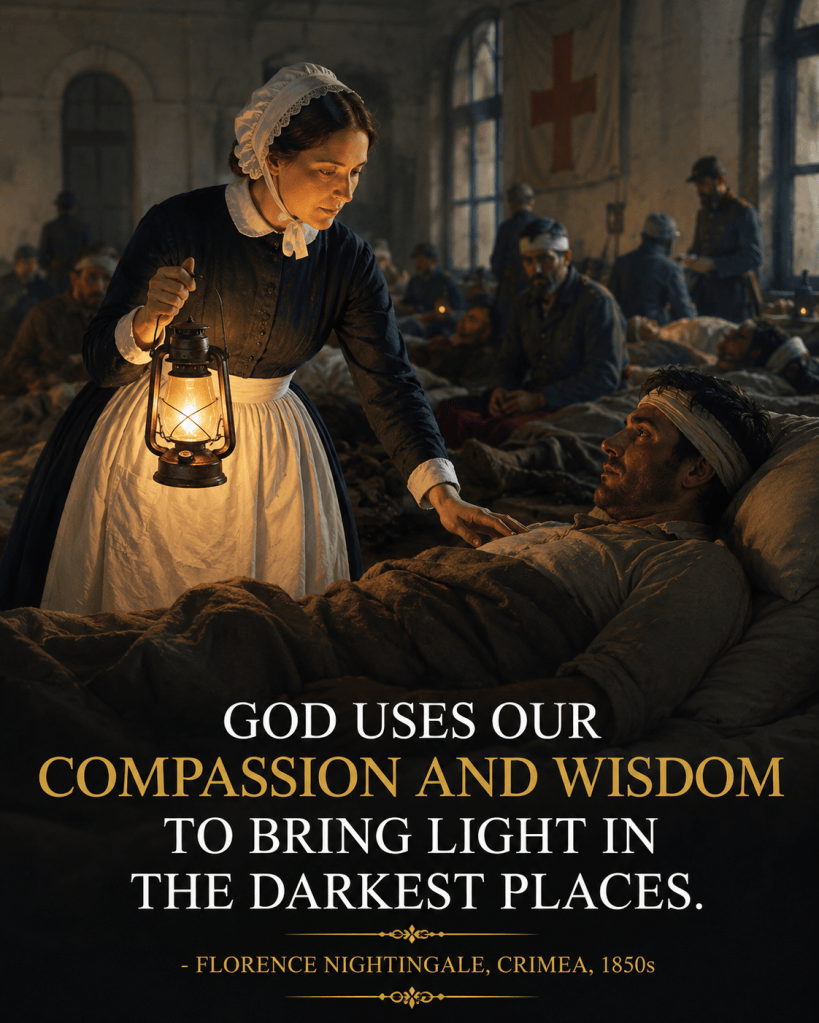
When Nightingale arrived at military hospitals in Scutari during the Crimean War, she encountered terrible conditions. Medical supplies were insufficient. Infection spread rapidly. Exhausted healthcare workers struggled under crushing pressure. Death rates remained extremely high.
Instead of surrendering to hopelessness, Nightingale combined compassion with disciplined wisdom.
She reorganized sanitation systems, improved ventilation, strengthened hygiene practices, and introduced better patient care procedures. Her leadership was practical, strategic, and deeply compassionate.
But her strength did not come merely from professional ability.
Nightingale spent time regularly in prayer and Scripture meditation. She believed wisdom, compassion, and leadership were responsibilities entrusted by God. Even under criticism and exhaustion, she continued serving faithfully.
Over time, mortality rates significantly decreased because of the reforms she introduced. Soldiers began calling her “The Lady with the Lamp” because she personally walked hospital corridors at night caring for wounded patients.
Like Solomon, Florence Nightingale demonstrated that wise leadership requires discernment, humility, courage, and servant-hearted responsibility. Her influence permanently transformed modern nursing and healthcare administration worldwide.
Her story reminds today’s professionals that wisdom is not merely intellectual brilliance. Godly wisdom serves people faithfully, solves problems compassionately, and leads humbly even during crisis.
🏭 Workplace Lessons for Today
Solomon’s story reminds professionals that leadership is far more than authority or technical expertise. Organizations often fail not because people lack talent, but because leaders lack discernment, humility, and moral wisdom.
Modern workplaces constantly demand difficult decisions:
• Ethical conflicts
• Team tension
• Financial pressure
• Information overload
• Public accountability
• Crisis management
Wisdom helps leaders see beyond short-term success into long-term consequences.
For healthcare professionals, wisdom combines knowledge with compassion. For engineers, wisdom prioritizes safety and integrity over shortcuts. For educators, wisdom shapes character alongside information. For business leaders, wisdom values ethical stewardship above temporary profit. For government officials, wisdom seeks justice rather than personal advancement.
Practical leadership wisdom includes:
• Listening before reacting
• Seeking counsel humbly
• Admitting limitations honestly
• Making decisions prayerfully
• Developing emotional maturity
• Leading people compassionately
Solomon’s later failures also remind believers that strong beginnings do not guarantee faithful endings. Leaders must continually remain dependent upon God.
Professional excellence becomes spiritually healthy only when joined with humility and obedience.
🔥 Spiritual Insight
Solomon’s life ultimately points beyond human wisdom toward Christ Himself.
Even the wisest human leaders remain imperfect. Solomon possessed extraordinary wisdom, yet he later drifted spiritually because wisdom disconnected from obedience eventually weakens the soul.
Scripture teaches that true wisdom begins with reverence for God.
The New Testament describes Jesus Christ as “the wisdom of God” (1 Corinthians 1:24). In Christ, believers discover not only wisdom for leadership but also wisdom for life, salvation, purpose, and eternity.
This transforms how Christians approach professional life:
• Work becomes stewardship
• Leadership becomes service
• Influence becomes responsibility
• Success becomes secondary to faithfulness
The Holy Spirit continues guiding believers through daily workplace pressures, ethical dilemmas, difficult conversations, and leadership responsibilities. God cares deeply about how His people lead within offices, hospitals, classrooms, factories, ministries, and public institutions.
Solomon’s story also warns against trusting giftedness more than God. Intelligence without humility eventually becomes dangerous.
Christ-centered wisdom listens carefully, serves faithfully, and depends continually upon the Lord.
🤔 Reflection Questions
1. Where in my professional life do I most need God’s wisdom today?
2. Am I depending more upon personal ability or upon God’s guidance?
3. How can I lead others with greater humility, discernment, and compassion?
🙏 Prayer
Heavenly Father, give me wisdom like Solomon and humility to depend upon You daily. Help me lead with integrity, compassion, discernment, and courage. Guard my heart from pride and self-dependence. Let my work reflect Your character and become a blessing to those around me through Christ my Lord. Amen.


Leave a comment