
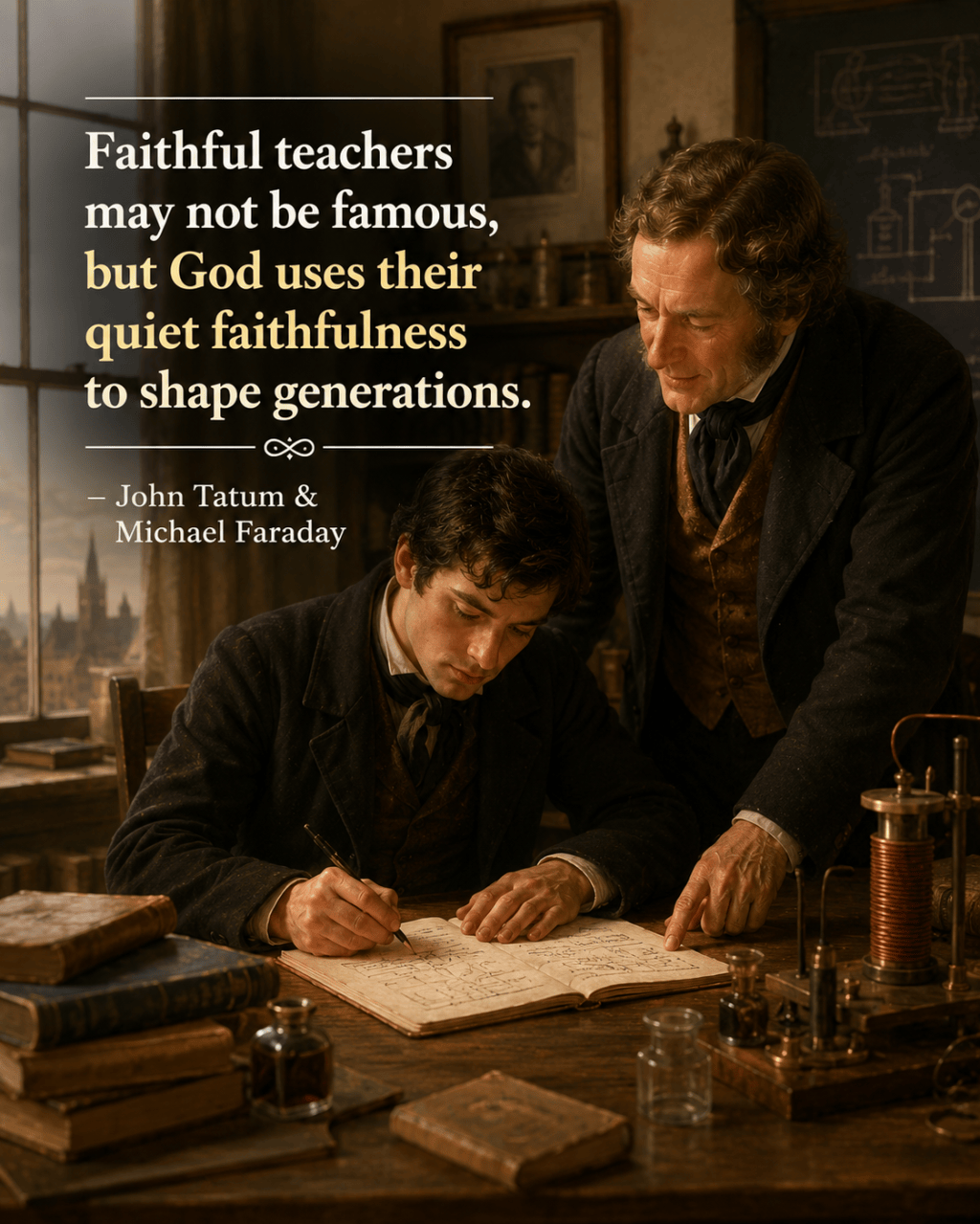
📖 Scripture Anchor :Exodus 35:34
“And he hath put in his heart that he may teach, both he, and Aholiab, the son of Ahisamach, of the tribe of Dan.”
Exodus 35:34 KJV
✨ Short Introduction
Many people desire visible leadership, public recognition, and personal success. Yet throughout history, God has often worked powerfully through faithful mentors, teachers, assistants, and encouragers whose names remain mostly unknown.
The story of John Tatum reminds us that one quiet believer investing faithfully in others can influence generations far beyond what he ever imagined.
Like Oholiab in the Bible, Tatum demonstrated that supporting roles in God’s work carry eternal significance.
⏳ Background / Before Christ (The Struggle)
Early nineteenth-century England was a season of enormous social and industrial change. Factories expanded rapidly, cities became crowded, and scientific discoveries began transforming transportation, manufacturing, and communication. Yet education remained largely limited to the wealthy and socially connected.
For ordinary workers, opportunities were extremely limited.
Many young apprentices worked long hours simply trying to survive. Skilled laborers and poor families often lacked access to formal scientific education. Intellectual societies were usually reserved for elites, university scholars, and wealthy professionals.
Among these struggling young workers was Michael Faraday.
Faraday was born in 1791 into a deeply poor family in England. His father worked as a blacksmith but struggled financially due to poor health. Because of poverty, Faraday received only basic schooling. As a teenager, he worked as an apprentice bookbinder in London.
Though intelligent and curious, Faraday faced enormous limitations:
• Little formal education
• No wealthy background
• No scientific reputation
• No influential social connections
• Limited career opportunities
Yet while binding books, Faraday developed a deep fascination with science. He carefully read the books passing through the shop and taught himself through observation and discipline.
Still, knowledge alone could not easily overcome social barriers.
At that time, scientific learning was often inaccessible to ordinary laborers. Many educated elites viewed working-class apprentices as intellectually unimportant. A poor young apprentice rarely received opportunities to grow within professional scientific communities.
Emotionally, this environment could easily produce discouragement:
• Feelings of insignificance
• Fear of failure
• Lack of opportunity
• Social rejection
• Financial uncertainty
Meanwhile, England’s Industrial Revolution also created spiritual challenges. Many people pursued technological advancement while neglecting moral and spiritual formation. Ambition, competition, and class divisions shaped much of society.
Yet in the middle of this culture, God was quietly preparing both a future scientist and a faithful mentor.
🔥 Turning Point (God’s Intervention)
God’s intervention came through a humble teacher willing to open doors for ordinary people.
John Tatum was a Christian lecturer, educator, and founder of scientific discussion gatherings in London. Unlike many intellectual leaders of his time, Tatum believed knowledge should not belong only to wealthy elites.
He believed ordinary workers also deserved opportunities to learn, grow, and develop their God-given abilities.
In 1808, Tatum founded a scientific discussion society that welcomed apprentices, tradesmen, mechanics, and working-class learners. His lectures created an environment where curiosity, discipline, and learning could flourish among common people.
This became a life-changing opportunity for Michael Faraday.
Faraday attended Tatum’s lectures eagerly while still working as a bookbinder apprentice. Sitting quietly among other workers, he carefully listened, took notes, and absorbed scientific ideas that would later shape his future discoveries.
Tatum may not have fully realized what God was doing through his simple faithfulness.
He was not building a global reputation for himself. He was simply teaching faithfully, encouraging learners, and creating opportunities for others.
Yet God used this quiet act of service powerfully.
Faraday’s learning eventually led him to attend lectures by Sir Humphry Davy at the Royal Institution. Later, Faraday himself became one of history’s most influential scientists, contributing foundational discoveries involving:
• Electromagnetism
• Electric motors
• Generators
• Transformers
• Electrical engineering principles
Modern electrical systems across the world were deeply influenced by Faraday’s discoveries.
But behind Faraday stood people like John Tatum.
God’s intervention was not dramatic in outward appearance. There were no public miracles or sudden wealth. Instead, God worked through:
• Faithful teaching
• Encouragement
• Access to learning
• Humble mentorship
• Quiet investment in others
Tatum demonstrated the spirit of Oholiab — supporting, teaching, strengthening, and helping others fulfill their calling.
Sometimes God changes history through people who never stand at the center of attention.
🌿 Transformation / After Christ
The greatest transformation in this story was not fame but multiplication.
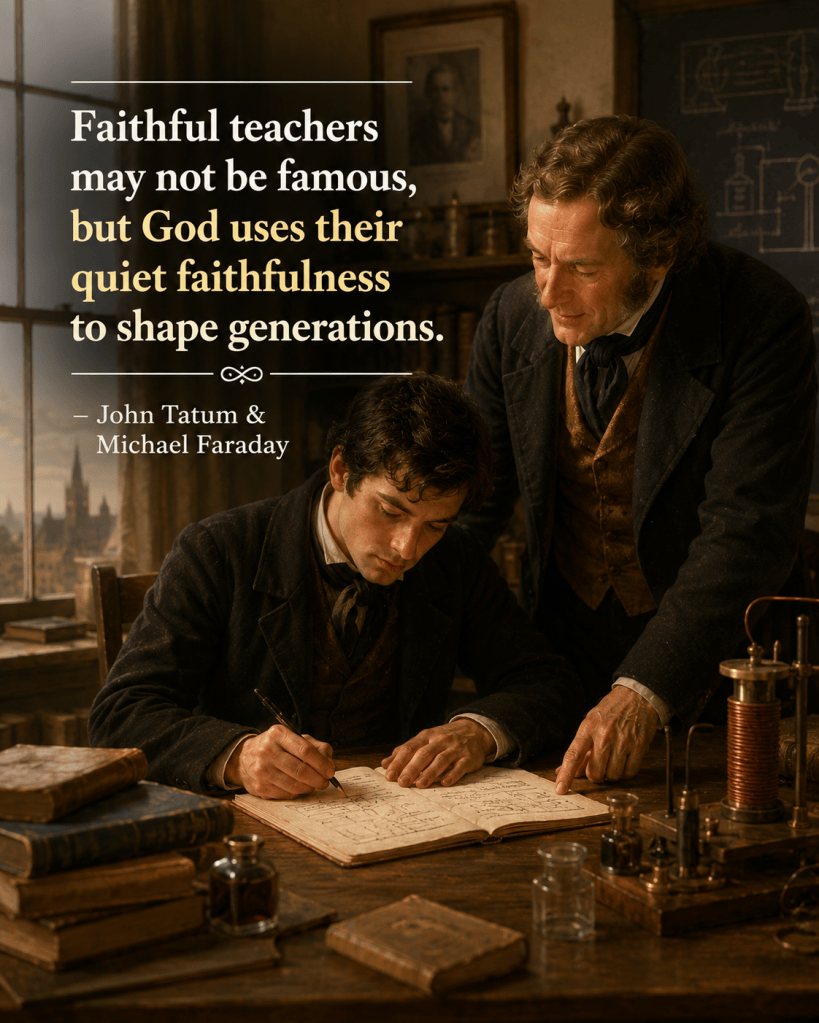
John Tatum never became as globally celebrated as Michael Faraday. History books rarely place his name beside famous inventors and scientists. Yet his faithful investment produced influence far beyond his own lifetime.
Faraday later became known not only for scientific brilliance but also for humility, integrity, and sincere Christian faith. As a committed member of the Sandemanian church community, he consistently emphasized moral character alongside intellectual achievement.
Faraday refused to use science merely for personal pride or power. His faith shaped his discipline, honesty, and humility.
The impact multiplied across generations:
• Electrical engineering expanded globally
• Communication systems advanced
• Transportation technologies improved
• Modern industries developed
• Scientific education became more accessible
Behind many visible achievements stood unseen encouragers, mentors, teachers, and assistants.
This reflects a deeply biblical principle.
Oholiab was not the primary public leader like Bezalel, yet God specifically honored his teaching ability and supportive craftsmanship. Scripture shows that the Kingdom of God advances not only through visible leaders but also through faithful contributors working quietly behind the scenes.
Even today, many believers serve faithfully without public recognition:
• Trainers developing younger employees
• Teachers encouraging struggling students
• Senior engineers mentoring juniors
• Nurses supporting exhausted teams
• Administrators organizing ministries
• Skilled workers training apprentices
• Parents discipling children faithfully
The world often celebrates visible success. But God also sees hidden faithfulness.
Transformation often spreads through ordinary believers who invest patiently in others.
📚 Source for Further Reading
• The Royal Institution – Michael Faraday History
🕊️ Spiritual Reflection / Lesson
The story of John Tatum teaches us that faithful support roles matter deeply in God’s Kingdom.
Not every believer is called to public leadership. Some are called to strengthen, mentor, teach, organize, encourage, and develop others quietly. Yet these hidden contributions often shape history more than people realize.
S.P.E.C.K. Insights
S — Sin to Avoid / Confess
• Seeking recognition more than faithfulness
• Withholding knowledge selfishly
• Ignoring opportunities to help others grow
P — Promise to Claim
“But he that watereth shall be watered also himself.” — Proverbs 11:25 (KJV)
God blesses those who invest faithfully in others.
E — Example to Follow
John Tatum used his knowledge and opportunities to uplift ordinary workers rather than protect status or prestige.
C — Command to Obey
Believers are called to teach, encourage, disciple, and strengthen others faithfully wherever God places them.
K — Knowledge About God
God values hidden faithfulness, humble service, and supportive ministry. He sees every unseen contribution and uses ordinary obedience for extraordinary purposes.
Key Learnings
• Quiet mentorship can influence generations.
• Teaching others is Kingdom work.
• Hidden faithfulness matters to God.
• Supporting roles carry eternal significance.
• God multiplies humble obedience over time.
💬 Closing Encouragement
Perhaps you serve in a role that feels unnoticed today.
You may support others more than you receive recognition yourself. You may train coworkers, encourage younger believers, help teams succeed, or quietly strengthen people behind the scenes.
Do not underestimate your influence.
God often works through faithful encouragers long before visible results appear. Like John Tatum and Oholiab, your willingness to teach, support, and invest in others may shape lives and futures you will never fully see on earth.
In God’s Kingdom, hidden faithfulness is never wasted.
🙏 Prayer
Lord Jesus, help me serve faithfully even when my work is unseen. Give me humility to encourage others, wisdom to teach patiently, and love to strengthen those around me. Protect my heart from pride and comparison. Use my quiet obedience to build Your Kingdom and bless future generations. Amen.


Leave a comment