
💬 Short Famous Quote
“Not all of us can do great things. But we can do small things with great love.”
— Mother Teresa
📖 Main Scripture Passage
Exodus 35:34–35
“And he hath put in his heart that he may teach, both he, and Aholiab, the son of Ahisamach, of the tribe of Dan. Them hath he filled with wisdom of heart, to work all manner of work, of the engraver, and of the cunning workman, and of the embroiderer, in blue, and in purple, in scarlet, and in fine linen, and of the weaver, even of them that do any work, and of those that devise cunning work.”
Exodus 35:34-35 KJV
🏢 Opening Workplace Connection
Many professionals quietly carry responsibilities that others never notice.
A senior engineer trains younger staff while someone else receives public recognition. A nurse supports exhausted doctors through long night shifts. A project coordinator keeps entire systems functioning behind the scenes without appearing in leadership meetings. A teacher patiently develops struggling students while administrators receive applause. An assistant manager absorbs workplace pressure while executives receive the credit.
Modern work culture often celebrates visible leadership but overlooks faithful support roles.
Many skilled professionals silently wonder:
“Does my contribution truly matter if I am not leading from the front?”
The Bible answers this question through the life of a man many believers barely remember—Oholiab.
Though his name appears beside the famous craftsman Bezalel, Oholiab’s calling was equally important in accomplishing God’s work. Scripture reveals that God not only appoints visible leaders but also empowers trainers, assistants, collaborators, and faithful team builders.
In God’s kingdom, supporting roles are never insignificant.
👨💼 Introducing Oholiab: The Spirit-Gifted Assistant and Teacher
Oholiab appears during Israel’s wilderness journey after deliverance from Egypt. God had commanded the construction of the Tabernacle—the sacred portable sanctuary where His presence would dwell among His covenant people.
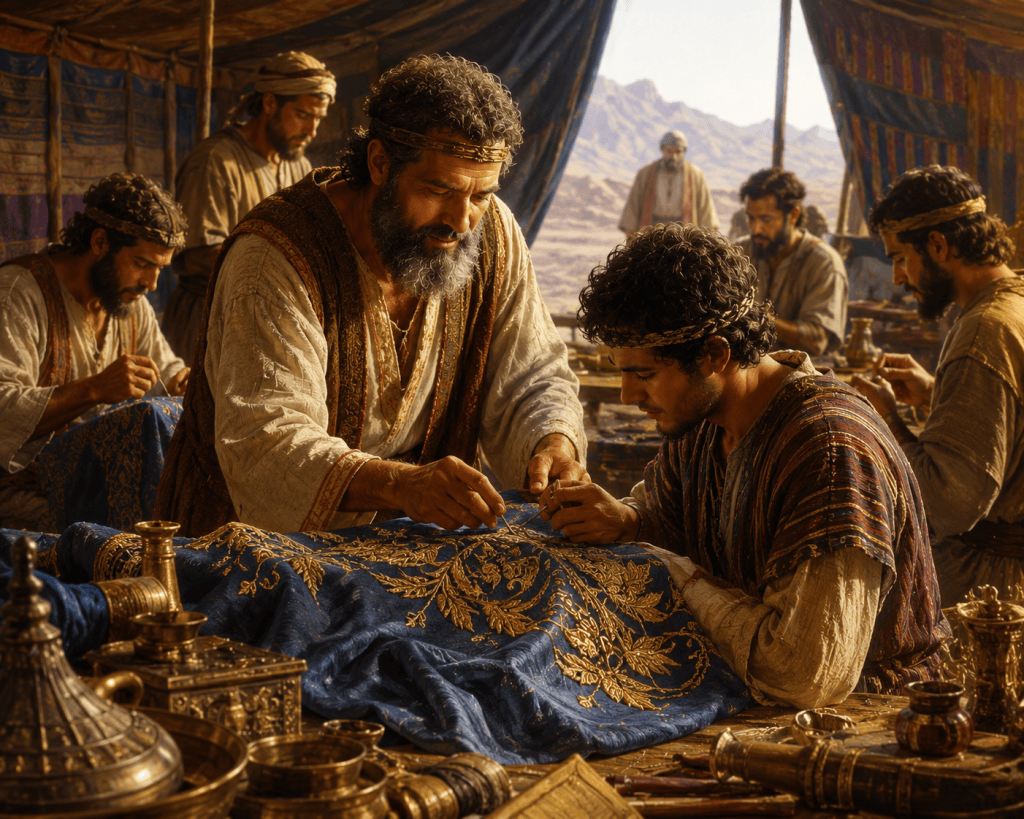
While Bezalel led the overall craftsmanship, Oholiab was specifically appointed to assist, teach, and strengthen the larger workforce responsible for the project.
Exodus 35:34 says God placed within him “the ability to teach.” This detail is remarkable. Scripture does not merely praise technical talent; it honors the ability to develop others.
Oholiab did not seek personal prominence.
His greatness appeared through faithful collaboration.
In today’s language, Oholiab functioned like a master trainer, technical instructor, senior support specialist, quality supervisor, and collaborative team leader.
He reminds modern professionals that kingdom impact is often built through faithful support, mentoring, and shared excellence rather than public visibility alone.
🛠️ The Excellence of Oholiab
What made Oholiab exceptional was not merely his artistic skill but his willingness to strengthen others.
Many professionals desire authority but resist hidden service. Oholiab embraced both excellence and humility simultaneously.
Scripture emphasizes that God “filled” him with wisdom. The Hebrew concept here goes beyond intellectual knowledge. It describes skill shaped by discernment, maturity, and faithful stewardship.
Oholiab’s work required:
• Precision under pressure
• Attention to sacred detail
• Team coordination
• Patience in teaching
• Submission to leadership
• Dependability behind the scenes
This balance remains deeply relevant today.
Organizations often succeed because of faithful contributors who quietly solve problems, train coworkers, maintain systems, prevent failures, and strengthen teams without demanding recognition.
The New Testament later echoes this principle in 1 Corinthians 12, where Paul describes the Body of Christ. Not every part stands visibly in front, yet every member remains essential.
Oholiab demonstrates that supporting roles are not secondary callings.
He also shows that teaching is itself a spiritual gift. Knowledge becomes far more powerful when shared faithfully. Skilled professionals who mentor younger workers multiply influence far beyond their individual accomplishments.
In many workplaces today, competition encourages people to protect expertise selfishly. Oholiab modeled the opposite spirit. He helped others grow so that God’s work could be completed excellently.
That requires spiritual maturity.
📜 The Story Behind the Skilled Collaboration
The story unfolds during one of the most formative seasons in Israel’s history. The nation had recently escaped Egyptian slavery through God’s mighty deliverance. Politically, Israel possessed no permanent homeland, no centralized government, and no military security. They lived as a wilderness community entirely dependent upon God.
At Mount Sinai, God established covenant relationship with His people. The Tabernacle became the visible center of worship, sacrifice, holiness, and divine presence.
Exodus 25–31 contains detailed instructions regarding the Tabernacle’s design. Gold-covered furniture, embroidered curtains, priestly garments, lampstands, altars, engraved stones, and sacred vessels all carried theological meaning. This was not merely construction work; it symbolized God dwelling among humanity.
Then came the crisis of the golden calf in Exodus 32.
Israel corrupted worship through impatience and idolatry. Human creativity, detached from obedience, became destructive. Yet God responded with mercy and restoration.
Within this restored covenant context, God appointed Bezalel and Oholiab.
Exodus 35:30–35 reveals something profound: God not only gave craftsmanship but also the ability to teach others. The Hebrew expression for “wisdom of heart” points toward practical skill empowered by God’s Spirit.
Oholiab belonged to the tribe of Dan, one of Israel’s smaller tribes. This detail matters. God intentionally used someone outside the dominant tribe of Judah to participate in sacred work. His kingdom values faithfulness more than social prominence.
Imagine the emotional atmosphere surrounding the project.
Thousands of former slaves now worked together to construct a holy sanctuary in harsh desert conditions. Materials had to be managed carefully. Artisans needed coordination. Sacred patterns had to be followed exactly. Failure carried spiritual consequences because the Tabernacle represented God’s holy presence.
Leadership pressure would have been immense.
Yet Scripture repeatedly emphasizes willing hearts, generous giving, skilled hands, and collaborative work. God’s dwelling place was built through unified contribution rather than individual achievement.
The literary structure of Exodus highlights this beautifully. After the chaos of idolatry comes ordered worship. After rebellion comes restored purpose. Skilled work becomes part of covenant renewal.
Canonically, the Tabernacle ultimately points toward Christ. John 1:14 says the Word “dwelt” among us, echoing the Tabernacle imagery of God dwelling with His people. Later, the Church itself becomes described as a spiritual temple built together in Christ.
This carries important theological truth for professionals today.
God often builds His purposes through collaboration.
The modern world frequently glorifies individual achievement, celebrity leadership, and personal branding. But Scripture repeatedly honors faithful teamwork:
• Aaron supported Moses
• Joshua served before leading
• Elisha learned under Elijah
• Timothy strengthened Paul’s ministry
• Priscilla and Aquila discipled Apollos together
The kingdom of God advances through faithful partnerships.
Oholiab’s story also reveals God’s character. The Lord sees hidden service. He values trainers, assistants, organizers, craftsmen, administrators, and support workers whose names rarely become famous publicly.
This truth comforts countless professionals today.
A technician maintaining safety systems, a teacher mentoring quietly, a healthcare assistant supporting exhausted staff, an administrator coordinating logistics, or a software tester preventing critical failures may never receive public applause. Yet faithful hidden work matters deeply to God.
Oholiab teaches that collaboration itself can become worship.
🌍 The Quiet Teacher Behind a Global Scientific Movement
In nineteenth-century England, Michael Faraday became one of history’s greatest scientists. His discoveries transformed electricity, engineering, and modern technology. Yet behind Faraday stood a lesser-known Christian mentor whose quiet support shaped generations.
That man was John Tatum.
In early 1800s London, Faraday came from deep poverty and received little formal education. As a young apprentice bookbinder, he possessed curiosity but lacked opportunity, social influence, and professional connections.
John Tatum, a Christian lecturer and founder of scientific discussion groups, welcomed ordinary workers and apprentices into educational gatherings normally reserved for elites. Instead of protecting knowledge for intellectual circles alone, he believed learning should help ordinary people flourish.
Faraday attended Tatum’s lectures eagerly.
Tatum never achieved Faraday’s global fame. He did not become history’s celebrated inventor. Yet his willingness to teach, encourage, and create opportunity helped shape one of the greatest scientific minds in history.
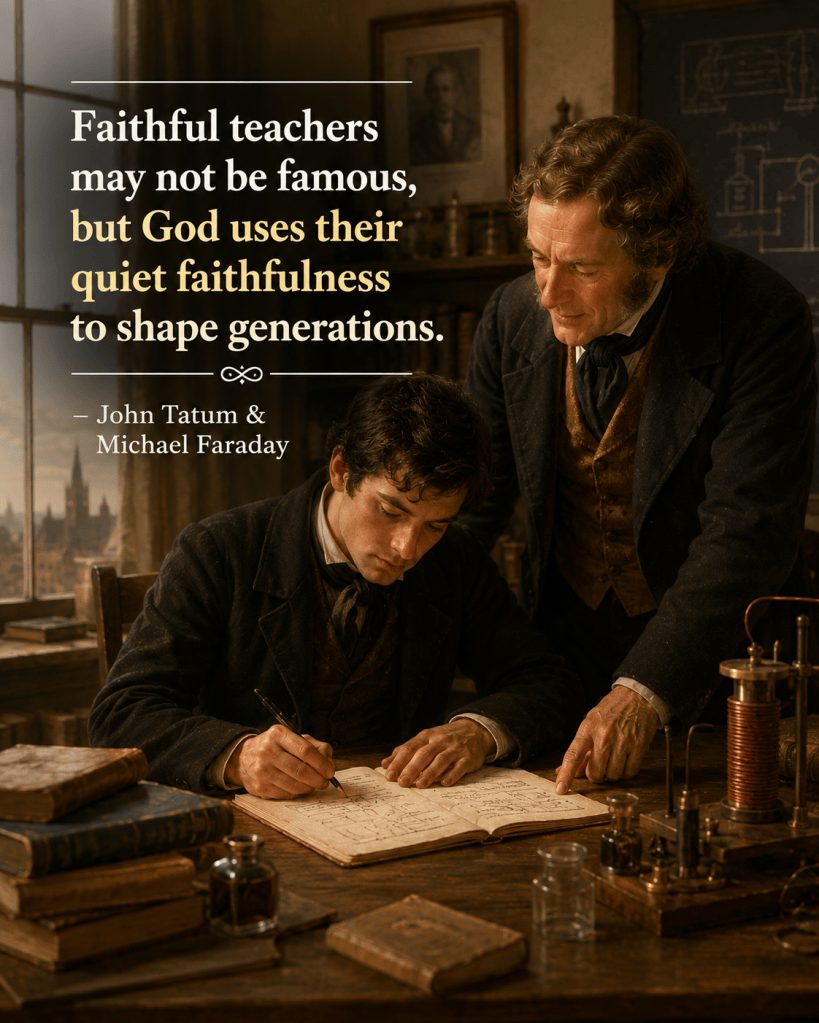
Faraday himself later became known not only for brilliance but also for humility, integrity, and deep Christian faith as a member of the Sandemanian church community.
The influence multiplied across generations.
Electric motors, generators, communication systems, and countless modern technologies emerged partly because one faithful teacher quietly invested in others without demanding recognition.
Like Oholiab, John Tatum understood that supporting roles carry eternal significance.
History often remembers visible leaders while forgetting mentors, trainers, assistants, and faithful encouragers standing behind them. Yet God sees every hidden contribution.
Further reading:
The Royal Institution – Michael Faraday History
🏭 Workplace Lessons for Today
Oholiab’s life speaks powerfully into modern workplaces where teamwork often determines success.
First, supporting roles matter deeply. Healthy organizations depend upon faithful contributors, trainers, coordinators, assistants, technicians, and collaborative workers. Hidden excellence still honors God.
Second, teaching multiplies impact. Skilled professionals should intentionally mentor younger workers rather than competing selfishly. Knowledge shared faithfully strengthens future generations.
Third, humility increases influence. Oholiab worked beside Bezalel without insecurity or rivalry. Mature professionals celebrate team success rather than seeking constant recognition.
Fourth, collaboration reflects kingdom values. Modern projects—whether in engineering, healthcare, education, government, manufacturing, or business—require trust, communication, and mutual support.
Fifth, spiritual maturity includes reliability. Workplaces value people who remain dependable under pressure, serve faithfully behind the scenes, and strengthen team culture consistently.
Finally, God sees hidden labor. Many professionals quietly carry heavy responsibilities without public acknowledgment. Scripture reminds us that unseen faithfulness still carries eternal significance.
Professionals who combine skill with humility become stabilizing influences in a fragmented world.
🔥 Spiritual Insight
Oholiab reminds us that the Holy Spirit empowers not only visible leaders but also faithful supporters, teachers, and collaborators.
This challenges modern culture profoundly.
Much of society measures value through titles, influence, followers, or public visibility. Yet God often works most powerfully through humble people serving quietly behind the scenes.
The Gospel itself reflects this pattern.
Before His public ministry, Jesus Christ spent years living in ordinary labor and hidden obedience. Much of His earthly life unfolded outside public recognition.
Likewise, many believers today serve Christ faithfully through unseen work:
• Trainers developing young professionals
• Nurses assisting exhausted medical teams
• Engineers supporting infrastructure safety
• Teachers investing patiently in struggling students
• Administrative staff maintaining order quietly
• Skilled workers strengthening projects faithfully
These roles matter eternally.
Oholiab also teaches that humility and excellence belong together. Supporting others does not diminish calling; it often fulfills it.
The kingdom of God advances through people willing to serve faithfully without demanding applause.
At the cross, Christ Himself demonstrated servant-hearted greatness. Because of Him, hidden faithfulness is never wasted.
God remembers every act of faithful service done for His glory.
🤔 Reflection Questions
1. Am I serving faithfully even when recognition is limited?
2. How can I use my skills to strengthen and mentor others?
3. Does my workplace attitude reflect humility, teamwork, and Christlike service?
🙏 Prayer
Lord, teach me to serve faithfully whether seen or unseen. Fill my work with wisdom, humility, patience, and excellence. Help me strengthen others through encouragement, teaching, and integrity. Protect my heart from pride and comparison. Let my daily work reflect the servant-hearted character of Christ and bring glory to Your name. Amen.


Leave a comment