
📖 ✝️ Scripture Reading: John 21:15–19
“God loves each of us as if there were only one of us.”
— Augustine of Hippo
💒 🕊️ ✨ Context (Story) :
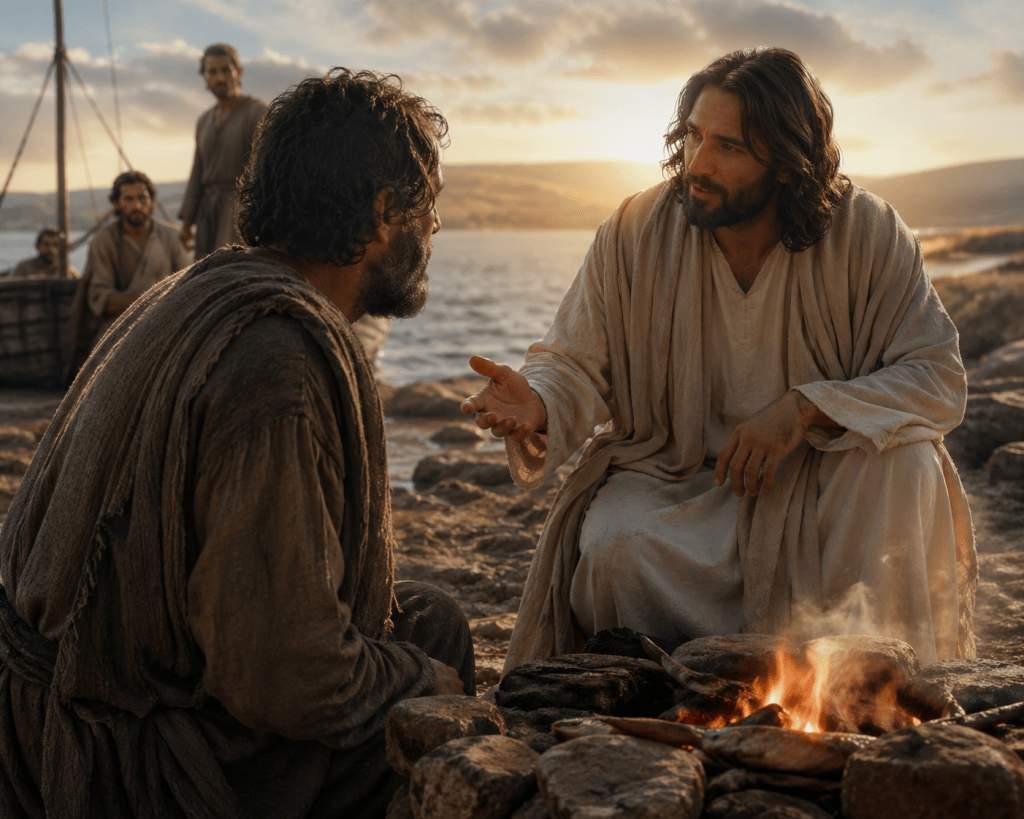
The morning air carries the scent of salt and smoke. A charcoal fire crackles on the shore of the Sea of Galilee. The risen Jesus stands among His disciples—alive, yet bearing the memory of the cross. The shadow of Roman rule still looms over the land. Israel’s hopes for a political Messiah remain unsettled. But here, in this quiet moment, a deeper kingdom is being revealed.
Peter sits near the fire. His heart is heavier than the nets he once carried. Not long ago, in the courtyard of the high priest, beside another charcoal fire, he denied Jesus three times. Fear overcame devotion. Shame replaced boldness.
Now Jesus speaks—not to the crowd, not to the group—but directly to him:
“Simon, son of John, do you love me more than these?”
The question is piercing. It reaches past Peter’s past confidence—“more than these”—a reminder of his earlier claim that he would remain faithful above all others.
The Greek text opens a window into the depth of this moment. Jesus asks using “ἀγαπᾷς” (agapas)—a word often associated with sacrificial, total love. Peter answers with “φιλῶ” (philo)—a word expressing affection, friendship, loyalty.
But this is not mere vocabulary—it is a mirror of Peter’s soul.
Once, Peter spoke boldly beyond his capacity. Now, he answers carefully, honestly:
“Yes, Lord; you know that I love you.”
Again the question comes. Again the same response. Then a third time—echoing the rhythm of his denials.
But something shifts.
The third time, Jesus uses Peter’s word—“φιλεῖς” (phileis).
It is as though Jesus steps into Peter’s honesty, meeting him not at the level of ideal love, but at the level of truthful love. The question now reaches even deeper:
“Peter, is your love—however imperfect—real?”
Peter is grieved. Not simply because of repetition, but because Jesus is uncovering the depth of his heart. No more self-confidence. No more comparisons. Only this:
“Lord, you know all things; you know that I love you.”
And Jesus responds—not with rebuke, but with calling:
“Feed my lambs.”
“Tend my sheep.”
“Feed my sheep.”
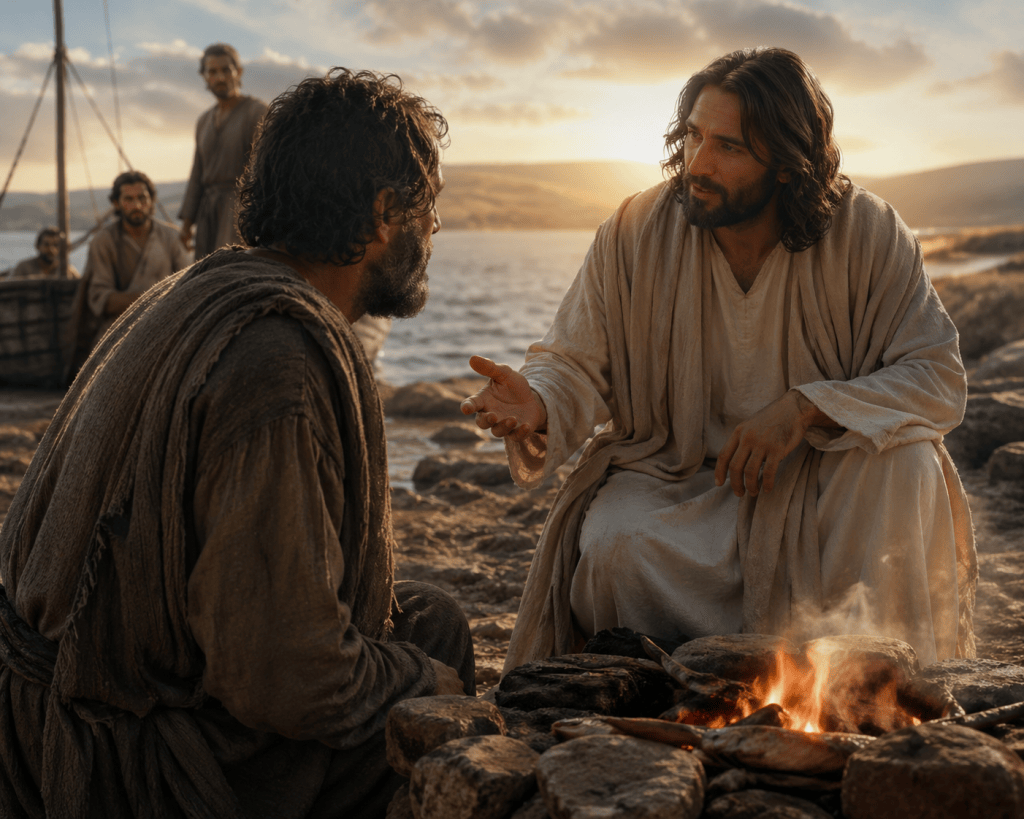
Under Roman oppression, shepherd imagery held deep resonance. Israel longed for faithful shepherds (Ezekiel 34), and God Himself had promised to shepherd His people. Now Jesus, the Good Shepherd, entrusts His flock to a once-failing disciple.
This moment fits beautifully within the Gospel narrative. After the resurrection, before the Ascension, Jesus is not merely proving He is alive—He is restoring mission. Failure does not cancel calling.
Then comes a sobering word: Peter’s future will include suffering. Love will cost him his life. Yet the final command remains unchanged:
“Follow me.”
🤔 🪞 💡 Reflection Thought:
At the center of this passage is not Peter’s failure—but Jesus’ question.

“Do you love Me?”

This is the most searching question in all of discipleship.

Jesus does not ask:
	•	“Are you strong enough?”
	•	“Are you faithful enough?”
	•	“Are you qualified enough?”

He asks about love.

Because love is the root of everything in the kingdom of God.

Peter’s answers reveal a transformed heart. Gone is the man who once overestimated himself. In his place stands a disciple who knows his weakness. His phileo is not lesser in sincerity—it is deeper in truth.

This reveals something profound about Christ’s character. Jesus does not demand exaggerated devotion. He invites honest love. He meets us where we truly are—not where we pretend to be.

Theologically, this passage shows that:
	•	Grace restores before it commissions
	•	Calling flows from relationship
	•	Love for Christ is the foundation of ministry

There is also a beautiful movement here: Jesus begins with agape, but ends with phileo. Not because the standard is lowered—but because God meets us in reality to raise us into transformation.

Peter’s love will grow. The same man who hesitated here will later stand boldly in Acts, preach fearlessly, and ultimately give his life under Roman persecution. This is the journey from broken love to sacrificial love.

And it begins with one honest answer.
🎬🔛 Historical True Event :
From Failure to Faithfulness: Thomas Cranmer’s Final Stand (England, 1556)
In 1556, during the reign of Queen Mary I of England, Thomas Cranmer faced intense persecution for his Protestant faith.
Under pressure, imprisonment, and the threat of death, Cranmer did the unthinkable—he signed documents recanting his beliefs. Fear overtook conviction. Like Peter by the fire, he faltered under pressure.
But something changed.
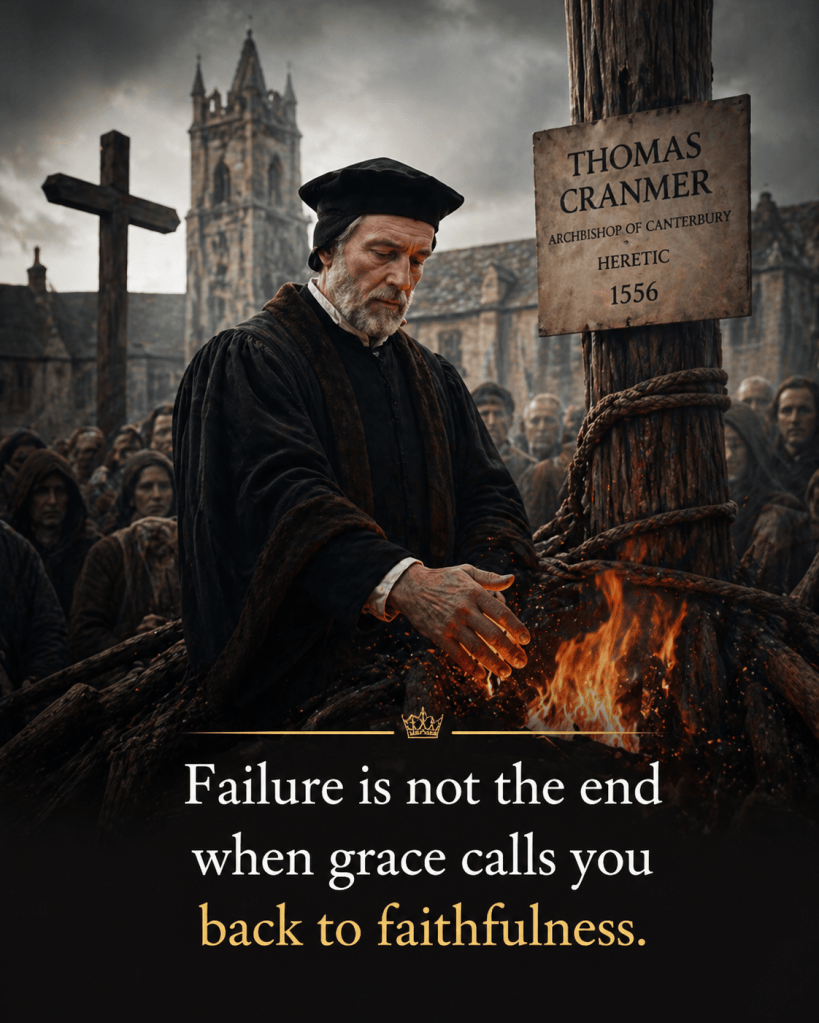
On the day of his execution in Oxford, standing before a crowd, Cranmer shocked everyone. He publicly renounced his recantations, declaring that his earlier denials were wrong. Then he said:
“This hand hath offended.”
As he was led to the stake, he placed his right hand—the one that had signed the recantation—into the flames first, holding it there as an act of repentance. He chose suffering over denial. Love for Christ had overcome fear.
Cranmer died that day, not as a coward—but as a restored witness.
Like Peter, he failed.
Like Peter, he was restored.
Like Peter, he followed Christ—even unto death.
🔗 Source :
https://www.britannica.com/biography/Thomas-Cranmer
⚒️🎯 Personal Application:
We often try to present a stronger version of ourselves before God—more faithful, more devoted, more consistent than we truly are. But Jesus does not ask for performance; He asks for truth. Today, His question comes to us personally: Do you love Me? Not perfectly, not impressively—but genuinely. When we respond with honest hearts, even in weakness, He restores us and calls us forward. Our past failures do not disqualify us; they become the very place where His grace begins to rebuild our calling.
🙏 🕯️ Prayer:
Lord Jesus,
You see beyond our words into our hearts.
Teach us to love You honestly and deeply.
Restore us where we have failed.
And give us courage to follow You, whatever the cost.
Amen.


Leave a comment