
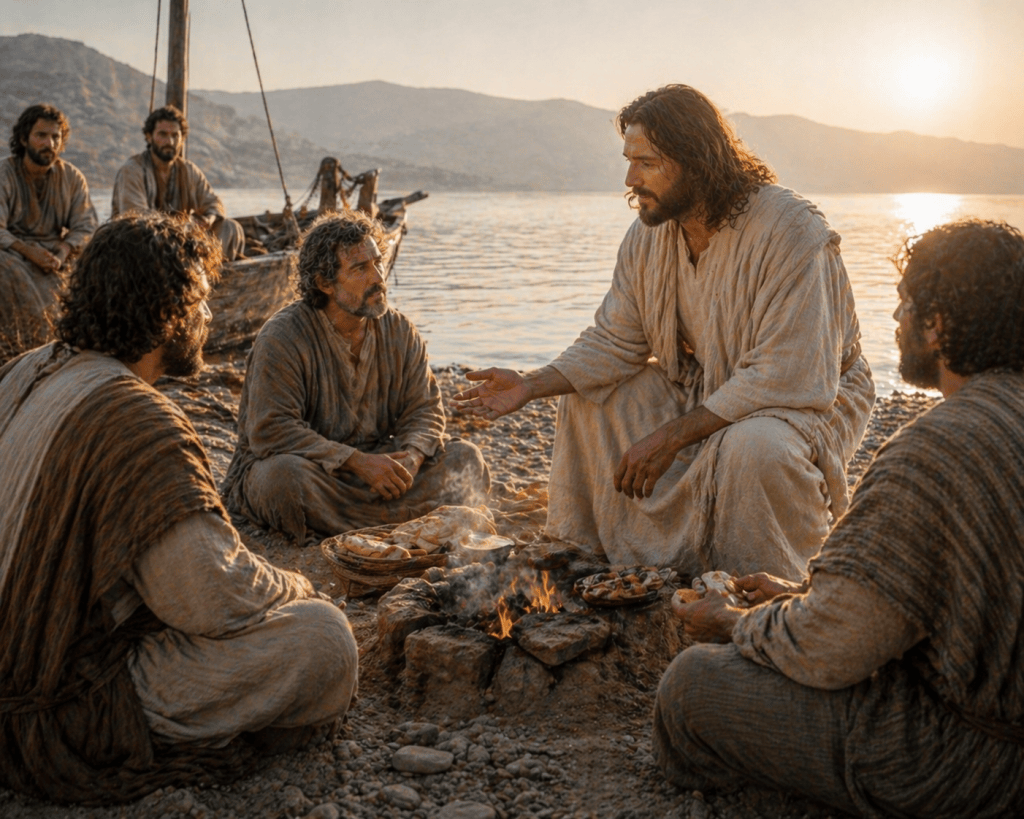
📖 ✝️ Scripture Reading:John 21:1–14
“The risen Christ comes to us not to condemn, but to restore.”
— F. F. Bruce
💒 🕊️ ✨ Context (Story) :
The echoes of the cross still linger. The disciples have seen the empty tomb, heard the reports, even encountered the risen Christ—yet something within them remains unsettled.
They return to Galilee.
Not with clarity, but with confusion.
Simon Peter, carrying the silent weight of his denial, says, “I go fishing.” It sounds simple, but it reveals something deeper—a retreat to the familiar after failure.
The others follow.
All night they labor on the Sea of Galilee. Nets cast. Pulled. Cast again. But the waters give nothing. Their effort produces emptiness.
This is more than a failed night of fishing—it mirrors their inner condition.
At dawn, a figure stands on the shore. The light is soft, the distance enough to conceal identity.
“Children, have you any meat?”
They answer honestly: “No.”
Then comes a command that seems ordinary but carries divine authority:
“Cast the net on the right side of the ship, and ye shall find.”
They obey.
Suddenly, the net fills beyond expectation. The Greek word “πλῆθος (plēthos)” suggests overwhelming abundance—grace beyond human effort.
Recognition breaks through.
“It is the Lord.”
John sees. Peter responds. Without hesitation, Peter throws himself into the sea. The same man who once stepped out in bold faith now rushes again—not to prove himself, but to be near Jesus.
On the shore, something deeply intentional awaits.
A charcoal fire.
Fish placed upon it. Bread ready.
The Greek word “ἀνθρακία (anthrakia)” appears only twice in the Gospel—here and at Peter’s denial. Jesus recreates the setting of failure.
Not to reopen wounds—but to redeem them.
In the broader literary context, this passage follows the miraculous catch of fish, echoing Luke 5—the moment Peter was first called. It is as though Jesus is re-writing Peter’s story, bringing him back to the beginning—but with deeper grace.
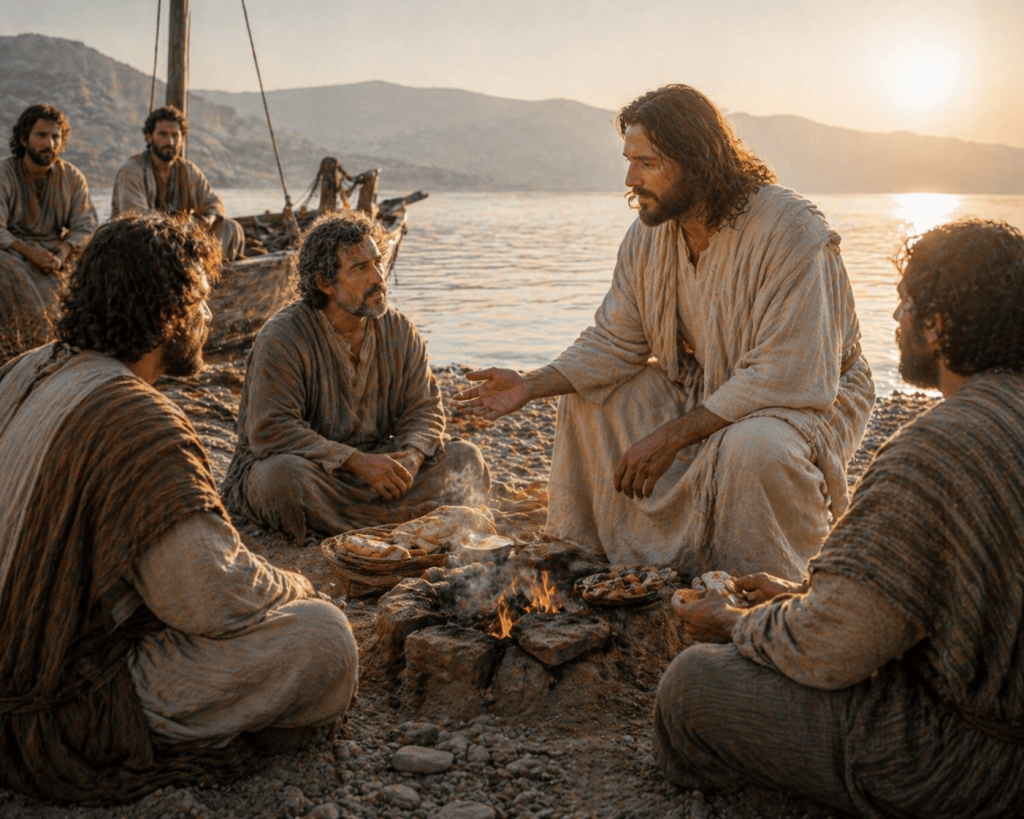
“Bring of the fish which ye have now caught.”
They bring the catch—153 fish—yet the net remains unbroken. A quiet symbol of divine provision and unity.
Then Jesus invites them:
“Come and dine.”
No rebuke.
No shame.
Only grace.
The risen Lord prepares a meal for those who failed Him.
Before Peter is recommissioned, he is restored.
🤔 🪞 💡 Reflection Thought:
This moment reveals the heart of Christ more clearly than words ever could.

Jesus does not begin with correction—He begins with connection.

Peter’s failure was real. Public. Painful. Yet Jesus meets him not with accusation, but with presence. The same environment of denial becomes the environment of restoration.

This is the Gospel in action.

Grace does not ignore failure—it transforms it.

The abundance of fish reminds us that fruitfulness is never the result of our striving alone. It flows from obedience to Christ’s voice. Apart from Him, even our best efforts remain empty.

Canonically, this reflects God’s consistent pattern—He restores broken vessels for His purpose. From David to Peter, from weakness to calling—God redeems what seems unusable.

Theologically, this passage reveals a Savior who is both sovereign and compassionate. The risen King still serves. He prepares, invites, and restores.

Even after the resurrection, Jesus is not distant—He is deeply personal.

He does not just forgive us—He restores us to fellowship and purpose.
🎬🔛 Historical True Event :
From Brokenness to Restoration – Brian Welch (USA, 2005–Present)
In the early 2000s, Brian Welch was a lead guitarist in the internationally known band Korn. Fame, wealth, and influence surrounded him—but inwardly, his life was falling apart.
He struggled with severe drug addiction, emotional emptiness, and the heavy responsibility of raising his young daughter. What appeared successful from the outside was deeply broken within.
At his lowest point, Brian cried out to God.
It was not a formal prayer—just a desperate plea for change, for freedom, for help.
In that moment of surrender, he experienced the presence of Christ in a real and personal way. His heart began to change. The addictions that once controlled him slowly began to lose their grip.
He made a radical decision—to leave his band at the height of success to follow Christ and rebuild his life.
Restoration was not instant.

There were struggles, challenges, and difficult transitions. But over time, God restored his heart, his identity, and his purpose. He became a committed follower of Christ, a devoted father, and a witness to those who feel trapped in brokenness.
Like Peter by the sea, Brian encountered Jesus not when everything was right—but when everything was falling apart.
And that encounter became the beginning of restoration.
🔗 Source :
https://www.iamsecond.com/seconds/brian-welch/
⚒️🎯 Personal Application:
We often carry silent failures like Peter. We return to old habits, avoid deeper surrender, or feel unworthy to come close to Jesus again. But this passage reminds us that Jesus meets us exactly where we are. He calls us back not with condemnation, but with invitation. When we obey His voice, even in small steps, He brings fruit where there was emptiness. Our past does not disqualify us—when surrendered to Christ, it becomes the very place where restoration begins.
🙏 🕯️ Prayer:
Lord Jesus,
Thank You for meeting us in our brokenness.
Restore our hearts and draw us close again.
Teach us to trust Your voice and walk in obedience.
Amen.


Leave a comment