
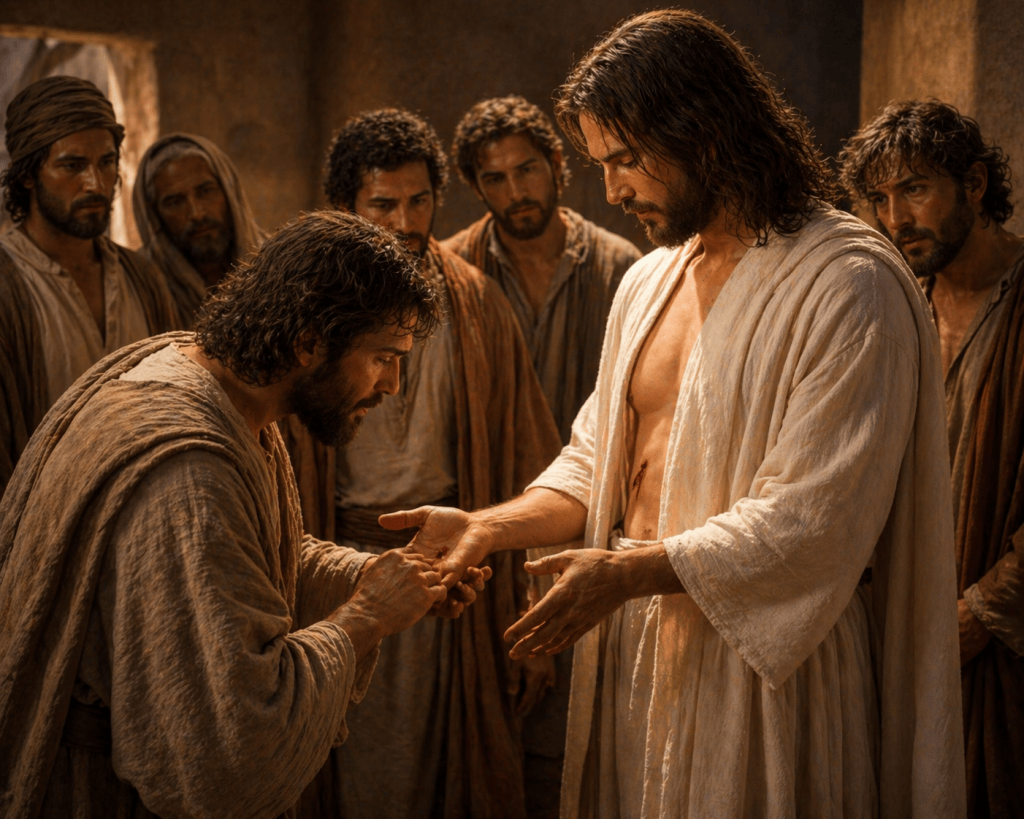
📖 ✝️ Scripture Reading: John 20:24–29
“Faith is deliberate confidence in the character of God whose ways you may not understand.”
— Oswald Chambers
💒 🕊️ ✨ Context (Story) :
The room carries a different atmosphere now—less fear, more wonder—but not complete certainty.
The risen Jesus has already appeared once to the disciples. Their sorrow has begun to turn into joy. But one voice stands outside this shared experience.
Thomas.
He was not there when Jesus first appeared. When the others tell him, “We have seen the Lord,” their words are full of conviction. But Thomas cannot accept it so easily.
The wounds of recent days are still fresh.
Under Roman rule, crucifixion was final and brutal. The man Thomas had followed—the one he believed could redeem Israel—had been publicly executed. His hopes had collapsed under the weight of the cross.
So Thomas responds with a demand:
“Except I shall see in his hands the print of the nails, and put my finger into the print of the nails, and thrust my hand into his side, I will not believe.”
The Greek expression here is striking—“οὐ μὴ πιστεύσω (ou mē pisteusō)”—a strong double negative meaning, “I will certainly not believe.” This is not casual doubt. It is a heart protecting itself from further disappointment.
Eight days pass.
Once again, the disciples are gathered inside, doors shut. This time, Thomas is present.
Suddenly, without any physical entry, Jesus stands among them.
No knock. No movement of doors.
Only divine presence.
“Peace be unto you.”
Then Jesus turns directly to Thomas.
There is no rebuke. No exposure of failure.
Only grace-filled invitation.
“Reach hither thy finger… behold my hands… thrust it into my side: and be not faithless, but believing.”
Jesus repeats Thomas’s own words back to him. This reveals that even in Thomas’s absence, his doubts were known to Christ. The risen Lord sees not only our actions—but our hidden thoughts.
The wounds are still visible.
They are not erased by resurrection. They are glorified. These marks connect to the prophetic suffering servant described in Isaiah 53—wounded for our transgressions, bearing the cost of redemption.
In that moment, Thomas no longer asks for evidence.
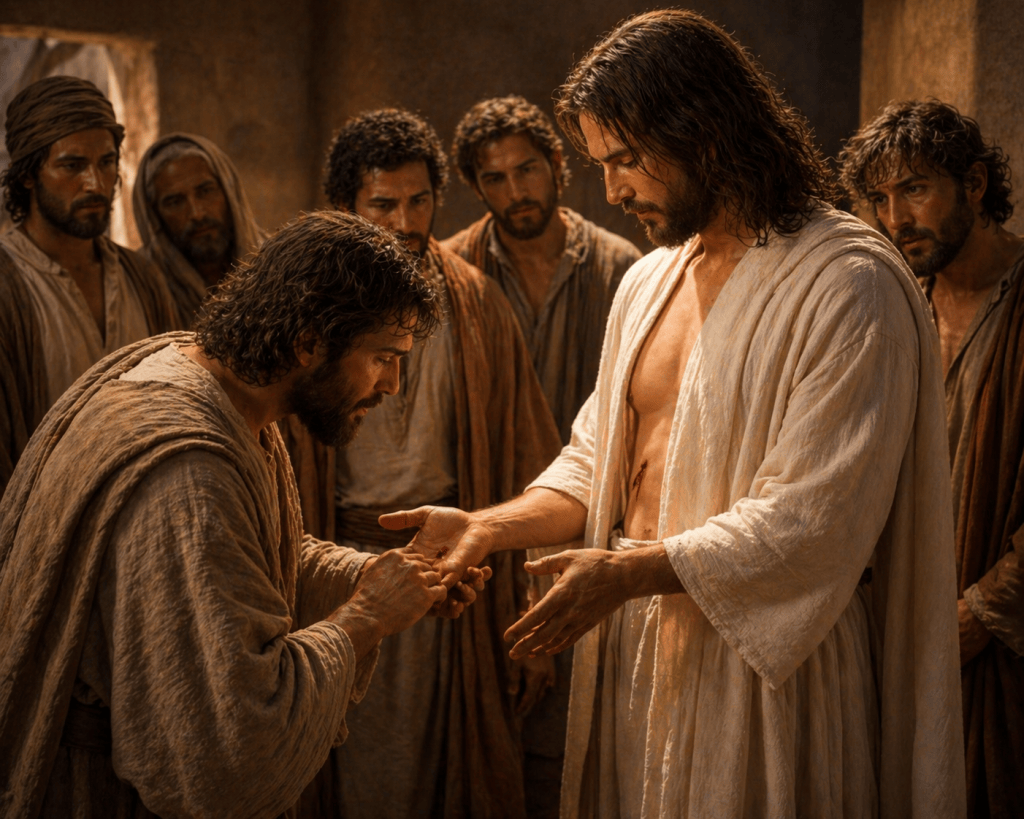
He responds with worship:
“My Lord and my God.”
This is one of the clearest declarations of Jesus’ divinity in all Scripture. The doubter becomes the confessor.
Then Jesus speaks words that extend far beyond that room:
“Thomas, because thou hast seen me, thou hast believed: blessed are they that have not seen, and yet have believed.”
The focus shifts from sight to faith.
From evidence to trust.
From that room—to us.
🤔 🪞 💡 Reflection Thought:
This passage reveals that doubt, when brought to Christ, can become a doorway to deeper faith.

Jesus does not reject Thomas. He meets him personally, addressing his exact struggle. This shows the compassionate nature of Christ—He is not threatened by our questions. He invites us to move from hesitation to trust.

Thomas represents the honest human condition. We desire certainty. We want to see before we believe. When life brings disappointment or confusion, doubt can quietly take root.

But faith is not built on visible proof alone.

The Greek contrast between “ἄπιστος (apistos)”—faithless, and “πιστός (pistos)”—believing, highlights a call to transition. Jesus does not leave Thomas in his doubt—He calls him forward into faith.

Theologically, Thomas’s confession affirms that Jesus is not only risen—He is Lord and God. The resurrection is not merely an event; it is a revelation of divine identity.

Canonically, this moment aligns with the purpose of the Gospel—to lead readers into belief without physical sight. It connects with passages like Hebrews 11:1, where faith is described as assurance of things not seen.

Faith, therefore, is not blind—it is anchored in the trustworthy character of Christ.
🎬🔛 Historical True Event :
Walking by Faith Alone – Lottie Moon in China (1870s–1912)
In the late 19th century, Lottie Moon left the comfort of her home in America to serve as a missionary in China. She stepped into a culture that was unfamiliar, where the Gospel was often resisted and misunderstood.
In the early years, there were no visible results.
She labored faithfully, yet saw little response. Villages remained closed. People were hesitant. At times, she felt isolated and physically exhausted. From a human perspective, her work seemed ineffective.
Questions could have easily filled her heart: Is God truly working here? Is anything changing?
Yet she chose to trust beyond what she could see.
She continued sharing the Gospel, teaching, and serving—believing that God was at work even when there was no immediate evidence. Her faith was rooted not in visible success, but in obedience to God’s call.
Slowly, change began to happen.
Hearts opened. Individuals came to faith. What seemed unseen began to bear fruit over time.
Even during famine and personal hardship, she remained committed. Her life became a testimony of quiet perseverance and unwavering trust.
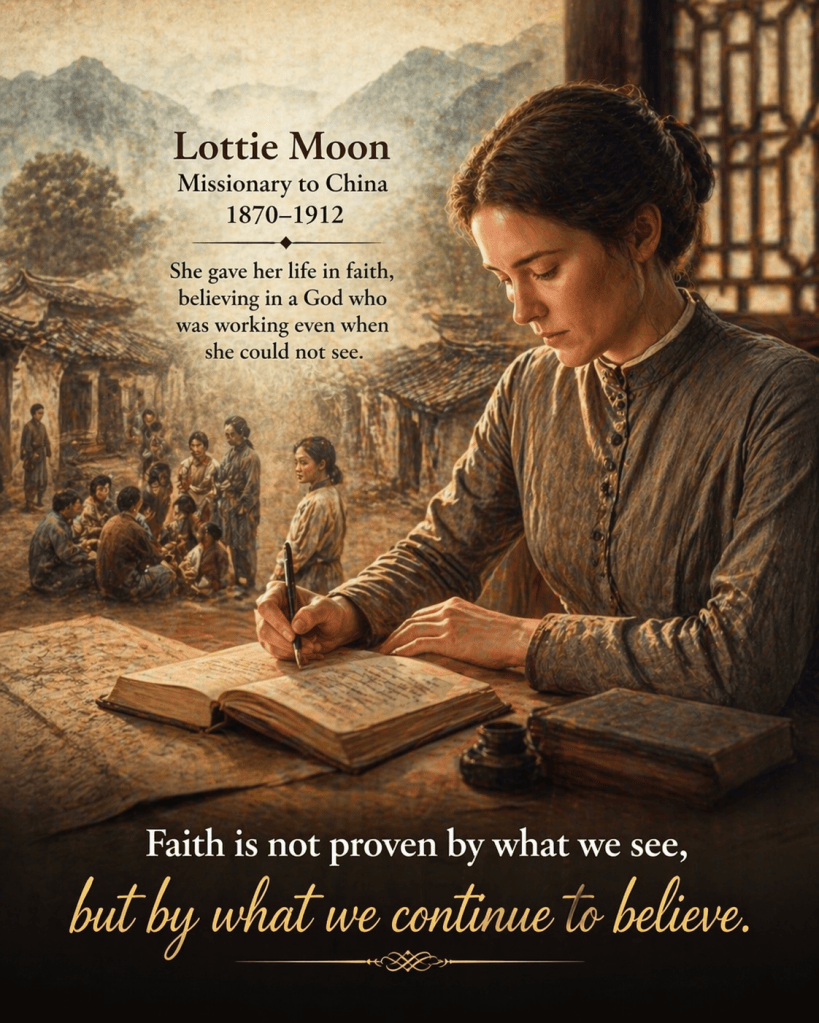
Her story echoes the words of Jesus—blessed are those who believe without seeing.
🔗 Source :
https://www.imb.org/2018/12/03/10-things-you-might-not-know-about-lottie-moon/
⚒️🎯 Personal Application:
We often live like Thomas—wanting clarity before commitment. We may say, “If I see God work, then I will trust Him.” But Jesus calls us to a deeper place. We are invited to believe even when we cannot see. Our situations may not always provide visible proof of God’s work, but His presence is still real. When we bring our doubts honestly before Him, He meets us there. As we choose to trust Him daily, our faith grows—not by sight, but by relationship with Him.
🙏 🕯️ Prayer:
Lord Jesus,
Help us to trust You even when we cannot see.
Strengthen our faith in moments of doubt.
Teach us to walk by faith and not by sight.
Amen.


Leave a comment