
📖 ✝️ Scripture Reading: Matthew 27:57–66
“God is not absent in silence; He is working in ways we cannot see.”
— Elisabeth Elliot
💒 🕊️ ✨ Context (Story) :
Evening falls over Jerusalem, and with it comes an unusual stillness. The chaos of the crucifixion has subsided, but the weight of what has happened hangs heavy in the air. Jesus—the one many hoped would be the Messiah—now hangs lifeless.
Under Roman rule, crucified bodies were often left exposed as a warning. Burial was not a right—it was a privilege rarely granted. Yet, in this moment, an unexpected figure steps forward: Joseph of Arimathea, a wealthy man and a member of the council. Matthew describes him as a disciple of Jesus, though quietly until now.
He goes boldly to Pilate and asks for the body of Jesus.
This is courage in silence. Associating with a crucified man could cost him everything—status, reputation, even safety. Yet love overcomes fear.
Pilate grants the request.
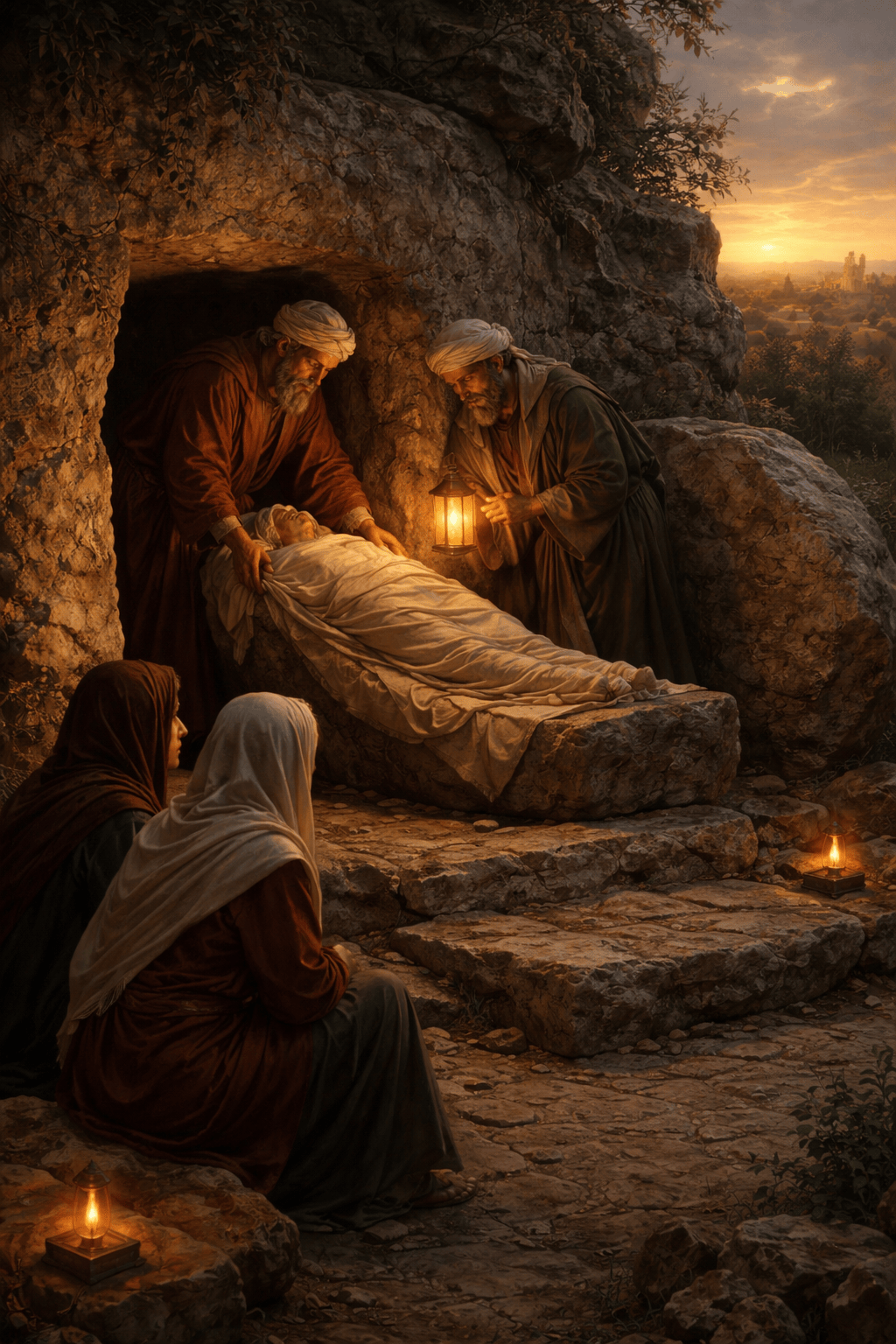
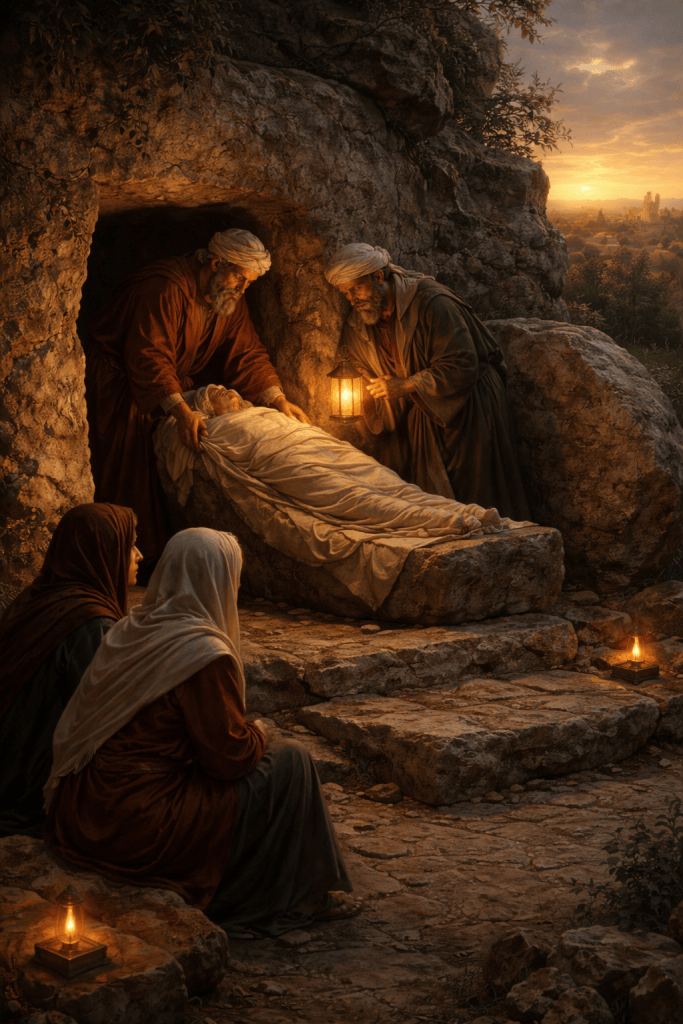
Joseph takes the body, wraps it in a clean linen cloth, and lays it in his own new tomb—cut out of rock. The Greek word used for “laid” is “ethēken” (ἔθηκεν)—a deliberate, careful placement. This is not hurried disposal; this is reverence, honor, and deep love.
A large stone is rolled across the entrance.
Nearby, two women—Mary Magdalene and the other Mary—sit opposite the tomb. They do not speak. They simply watch. Their silence is filled with grief, confusion, and unanswered questions.
This moment fulfills prophecy. Isaiah had written centuries earlier:
“He was with a rich man in His death” (Isaiah 53:9)
What seemed like a tragic end is still under divine orchestration.
But the story does not end there.
The next day, the religious leaders approach Pilate with concern. They remember Jesus’ words—that He would rise again after three days. Ironically, those who opposed Him remember His promise more clearly than His followers.
They request security.
A guard is posted. The tomb is sealed.
The Greek word for “sealed” is “sphragizō” (σφραγίζω)—to secure, to authenticate, to prevent tampering. Rome’s authority stands against any possibility of resurrection.
A stone. A seal. Soldiers.
Everything declares: This is final. This is over.
And yet—this is only the silence before resurrection.
🤔 🪞 💡 Reflection Thought:
This passage invites us into one of the most overlooked yet deeply meaningful moments in the Gospel—the silence of the tomb.

Here, we see a Savior who has truly died. There is no illusion, no escape. Jesus enters fully into death, bearing the weight of sin completely. Theologically, this affirms the completeness of His sacrifice. The cross was not partial—it was final.

And yet, the silence of the tomb creates tension.

From a human perspective, everything appears lost. The disciples are scattered. Hope seems buried. The kingdom they anticipated looks defeated. This is the space between promise and fulfillment—the place where faith is tested.

Joseph’s act reveals something profound about discipleship. While others hide, he steps forward. Quiet faith becomes bold obedience. True devotion often shines brightest when everything else grows dark.

The sealed tomb represents humanity’s attempt to contain God. The religious leaders, in fear and control, try to secure the situation. But no human authority can restrain divine power.

Canonically, this moment stands between the suffering of the cross and the victory of the resurrection. It echoes the pattern seen throughout Scripture—God often works in hiddenness before revealing glory. Just as creation began in darkness before light, resurrection begins in silence before triumph.

This is the mystery of God’s kingdom:
What appears like defeat is often the very ground of victory.
🎬🔛 Historical True Event :
Faith in the Dark: Corrie ten Boom in Ravensbrück (Germany, 1944)
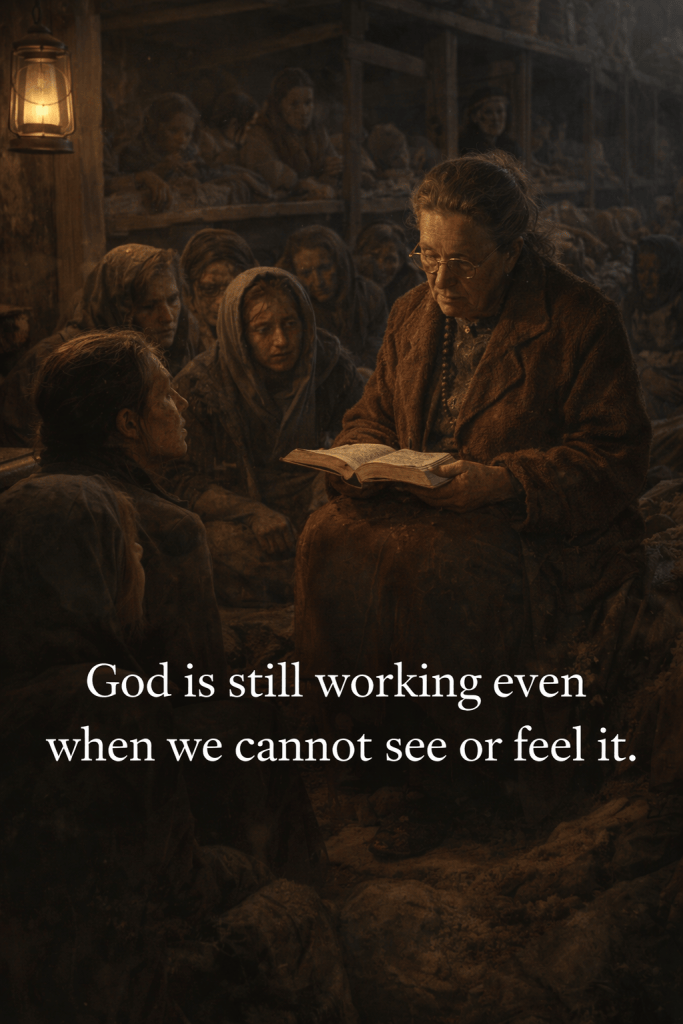
During World War II, Corrie ten Boom, a Dutch Christian, was imprisoned in the Ravensbrück concentration camp for helping Jews escape the Nazis. Along with her sister Betsie, she endured unimaginable suffering—overcrowded barracks, disease, and cruelty.
In the darkness of that camp, it seemed as though God was silent.
There were moments when hope felt buried—just like the sealed tomb of Christ. Betsie eventually died in the camp, leaving Corrie alone in grief and confusion.
Yet even in that silence, something unseen was happening.
Corrie later discovered that a small Bible she had managed to smuggle into the camp had become a source of hope—not just for her, but for many prisoners. They secretly held Bible studies, and countless women found faith in Christ during those hidden moments.
After the war, Corrie was released due to a clerical error—just days before all women her age were executed.
Looking back, she realized:
God was never absent in the silence—He was working in ways she could not see.
Her life became a testimony of forgiveness, hope, and trust in God’s unseen work.
🔗 Source :
https://www.corrietenboom.com/en/information/the-story-of-corrie-ten-boom/
⚒️🎯 Personal Application:
There are seasons in our lives that feel like this tomb—silent, uncertain, and heavy with unanswered prayers. We may not see God moving, and hope may feel buried beneath disappointment. But this passage reminds us that silence does not mean absence. Even when nothing seems to be happening, God is still working behind the stone. Let us learn to trust Him not only in moments of visible breakthrough but also in seasons of quiet waiting. Our faith is not based on what we see, but on who He is.
🙏 🕯️ Prayer:
Lord,
In moments when everything feels silent and uncertain, help us to trust You.
Teach us to believe that You are working even when we cannot see it.
Strengthen our faith in the waiting and fill our hearts with hope.
Amen.


Leave a comment