
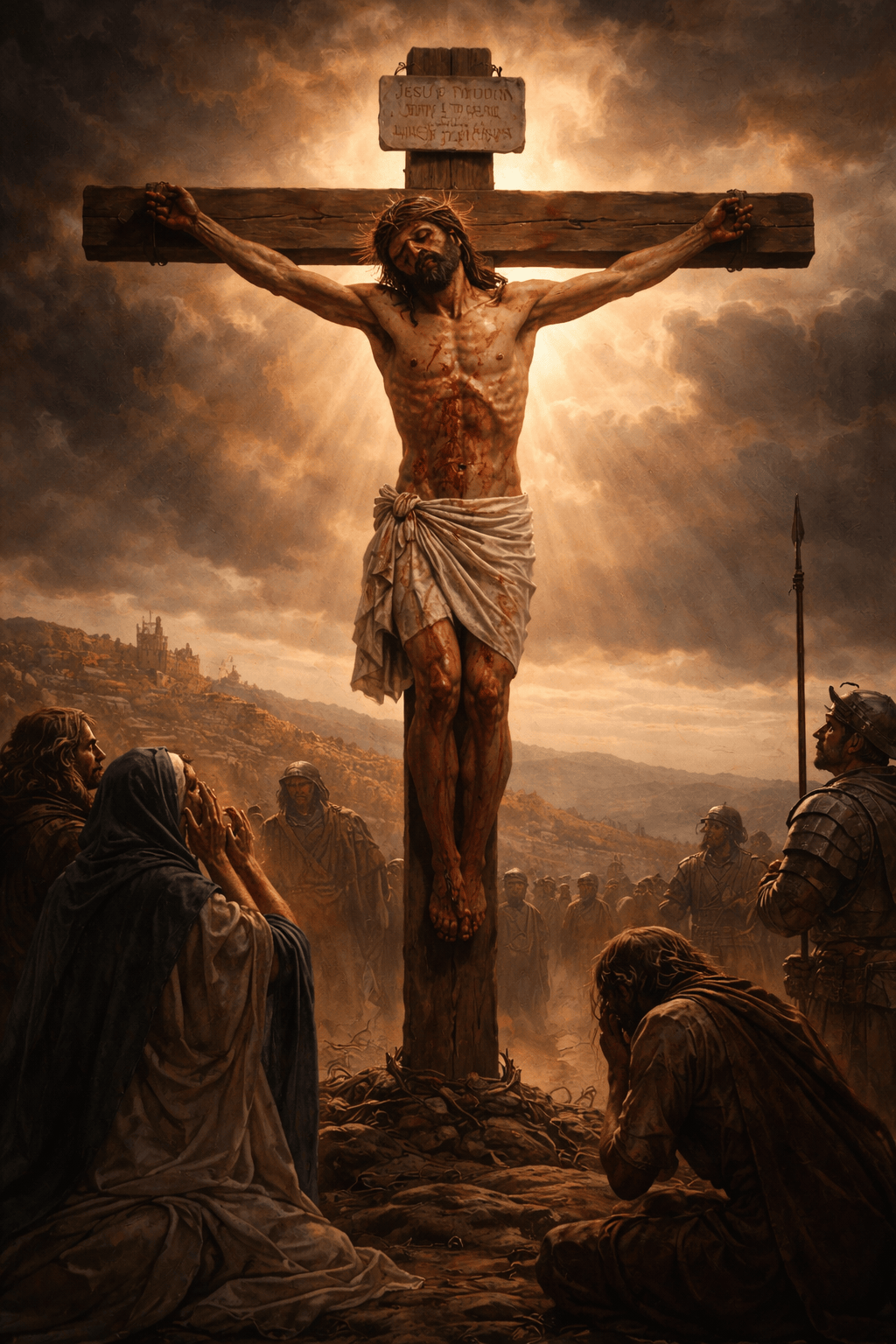
📖 ✝️ Scripture Reading: John 19:28–30
“Upon a life I did not live, upon a death I did not die, I stake my whole eternity.”
— Horatius Bonar
💒 🕊️ ✨ Context (Story) :
The hill of Golgotha stands silent under a darkening sky. The journey that began with shouts of “Hosanna” on Palm Sunday has now reached its final, agonizing moment. Rome’s power is on full display—crucifixion, the empire’s most brutal instrument of control, is meant to crush both body and hope.
Jesus hangs on the cross, His body torn, His strength nearly gone. The crowd has thinned, but the weight of the moment has not. Religious leaders have already mocked Him. Soldiers have fulfilled their duty. The world watches, unaware that eternity is being rewritten.
John’s Gospel brings us into a deeply intentional moment. “After this, Jesus, knowing that all things were now accomplished…” Nothing here is accidental. The suffering is not chaos—it is divine purpose unfolding.
Jesus says, “I thirst.”
This simple statement carries profound depth. Physically, it reflects the reality of crucifixion—extreme dehydration and suffering. But it also fulfills Scripture, echoing Psalm 69:21: “In my thirst they gave me vinegar to drink.” A sponge soaked in sour wine is lifted to His lips. Even in His final breaths, prophecy is being fulfilled with precision.
Then comes the climactic declaration.
“When Jesus therefore had received the vinegar, He said, ‘It is finished.’”
The Greek word used here is “tetelestai” (τετέλεσται). This word is rich with meaning. It was used in business to signify “paid in full,” in legal contexts to indicate a completed sentence, and in religious settings to describe a fulfilled sacrifice.
Jesus does not say, “I am finished.” He says, “It is finished.”
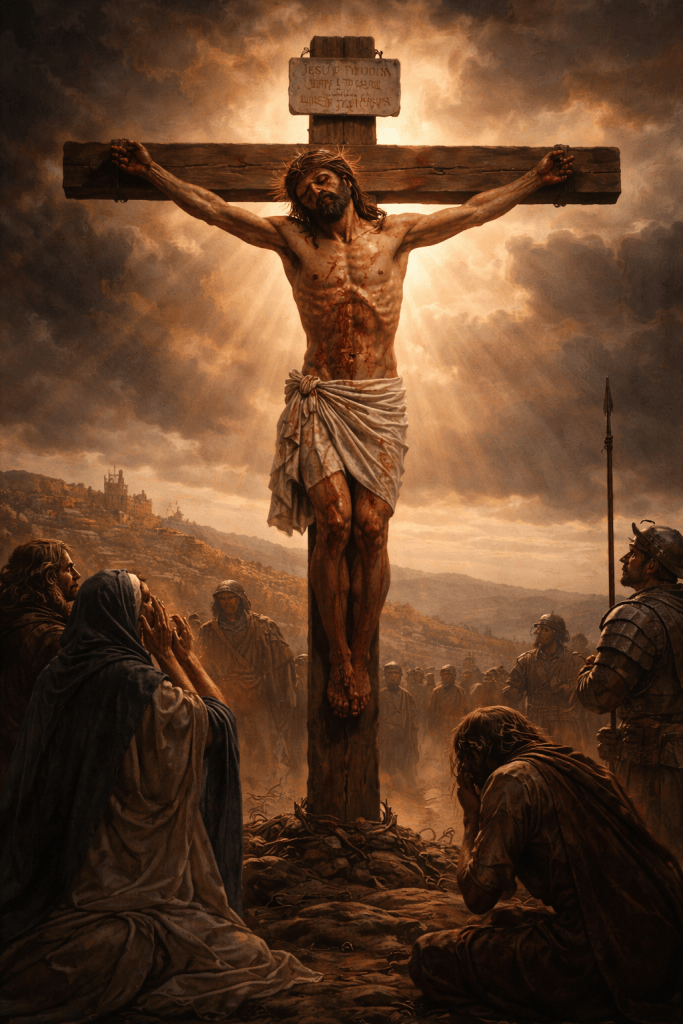
The mission given by the Father is complete. The debt of sin is fully paid. The sacrificial system, with its endless offerings, finds its fulfillment in this one perfect act. As foretold in Isaiah 53, the suffering servant has borne the iniquities of many.
Then, in a final act of sovereign surrender, “He bowed His head and gave up His spirit.”
Notice the order—He bows His head before He gives up His spirit. This is not defeat; this is authority. No one takes His life from Him. As He declared earlier in John 10:18, He lays it down willingly.
The King completes His work—not with a cry of despair, but with a declaration of victory.
🤔 🪞 💡 Reflection Thought:
The words “It is finished” stand as one of the most powerful declarations in all of Scripture. In them, we see the fullness of Christ’s mission and the depth of God’s love.

At the cross, the character of Christ is revealed in its purest form—obedient, sacrificial, and sovereign. He endures suffering not as a victim, but as a willing Redeemer. His obedience is complete, fulfilling the will of the Father perfectly.

Human response to Jesus, however, remains divided. Some see only a dying man. Others, by faith, see the Lamb of God taking away the sin of the world. The difference lies not in what is visible, but in what is believed.

Spiritually, this moment exposes both blindness and revelation. To the natural eye, the cross is weakness. To the eyes of faith, it is the power of God unto salvation.

Theologically, tetelestai proclaims the doctrine of atonement. Sin’s penalty has been fully satisfied. There is nothing left for humanity to add. Hebrews 10:12 affirms this: “But this man, after he had offered one sacrifice for sins forever, sat down on the right hand of God.”

This is the end of striving for acceptance. The end of trying to earn God’s favor. The end of carrying the burden of guilt alone.

The cross also redefines kingship. Jesus reigns through sacrifice. His crown is not gold but thorns. His throne is not elevated but lifted on wood. Yet through this, He establishes an eternal kingdom.

In the Gospel narrative, John emphasizes fulfillment—every detail aligns with God’s redemptive plan. Nothing is wasted. Nothing is случай. Everything leads to this moment where redemption is completed.
🎬🔛 Historical True Event :
The Burden Lifted: Martin Luther’s Breakthrough (Wittenberg, 1519)
In the early 1500s, Martin Luther, a German monk, lived under a crushing weight of guilt. Despite his deep devotion, fasting, and endless confessions, he could not find peace with God. He feared judgment and felt that no amount of effort could make him righteous.
While studying the book of Romans in Wittenberg around 1519, Luther encountered a truth that changed everything: “The just shall live by faith” (Romans 1:17).
For years, he had believed that righteousness was something to be achieved. But through Scripture, he realized it was something to be received—a gift of grace through faith in Christ.
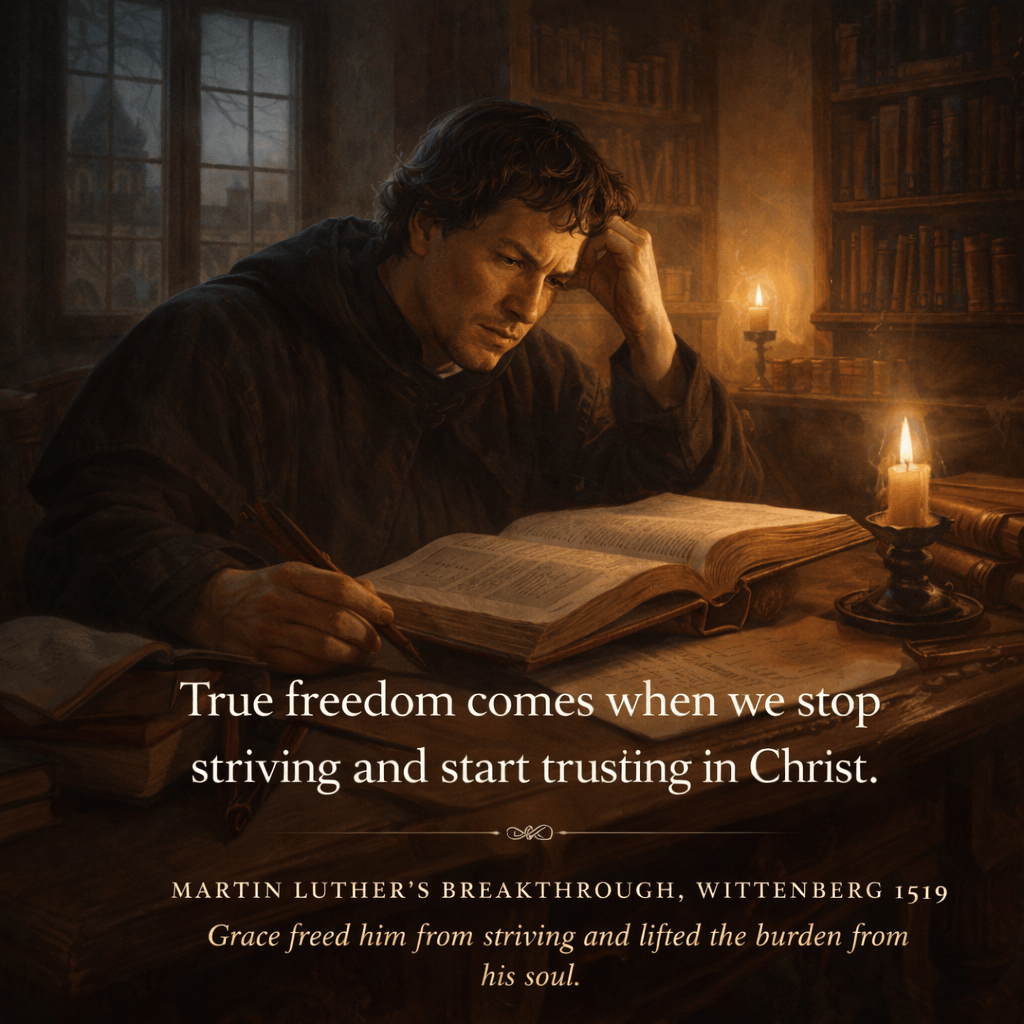
In that moment, Luther understood what Christ meant when He said, “It is finished.” Salvation was not his work to complete—it was Christ’s work already accomplished.
He later described it as if “the gates of paradise had been opened.” The burden of striving was lifted. His life was transformed, and this revelation would ignite the Protestant Reformation, bringing the message of grace back to the center of Christian faith.
🔗 Source :
https://www.ligonier.org/learn/articles/martin-luther-and-justification-by-faith-alone
⚒️🎯 Personal Application:
These words call us to rest in what Christ has already accomplished. Too often, we live as though something is still unfinished—as though we must earn forgiveness or prove our worth. But the cross declares otherwise. It is finished. Today, we are invited to lay down our striving, confess our sin, and trust fully in the completed work of Jesus. Let us live not in fear or guilt, but in the freedom of grace, knowing that our salvation rests entirely in Him.
🙏 🕯️ Prayer:
Lord Jesus,
Thank You for completing the work of salvation on the cross.
Forgive us for trying to earn what You have already given.
Teach us to rest in Your finished work and walk in Your grace.
Help us to trust You fully, now and always.
Amen.


Leave a comment