
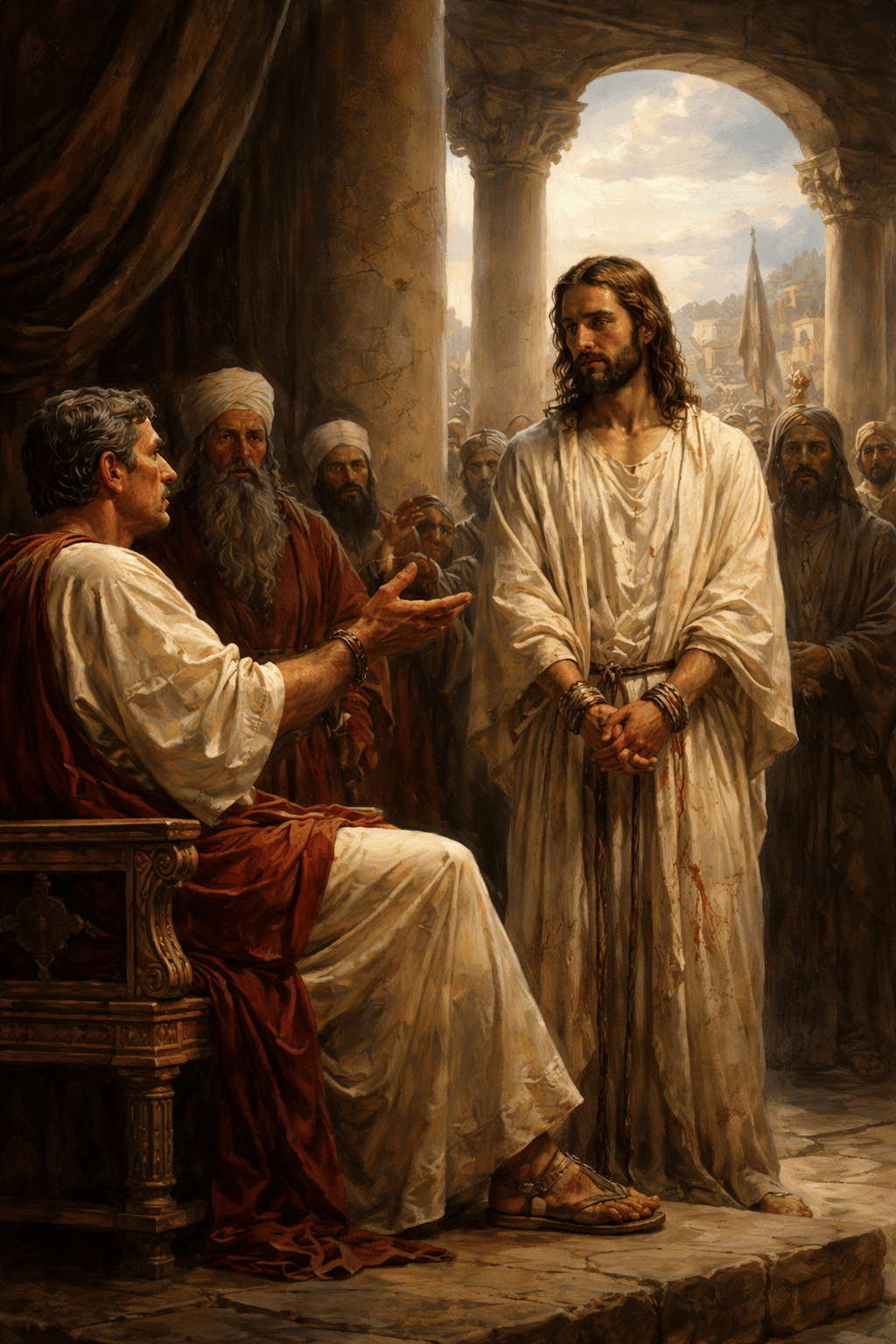
📖 ✝️ Scripture Reading: John 18:33–40
“Truth is not determined by majority vote.”
— R.C. Sproul
💒 🕊️ ✨ Context (Story) :
The night air in Jerusalem is tense. The religious leaders have already condemned Jesus in their own council, but under Roman rule, they lack the authority to execute Him. So they bring Him to the Roman governor—Pontius Pilate.
Inside the Praetorium, a stark contrast unfolds. The Jewish leaders remain outside to avoid ceremonial defilement before Passover, yet they are plotting the death of the true Passover Lamb.
Pilate summons Jesus. The question is direct, political, and loaded:
“Are you the King of the Jews?”
This is no small accusation. Under Roman law, claiming kingship could be seen as rebellion against Caesar. The Roman Empire tolerated many religions, but not rival kings.
Jesus responds with a question that pierces deeper than politics:
“Do you say this of your own accord, or did others say it to you about me?”
Here, the Greek emphasis on “of your own accord” (ἀφ’ ἑαυτοῦ) exposes the heart. Pilate is not seeking truth—he is navigating pressure.
Pilate, almost irritated, distances himself:
“Am I a Jew? Your own nation… have delivered you over to me.”
Then Jesus speaks words that redefine kingship forever:
“My kingdom is not of this world.”
The phrase “not of this world” (οὐκ ἔστιν ἐκ τοῦ κόσμου τούτου) does not mean His kingdom has no presence here—but that its origin, authority, and nature are divine, not earthly.
If His kingdom were earthly, His servants would fight. But instead of swords, there is surrender. Instead of resistance, there is sacrifice.
Pilate presses further:
“So you are a king?”
Jesus answers with profound clarity:
“You say that I am a king. For this purpose I was born… to bear witness to the truth.”
Here lies the mission of Christ—truth. Not just speaking truth, but embodying it. As declared earlier in John’s Gospel, He is “the way, the truth, and the life.”
Pilate’s famous response echoes through history:
“What is truth?”
This is not a sincere question—it is the sigh of a cynical man trapped between truth and convenience.
Outside, the crowd grows restless. Pilate, finding no guilt in Jesus, offers a choice: release Jesus or Barabbas—a known rebel.
The irony is staggering.
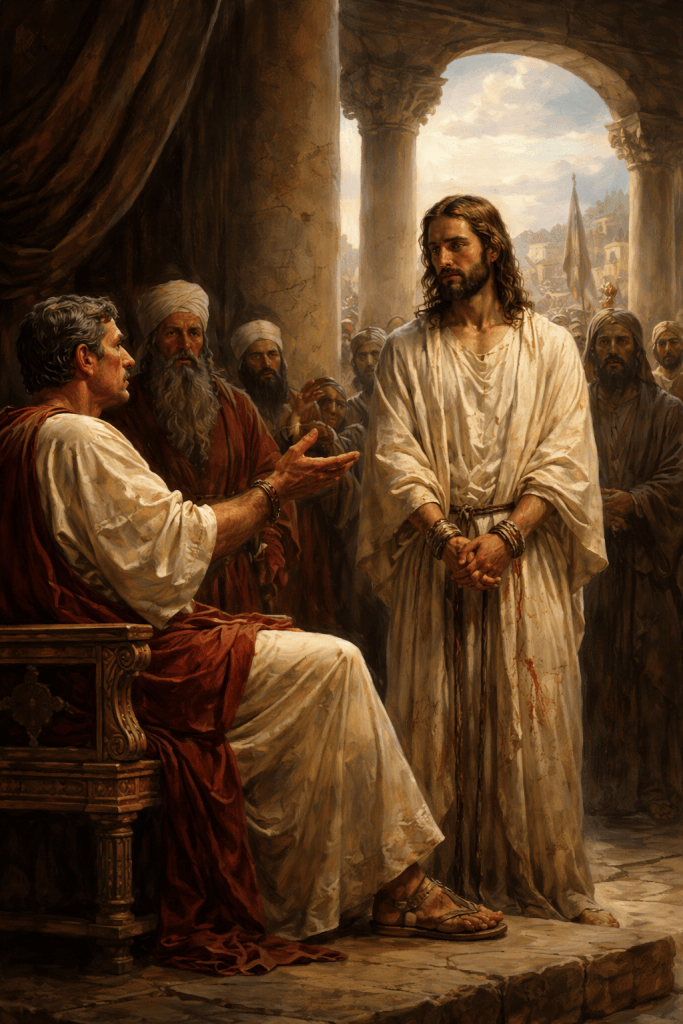
They reject the true King and choose a criminal.
They deny truth and embrace violence.
They stand before the Light—and choose darkness.
This moment fulfills the prophecy of Isaiah 53, where the suffering servant is “despised and rejected by men.”
The King stands trial—but in reality, humanity is on trial.
🤔 🪞 💡 Reflection Thought:
This passage reveals a kingdom that defies every human expectation. Jesus is not the kind of king people wanted—but He is exactly the King we need.

His kingship is not established by force, but by truth. Not by domination, but by sacrifice.

Pilate represents the intellectual skeptic—standing before truth yet unwilling to embrace it. The religious leaders represent hardened hearts—so committed to their system that they reject their Messiah. The crowd represents the unstable human will—easily swayed, choosing what is convenient over what is right.

And Jesus? Silent, steady, sovereign.

He is not a victim of injustice; He is the author of redemption. Even in trial, He is in control. His kingdom is advancing—not through armies, but through the cross.

Spiritual blindness is not the absence of evidence—it is the rejection of truth. Pilate had truth standing before him, speaking to him, inviting him. Yet he walked away.

The question “What is truth?” still echoes today—not as a philosophical puzzle, but as a spiritual crisis. Truth is not abstract. Truth has a face. Truth has a name—Jesus Christ.
🎬🔛 Historical True Event :
“The Judge Who Found the True King – England, 1895”
In late 19th-century England, Sir Charles Russell, Lord Chief Justice, was known for his sharp legal mind and skepticism toward Christianity. He had spent years weighing evidence in courtrooms, determining truth from falsehood.
One day, challenged by a Christian friend, he decided to examine the claims of Christ as he would any legal case.
He studied the Gospels rigorously—examining eyewitness accounts, cross-referencing testimonies, and testing historical reliability.
What he discovered shook him.
The evidence for Christ’s identity, death, and resurrection was overwhelming. He later declared that the case for Christianity was stronger than any case he had ever judged in court.
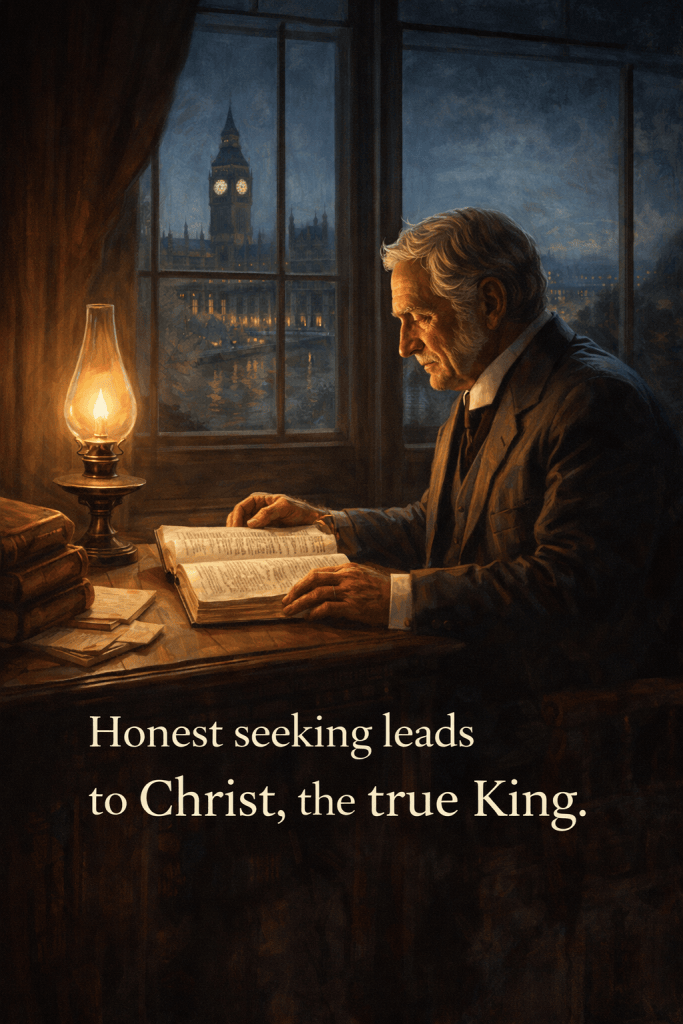
Like Pilate, he had once stood before the question of truth. But unlike Pilate, he chose to accept it.
His investigation led him to a firm conviction: Jesus Christ is the true King.
🔗 Source :
https://www.christianheritagefellowship.com/sir-charles-russell-testimony
⚒️🎯 Personal Application:
This passage confronts us with a choice we cannot avoid. We may not stand in Pilate’s court, but we face the same question: What will we do with Jesus? We often try to remain neutral, balancing truth and convenience, faith and fear. But neutrality is an illusion. Like the crowd, we either receive Him as King or reject Him. Today, we are called to surrender to His truth, align with His kingdom, and follow Him—not when it is easy, but when it costs us something.
🙏 🕯️ Prayer:
Lord Jesus,
You are the true King and the embodiment of truth.
Forgive us for the times we choose convenience over conviction.
Open our eyes to see You clearly and give us courage to follow You fully.
Let Your truth reign in our hearts.
Amen.


Leave a comment