
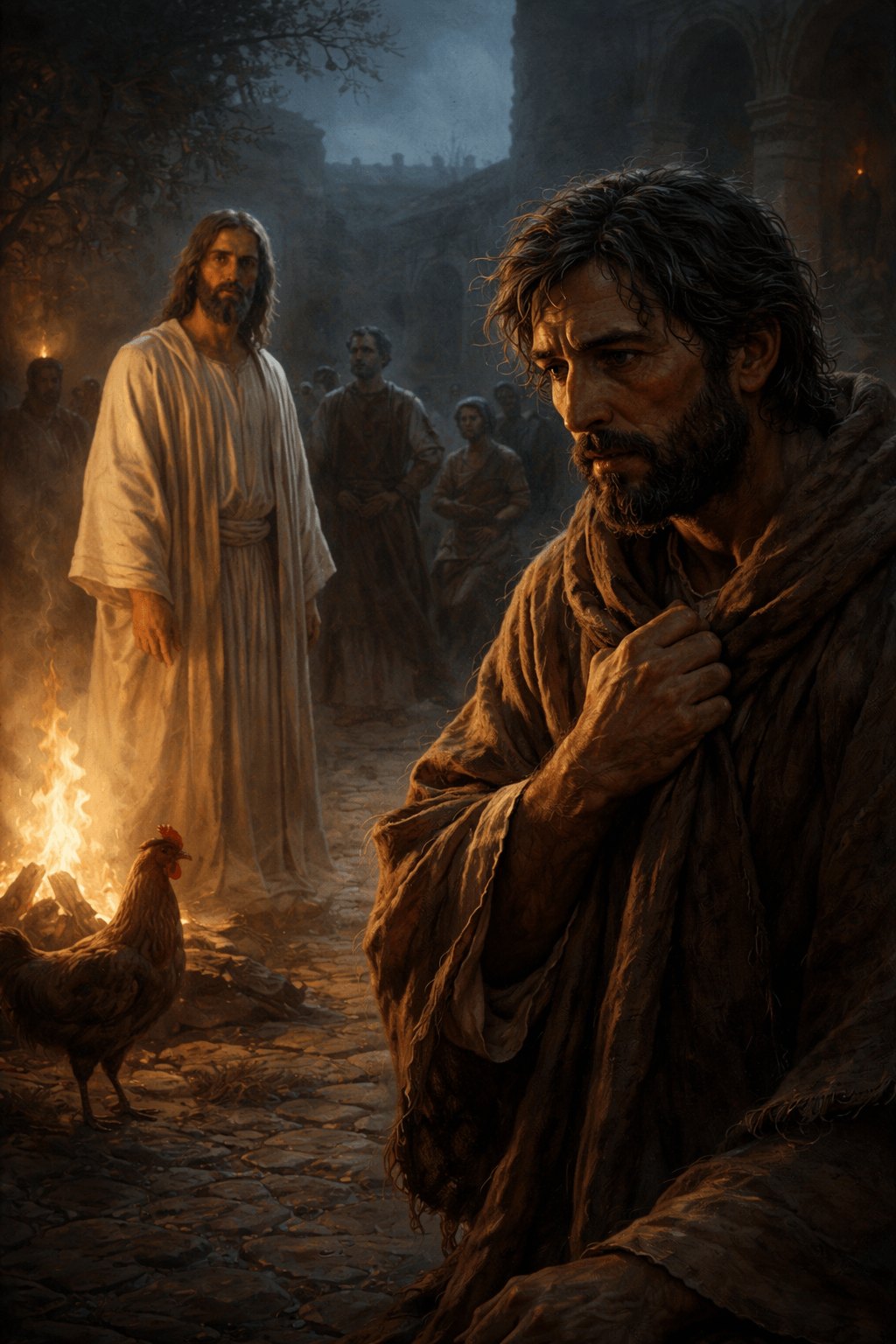
📖 ✝️ Scripture Reading: Luke 22:54–62
“The greatest of all faults is to be conscious of none.”
— Thomas Carlyle
💒 🕊️ ✨ Context (Story) :
The night has turned colder.
After the arrest in Gethsemane, Jesus is led into the house of the high priest. The tension is thick—religious leaders are determined, Roman authority is looming, and the disciples are scattered in fear. What began as triumph has now descended into betrayal and silence.
But one disciple follows… at a distance.
Peter.
The same Peter who once declared unwavering loyalty now walks in uncertainty. His distance is not only physical—it is spiritual. Fear is quietly replacing faith.
Inside the courtyard, a fire burns. Servants and guards gather for warmth. Peter sits among them, hoping not to be noticed.
But the firelight reveals.
A servant girl studies his face.
“This man was also with Him.”
Peter quickly replies, “Woman, I do not know Him.”
Another voice rises. Then another. Each accusation sharpens the pressure. Each denial grows stronger.
“Man, I am not!”
And then—
A rooster crows.
At that very moment, the Lord turns… and looks at Peter.
No words. Just a look.
A look filled with truth, sorrow, and love.
Jesus sees him completely—and still loves him.
Peter remembers.
And he breaks.
He goes out and weeps bitterly.
This is not mere regret. This is repentance.
The strong fisherman is undone—and grace has already begun its work.
🤔 🪞 💡 Reflection Thought:
Peter’s denial reveals a truth we often resist—human strength cannot sustain spiritual faithfulness without dependence on God.

His fall was not instant. It was gradual:
	•	Distance
	•	Fear
	•	Denial

Yet even in failure, Christ remains faithful.

Before Peter ever fell, Jesus had already prayed for him (Luke 22:32). This reveals a profound truth:
Our restoration begins not with our effort—but with Christ’s intercession.

Peter’s story is our story.

We may not deny Christ with words, but through silence, compromise, or fear of people, we drift.

Still, the gospel shines brightest here:

Failure is not final for those who return.

Peter’s bitter weeping reflects true repentance—deep sorrow not just for consequences, but for sin itself, echoing the heart cry of Psalm 51.

Later, in John 21, Jesus restores Peter publicly—three denials met with three affirmations of love.

Grace does not ignore failure.
It redeems it.

Salvation is not built on our consistency— but on Christ’s faithfulness.
🎬🔛 Historical True Event :
From Failure to Faithfulness: The Story of John Newton (England, 1748)
In 18th-century England, John Newton lived far from God. He was deeply involved in the transatlantic slave trade, profiting from human suffering.
Though he had early exposure to faith, he rejected it and lived recklessly.
Like Peter, he drifted far.
Then came a storm.
In 1748, while aboard a ship in the Atlantic, Newton faced a violent life-threatening storm. In desperation, he cried out to God.
That cry marked the beginning of his transformation.
Over time, God changed his heart. Newton left the slave trade, became a pastor, and later spoke strongly against slavery.
He penned the hymn Amazing Grace:
“…that saved a wretch like me.”
He never forgot his past—
but he lived in God’s grace.
Like Peter, his failure was not the end.
⚒️🎯 Personal Application:
We often live between confidence and compromise.
In moments of ease, we feel strong.
In moments of pressure, we may fall silent or drift away.
But this passage reminds us:
When we fall, Jesus does not turn away—He turns toward us.
His gaze is not to condemn, but to restore.
Do not stay in shame.
Return in repentance.
Because in your weakest moment,
His grace is still sufficient.
🙏 🕯️ Prayer:
Lord Jesus,
In our weakness, we often fail You.
Forgive us when fear overcomes our faith.
Help us return to You with true repentance.
Thank You for Your mercy that restores and renews us.
Strengthen us to stand firm in every situation.
Amen.


Leave a comment