
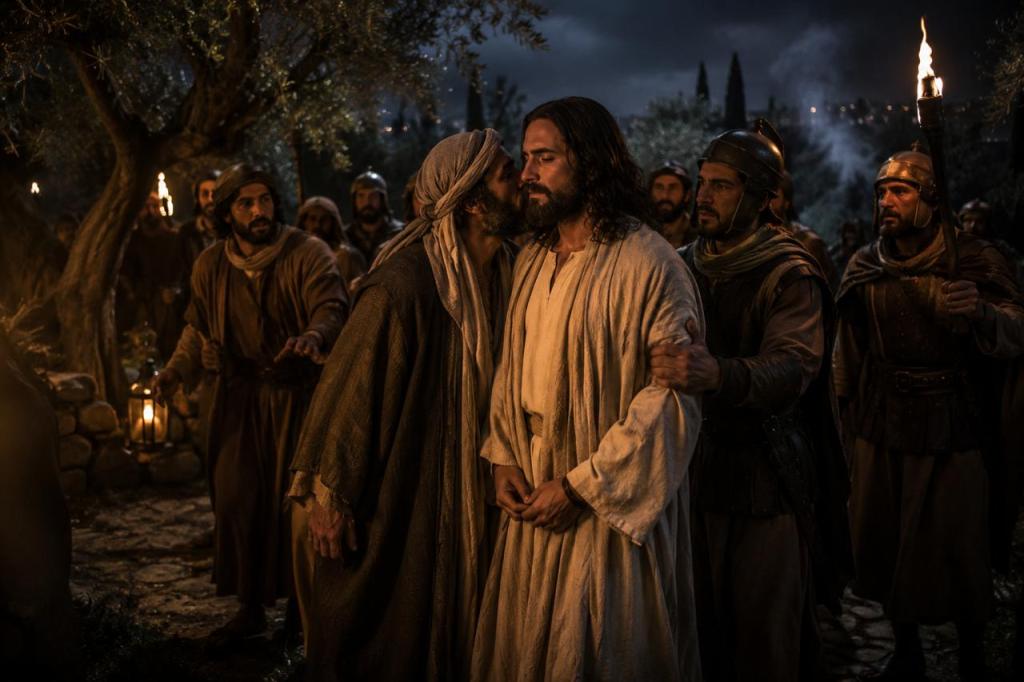
📖 ✝️ Scripture Reading: John 18:1–11
“Christ did not die to make bad men good, but to make dead men live.”
— Ravi Zacharias
💒 🕊️ ✨ Context (Story) :
The night air is heavy as Jesus leaves the upper room after His high priestly prayer in John 17. The journey now moves from intimate communion to impending confrontation. He crosses the Kidron Valley—a place historically associated with sorrow and judgment, where King David once fled in betrayal (2 Samuel 15:23). The shadow of the cross looms nearer.
They enter a familiar garden—a place of prayer, now a place of betrayal.
Judas, who knew this place well, arrives—not alone, but leading a detachment of Roman soldiers and temple guards. This mixture of Roman authority and Jewish leadership reveals the depth of opposition. Under Roman rule, the Jewish leaders needed political power to execute their plans. The Messiah they expected was not one who would surrender—but one who would conquer. Yet here stands Jesus, ready not to fight, but to give Himself.
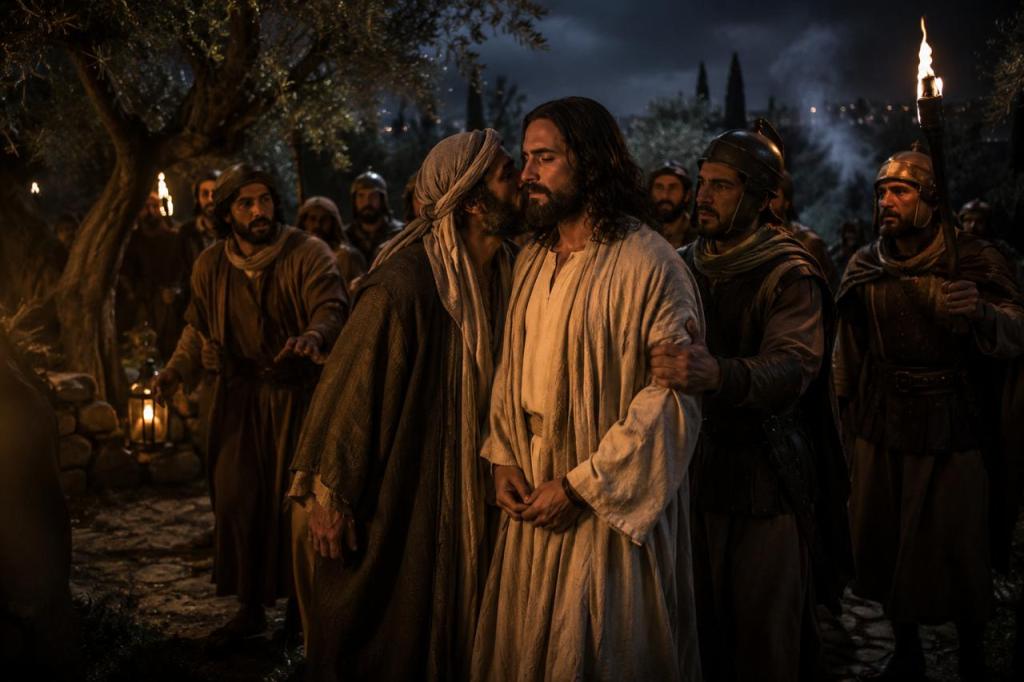
Torches flicker. Weapons glint. Tension fills the air.
But Jesus is not hiding.
He steps forward.
“Whom seek ye?”
This is not a question of ignorance, but of authority. The Greek phrase carries intentional confrontation—Jesus is initiating the moment.
They answer, “Jesus of Nazareth.”
Then comes a powerful declaration:
“I am He.”
In Greek, “ἐγώ εἰμι” (ego eimi)—the same phrase used in divine self-revelation (Exodus 3:14, “I AM THAT I AM”). This is not merely identification; it is revelation.
At these words, something extraordinary happens.
They draw back—and fall to the ground.
The arresting party collapses before the One they came to arrest. In this moment, we see that Jesus is not a victim—He is in control. Even in surrender, His authority remains unmatched.
He asks again, giving them another opportunity. Then He protects His disciples:
“If therefore ye seek me, let these go their way.”
Here, the Good Shepherd stands between danger and His sheep, fulfilling His earlier words (John 17:12). This echoes Isaiah 53—the suffering servant who gives Himself for others.
Suddenly, Peter reacts. Drawing his sword, he strikes the servant of the high priest, cutting off his ear.
It is a human response—fear mixed with misplaced courage.
But Jesus rebukes him:
“Put up thy sword… the cup which my Father hath given me, shall I not drink it?”
The “cup” again reflects divine judgment and suffering. Jesus is not resisting—He is submitting.
This is not defeat.
This is chosen obedience.
The King is arrested—not because He is powerless, but because He is willing.
🤔 🪞 💡 Reflection Thought:
In this moment of darkness, the true light of Christ shines brightest.

Jesus reveals a courage that is not loud or aggressive—but steady, surrendered, and divine. He does not escape suffering; He steps into it with full awareness. His question, His declaration, His protection of the disciples—all reveal a Savior who is completely in control.

Humanly, we see confusion—soldiers falling, disciples fearful, Peter acting impulsively. Spiritually, we see perfect order. Nothing is accidental. Every step is aligned with the Father’s will.

Spiritual blindness is evident. Those who came to arrest Him saw only a man—they did not recognize the “I AM” standing before them.

Yet faith sees differently.

Theologically, this moment reveals the nature of salvation. Jesus is not overpowered; He offers Himself. Redemption is not forced—it is chosen.

His courage is rooted in surrender. His authority is revealed in obedience.

The kingdom of God advances not through violence, but through sacrifice.
🎬🔛 Historical True Event :
Faith in the Fire: The Story of Perpetua (Carthage, AD 203)
In the early centuries of Christianity, following Christ often meant facing death. In Carthage (modern-day Tunisia), a young noblewoman named Perpetua chose faith over fear.
She was newly married, a mother of an infant, and came from a respected Roman family. When she confessed her faith in Christ, she was arrested along with other believers during a time of persecution under the Roman Empire.
Her father pleaded with her to deny Christ—to think of her child, her future, her family.
But Perpetua remained firm.
While imprisoned, she faced harsh conditions, uncertainty, and the emotional pain of separation from her child. Yet in the darkness of that prison, her faith only grew stronger. She wrote of visions and a deep sense of God’s presence sustaining her.
When the day of execution arrived, she walked into the arena with remarkable peace.
Instead of fear, there was courage. Instead of despair, there was faith.
She was executed for her unwavering commitment to Christ.
Perpetua’s story reflects the same truth seen in Jesus’ arrest—true courage is not in escaping suffering, but in standing firm in obedience to God. Even in the face of death, her faith did not waver.
🔗 Source :
https://www.christianitytoday.com/history/people/martyrs/perpetua.html
⚒️🎯 Personal Application:
We often think courage means fighting back, defending ourselves, or avoiding pain. But in this passage, we learn that true courage is trusting God even when we walk into difficulty. Like Peter, we may react in fear or impatience. But Jesus calls us to a deeper response—obedience. When we face dark moments, let us remember that God is still in control. As we surrender to His will, we walk in a courage that is not our own, but comes from Him.
🙏 🕯️ Prayer:
Lord Jesus,
Teach us to trust You in moments of fear and uncertainty.
Give us courage to surrender our will to Yours.
Help us to walk in obedience, even when it is difficult.
Strengthen our hearts to remain faithful in every situation.
Amen.


Leave a comment