
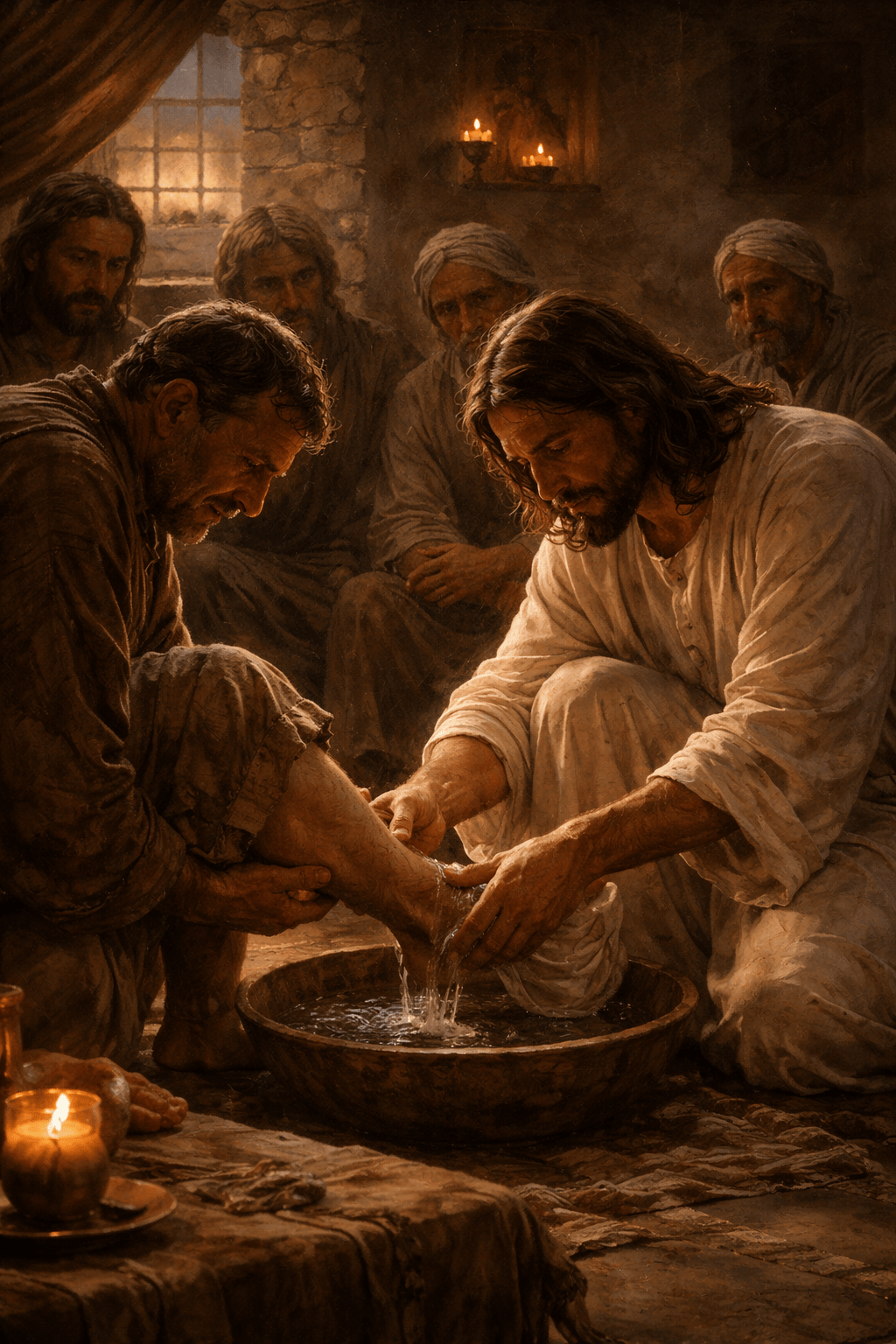
📖 ✝️ Scripture Reading: John 13:1–17
“The measure of a life is not its duration, but its donation.”
— Corrie ten Boom
💒 🕊️ ✨ Context (Story) :
Jerusalem is alive with Passover pilgrims. Under the iron grip of Rome, the Jewish people carry a quiet longing for deliverance. In the upper room, the air is thick with anticipation—and something deeper, unspoken.
John tells us that Jesus knew “His hour had come.” The Greek word “ὥρα” (hōra) carries divine timing—the appointed moment of His glorification through suffering. He is fully aware: betrayal is already in motion, the cross is near, and yet, “having loved His own… He loved them to the end.”
The meal begins. Dusty roads have done their work; feet are filthy. In that culture, foot-washing is the task of the lowest servant. No one moves. Pride and hierarchy quietly hold the room.
Then, the unthinkable happens.
Jesus rises.
He lays aside His outer garment—John uses the verb “τίθησιν” (tithēsin, “to lay down”), the same root later used for laying down His life. He wraps a towel around His waist. The King dresses as a slave.
He pours water into a basin.
And one by one, He begins to wash the disciples’ feet.
The room is silent except for the sound of water.
When He reaches Peter, the tension breaks. “Lord, do You wash my feet?” Peter resists. His instinct is right—this is too low for the Messiah. But Jesus answers, “What I am doing you do not understand now, but afterward you will understand.”
The word for “understand” (“γινώσκω”, ginōskō) implies experiential knowing. This is not theory—it will be revealed through the cross.
Peter protests again: “You shall never wash my feet.” Jesus replies with a startling condition: “If I do not wash you, you have no part with Me.”
This is more than hygiene—it is cleansing, participation, belonging.
Suddenly Peter swings to the other extreme: “Lord, not my feet only but also my hands and my head!” Jesus gently corrects him. One who is already bathed needs only to wash his feet. The imagery is clear: a once-for-all cleansing (salvation) and a continual cleansing (daily fellowship).
Judas is there.
Jesus washes his feet too.
The betrayal is known. The love remains.
After finishing, Jesus puts on His garment again and asks, “Do you understand what I have done to you?”
He reclaims His identity: “You call Me Teacher and Lord—and you are right.”
Then He turns the world upside down.
“If I then, your Lord and Teacher, have washed your feet, you also ought to wash one another’s feet.”
In a culture obsessed with honor, Jesus institutes a kingdom of humility.
This moment sits just before Gethsemane and the cross. It is not an isolated act—it is a living parable. The One who kneels with a towel will soon hang on a cross.
🤔 🪞 💡 Reflection Thought:
Here, the glory of Christ is revealed—not in power, but in humility.

He knows who He is. John emphasizes that the Father has given all things into His hands. Yet the One who holds all authority chooses to serve.

This is the paradox of the kingdom: true greatness is downward.

Theologically, this act points to the cross. The laying aside of garments mirrors the laying aside of heavenly glory (Philippians 2). The washing of dirty feet foreshadows the cleansing of sinful hearts.

Even more striking is the inclusion of Judas.

Jesus serves the one who will betray Him.

This exposes the radical nature of divine love—undeserved, persistent, and self-giving.

Humanly, we resist both sides of this truth. Like Peter, we struggle to be served by grace—we prefer earning. And we struggle to serve others—we prefer status.

But the gospel confronts both.

We must be washed before we can serve.

Canonically, this moment echoes Isaiah 52:7—“How beautiful… are the feet.” The very feet Jesus washes will soon carry the message of salvation to the world.

From a genre perspective, John’s Gospel presents this with quiet depth—no parables, just action. Yet the action is the message.

And the message is clear: the cross is not just an event to admire—it is a pattern to follow.
🎬🔛 Historical True Event :
“The Doctor Who Stayed – Dr. Paul Brand, India, 1950s”
In the 1950s, in Vellore, a British surgeon named Paul Brand began working with patients suffering from leprosy—a disease feared, misunderstood, and socially isolating.
Before encountering Christ deeply in his work, many doctors treated leprosy patients with distance, caution, and often reluctance. The disease carried stigma. People avoided touch.
But Brand saw something different.
He saw Christ in the suffering.
Instead of maintaining distance, he chose to serve closely. He touched wounds others would not look at. He washed infected limbs. He sat with patients rejected by their own families.
One day, a patient wept—not because of pain, but because someone finally touched him without fear.
That touch changed everything.
Brand later wrote that the greatest healing was not just physical—it was restoring dignity.
Like Jesus washing feet, Brand stepped into the lowest place.
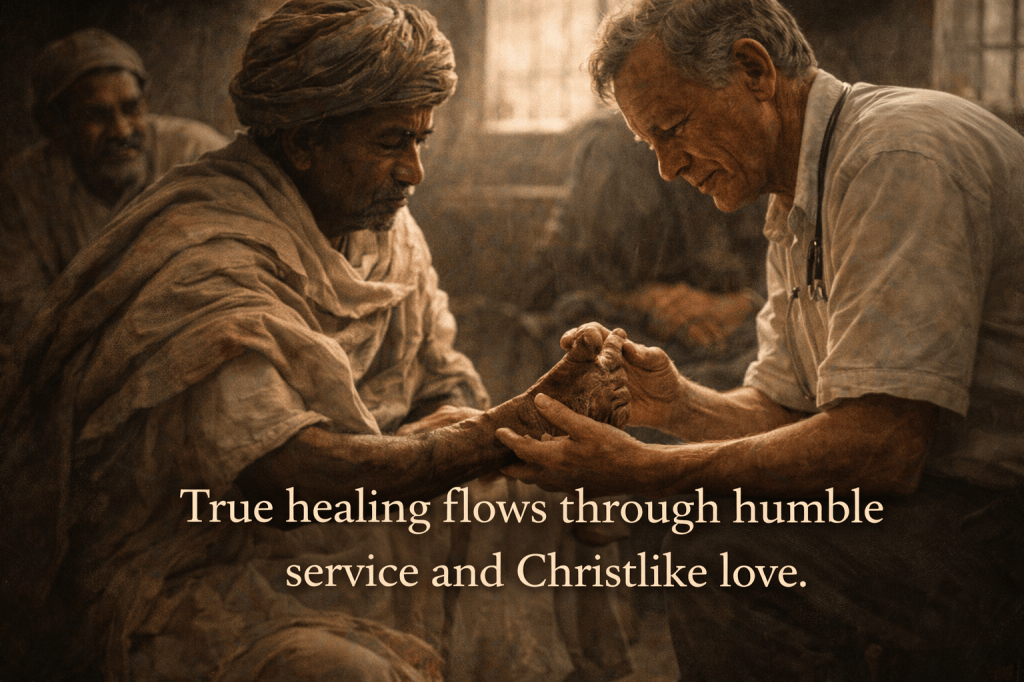
Before, patients lived in shame and isolation. After, many found hope, care, and restored identity—not just through medicine, but through Christ-like love.
His life became a testimony: true healing flows through humble service.
🔗 Source :
⚒️🎯 Personal Application:
Today, we are called to live what Jesus demonstrated. We must allow Him to cleanse our hearts daily, laying aside pride and self-sufficiency. At the same time, we are invited to serve others in humility—especially when it costs us comfort, recognition, or control. We are challenged to love not just those who appreciate us, but even those who may hurt or misunderstand us. True discipleship is not about position, but about surrender. We follow a Savior who knelt—and so must we.
🙏 🕯️ Prayer:
Lord Jesus, Thank You for showing us what true humility looks like. Cleanse our hearts from pride and self-centeredness. Teach us to serve others with love, even when it is difficult. Help us to follow Your example daily. Amen.


Leave a comment