
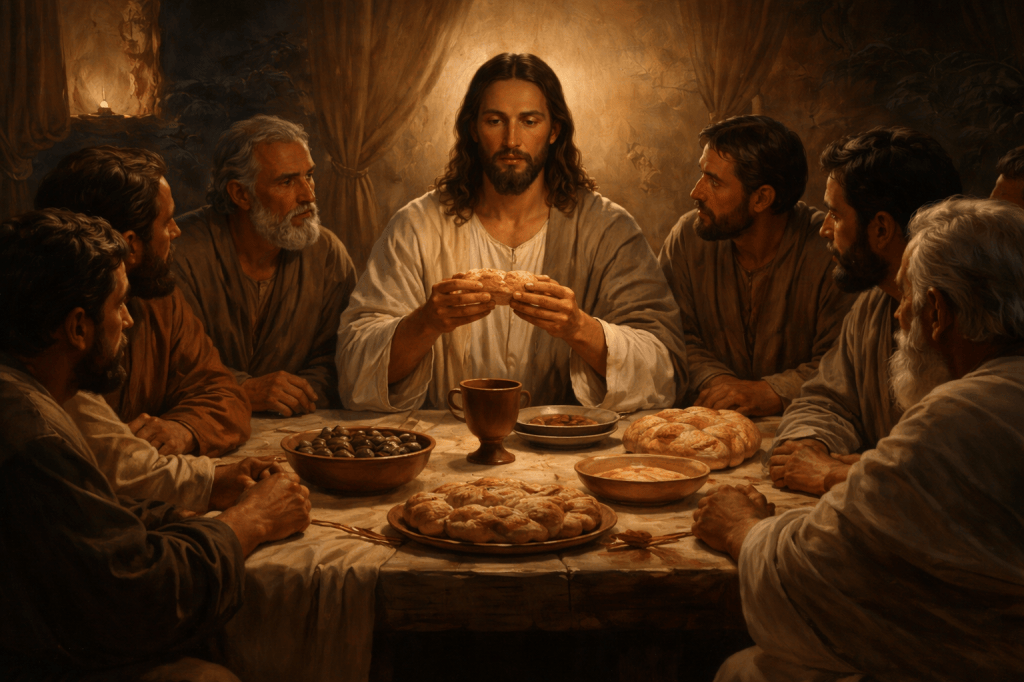
📖 ✝️ Scripture Reading: Matthew 26:26–30
“Christ did not say, ‘This represents my body,’ but, ‘This is my body.’”
— Martin Luther
💒 🕊️ ✨ Context (Story) :
The city of Jerusalem is trembling with anticipation. It is the time of Passover—a sacred remembrance of Israel’s deliverance from Egypt. Under the heavy shadow of Roman rule, Jewish hearts long for another deliverance, another exodus—this time from oppression and injustice.
Into this charged atmosphere, Jesus gathers with His disciples in an upper room. Just days earlier, He had entered Jerusalem as a King, welcomed with palm branches. Now, the tone has shifted. The air is heavy. There is an unspoken tension.
As they recline at the table, the familiar Passover meal begins. Bread is broken. Cups are shared. But suddenly, Jesus does something unexpected.
He takes the bread, blesses it, breaks it—and gives it to them.
“This is My body.”
The Greek phrase “τοῦτό ἐστιν τὸ σῶμά μου” (touto estin to sōma mou) is strikingly direct. The word “estin” (“is”) does not suggest mere symbolism—it carries the weight of identification. Jesus is not merely explaining the meal; He is redefining it.
Then He takes the cup.
“This is My blood of the covenant, which is poured out for many for the forgiveness of sins.”
Here, the term “διαθήκη” (diathēkē — covenant) echoes deeply through Jewish history. It recalls Moses at Sinai in Exodus 24, where blood sealed the covenant between God and Israel. But now, Jesus presents Himself as both priest and sacrifice.
This is the New Covenant promised in Jeremiah 31:31—a covenant not written on stone, but on hearts.
The disciples sit in stunned silence. They do not fully understand yet. How can their Rabbi speak of His body being broken? His blood poured out?
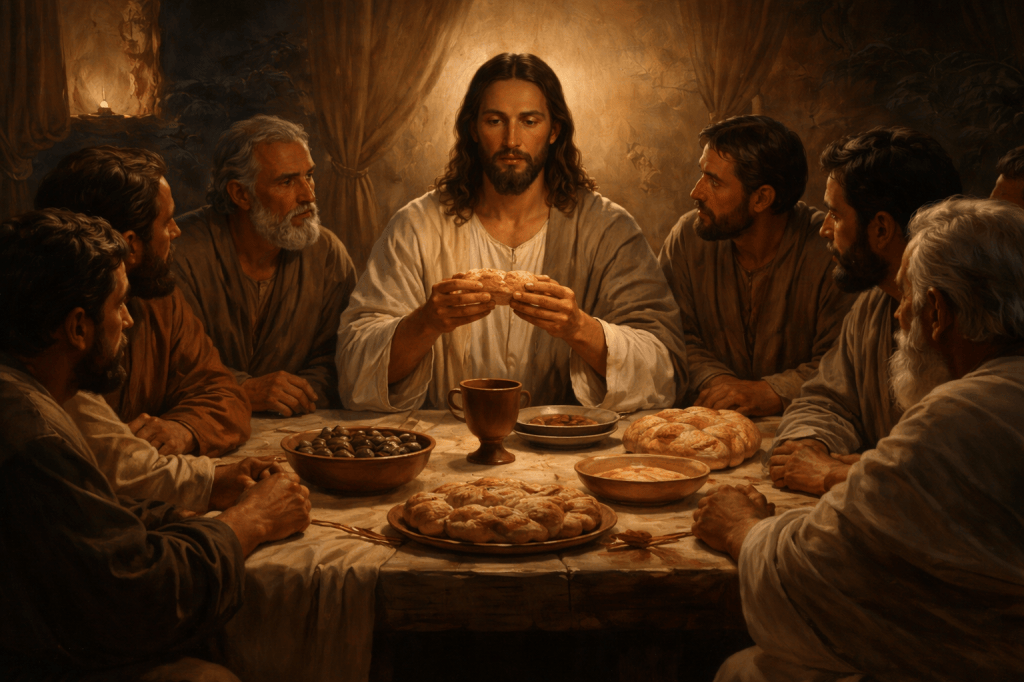
And yet, the shadow of the cross is already falling across the table.
In the literary flow of Matthew’s Gospel, this moment stands between betrayal and crucifixion. Judas has already agreed to betray Jesus. Soon, Gethsemane will unfold. The Last Supper becomes the bridge between fellowship and sacrifice.
They sing a hymn—likely from the Hallel Psalms (Psalm 113–118)—and walk into the night.
The King goes willingly toward His death.
🤔 🪞 💡 Reflection Thought:
At this table, we see the heart of Christ unveiled.

He is not a victim of circumstance—He is the willing Lamb. Like the Passover lamb in Exodus, whose blood spared Israel from judgment, Jesus now offers Himself as the ultimate sacrifice. Yet unlike every sacrifice before Him, His offering is once for all.

Theologically, this moment reveals a profound mystery: substitutionary atonement. His body for ours. His blood for our forgiveness.

But it also reveals intimacy.

In ancient culture, sharing a meal signified relationship, trust, and covenant loyalty. Jesus invites His disciples—not perfect men, but flawed, doubting, even betraying men—into this sacred act.

Even Judas is present.

Here lies the paradox of grace: Jesus gives Himself fully, even to those who will fail Him.

Canonically, this moment connects the entire story of Scripture—from the blood of lambs in Egypt to the suffering servant of Isaiah 53, to the Lamb of God in John 1:29. The Bible converges at this table.

From a genre perspective, the Gospel narrative is simple, yet loaded with eternal meaning. There is no dramatic language—just bread, a cup, and words. Yet these simple elements carry cosmic significance.

And what does this reveal about us?

We often approach God casually, forgetting the cost of our redemption. We take the bread, but overlook the brokenness. We drink the cup, but forget the blood.

Still, Jesus invites us.

Again and again.
🎬🔛 Historical True Event :
“The Covenant in the Cell – Richard Wurmbrand (Romania, 1950s)”
In Communist Romania, during the 1950s, Christians were hunted, imprisoned, and tortured for their faith. Among them was Richard Wurmbrand.
Thrown into a dark prison cell, isolated and beaten, Wurmbrand endured unimaginable suffering. Food was scarce. Hope seemed distant.
One day, a fellow believer managed to smuggle a small piece of bread into the cell.
There was no wine. No church building. No congregation.
But in that cold, silent prison, Wurmbrand and a few prisoners gathered.
They broke the bread.
And they remembered.
“This is His body, broken for us.”
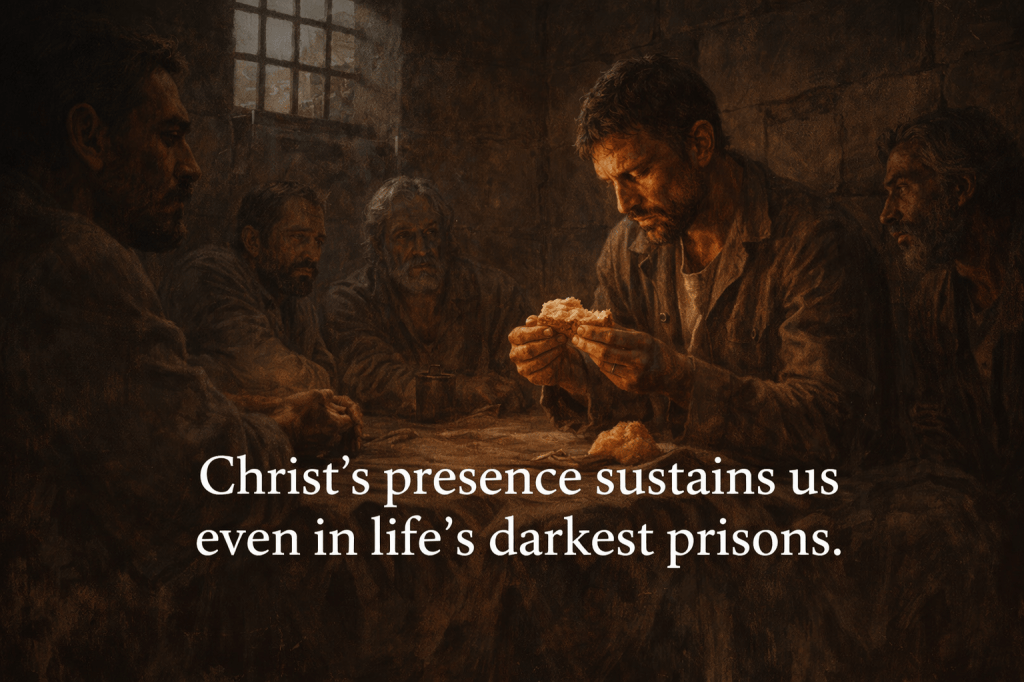
Tears flowed. Voices trembled. The presence of Christ filled that prison more powerfully than any cathedral.
Before imprisonment, Wurmbrand had preached about Christ. But in prison, he lived the covenant. He understood the cost of following Jesus—not as theory, but as reality.
After 14 years of imprisonment, he emerged—not bitter, but burning with love for Christ.
The bread and the covenant had sustained him.
🔗 Source :
Voice of the Martyrs – Richard Wurmbrand Story
https://www.persecution.com/stories/richard-wurmbrand/
⚒️🎯 Personal Application:
When we come to Christ today, we are invited into this same covenant relationship. We are called not just to remember His sacrifice, but to live in its reality. We must examine our hearts, surrender our pride, and receive His grace with reverence and gratitude. The Last Supper challenges us to move from casual faith to covenant commitment—where our lives reflect the cost and depth of what Jesus has done for us.
🙏 🕯️ Prayer:
Lord Jesus, Thank You for giving Your body and shedding Your blood for us. Help us never take Your sacrifice lightly. Teach us to live as people of the New Covenant—faithful, humble, and surrendered. Draw us closer to You each day. Amen.


Leave a comment