
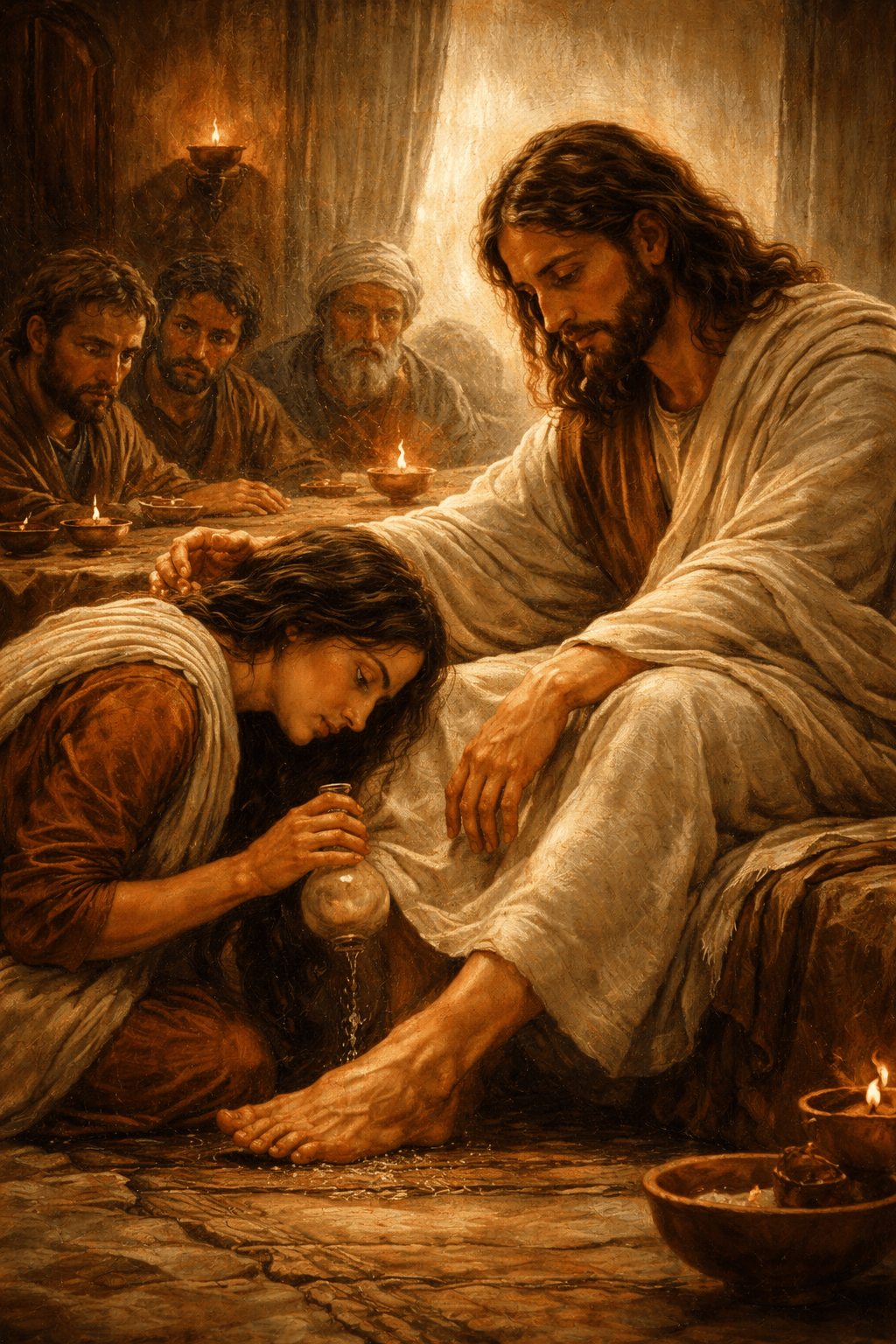
📖 ✝️ Scripture Reading: John 12:1–8
“The measure of love is to love without measure.”
— Bernard of Clairvaux
💒 🕊️ ✨ Context (Story) :
Six days before Passover, the shadow of the Cross is already stretching across the path of Jesus Christ. He arrives in Bethany, a small village just outside Jerusalem—a place filled not with hostility, but with love. Here lives Lazarus, whom Jesus had raised from the dead, a living testimony of divine power. The air itself must have carried a sense of awe.
A dinner is prepared in His honor. Martha serves, as she always does—faithful, active, devoted in her own way. Lazarus reclines at the table, a silent witness to resurrection life. But then, in a moment that interrupts the ordinary flow of the evening, Mary steps forward.
Mary of Bethany carries an alabaster jar filled with pure nard—an expensive perfume imported from distant lands, possibly worth a year’s wages. The Greek word used here, nardos pistikē, emphasizes its purity and authenticity—this is no diluted offering; it is costly, rare, and precious.
Without hesitation, she breaks the jar.
The fragrance fills the entire house.
She pours it on Jesus’ feet and wipes them with her hair—an act of deep humility and extravagant devotion. In a culture where a woman’s hair was her dignity, this act is shocking. She lowers herself completely, holding nothing back.
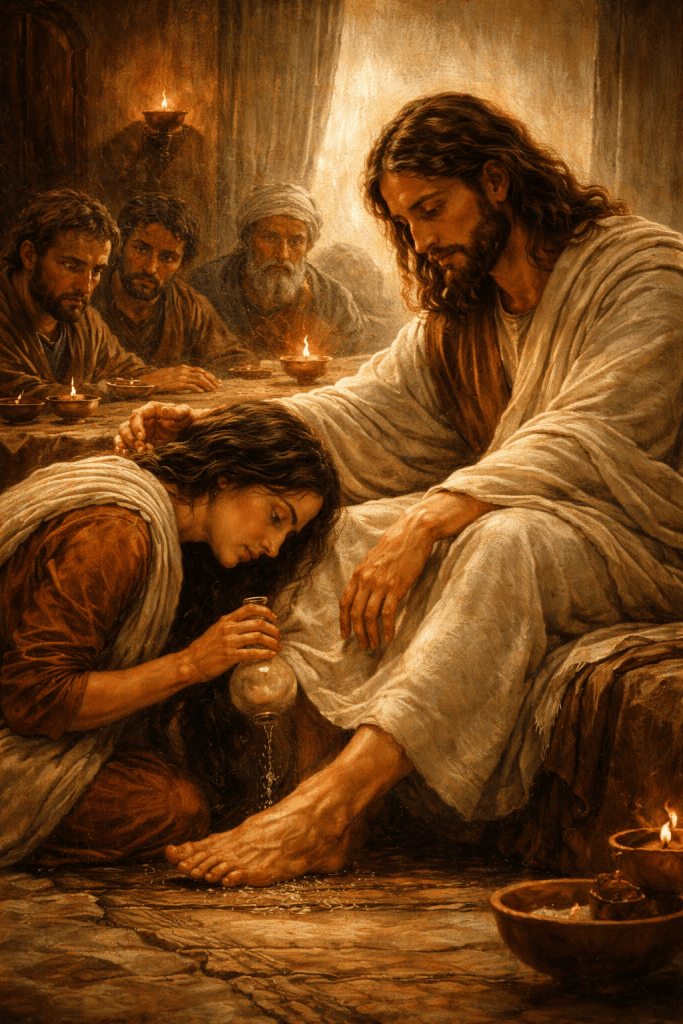
This moment echoes the heart of Old Testament worship—like the sacrificial offerings described in Book of Leviticus, where pleasing aroma rises to God. Yet here, the offering is not an animal—it is love poured out upon the Lamb of God.
But not everyone understands.
From the corner of the room, a voice cuts through the fragrance. Judas Iscariot objects. Why this waste? Why not sell it and give to the poor?
On the surface, it sounds righteous.
But the Gospel reveals his heart. He does not speak out of compassion, but out of greed. The same disciple who will soon betray Jesus cannot comprehend true worship.
Jesus responds gently but firmly. “Leave her alone… she has kept this for the day of my burial.”
In that moment, the room shifts.
Mary has done something profound—something even the disciples do not yet grasp. While others anticipate a political kingdom, she prepares a suffering Savior. Her act becomes prophetic.
Literarily, this scene stands just before Jesus’ triumphal entry into Jerusalem. While crowds will soon shout “Hosanna,” Mary quietly anoints Him for death.
The King is being prepared—not for a throne, but for a Cross.
🤔 🪞 💡 Reflection Thought:
This passage reveals a striking contrast between true devotion and spiritual blindness.

Mary sees what others miss. Her love is not calculated—it is surrendered. She gives her best, not because it is practical, but because Jesus is worthy. Her worship is extravagant because her understanding of Christ is deep.

Judas, on the other hand, represents a heart that is near to Jesus but far from Him. He measures devotion in terms of cost and utility, while Mary measures it in love.

Theologically, this moment points directly to the Cross. Jesus interprets her act as preparation for His burial. Before the nails, before the suffering, there is an anointing—an acknowledgment that He is the Lamb who will be sacrificed.

We also see the nature of Christ. He receives her worship. He defends her devotion. He values the heart behind the offering more than the opinions of the crowd.

True worship is often misunderstood. It may look wasteful to the world. It may invite criticism. But in the eyes of Christ, surrendered love is never wasted.

Mary’s act teaches us that the greatest offering we can bring is not our excess—but our everything.
🎬🔛 Historical True Event :
The Broken Bottle: The Story of Amy Carmichael (India, Early 1900s)
In the early 20th century, in the temple towns of South India, thousands of young girls were being dedicated to temple prostitution under the devadasi system. It was a dark reality hidden behind religious tradition.
Into this broken system came Amy Carmichael, an Irish missionary who felt a deep burden from God.
One day, a young girl escaped from a temple and ran to Amy for refuge. Helping her meant breaking cultural norms and risking serious consequences. Authorities, temple leaders, and even some Christians criticized her actions. It was seen as disruptive, unnecessary—even dangerous.
But Amy could not turn away.
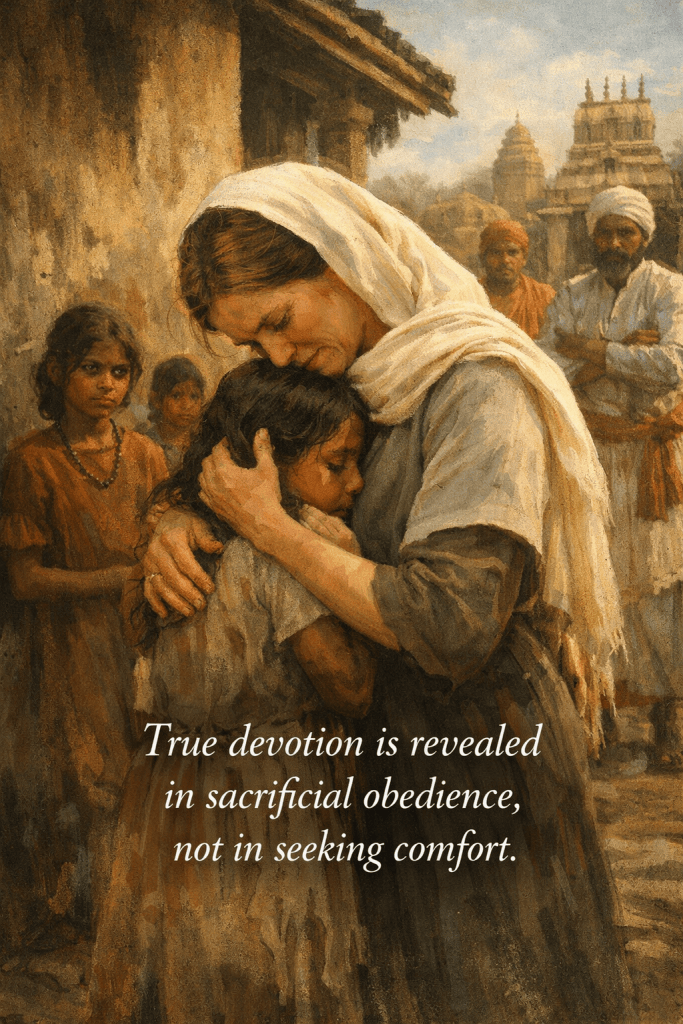
She began rescuing more children, often at great personal risk. Over time, she established the Dohnavur Fellowship—a safe haven for hundreds of rescued girls.
Her life became a “broken alabaster jar.”
She gave up comfort, reputation, and even her health. She never returned to her homeland. She spent over 50 years in India, pouring out her life for those society had forgotten.
Like Mary of Bethany, her devotion was misunderstood by many. But in the eyes of Christ, it was a fragrant offering.
Her sacrifice was not waste—it was worship.
🔗 Source :
https://www.wholesomewords.org/missions/biocarmichael.html
⚒️🎯 Personal Application:
This passage invites us to examine our own devotion. Are we giving Jesus what is convenient, or what is costly? We often calculate, measure, and hold back—but true worship calls us to surrender fully. Like Mary, we are called to pour out our lives in love, even when others misunderstand. Let us not be like Judas, evaluating devotion through worldly logic, but instead choose a heart that treasures Christ above all else.
🙏 🕯️ Prayer:
Lord Jesus, Teach us to love You with wholehearted devotion. Help us to give not what is easy, but what is costly. Remove every fear of criticism from our hearts. May our lives become a fragrant offering to You. Amen.


Leave a comment