
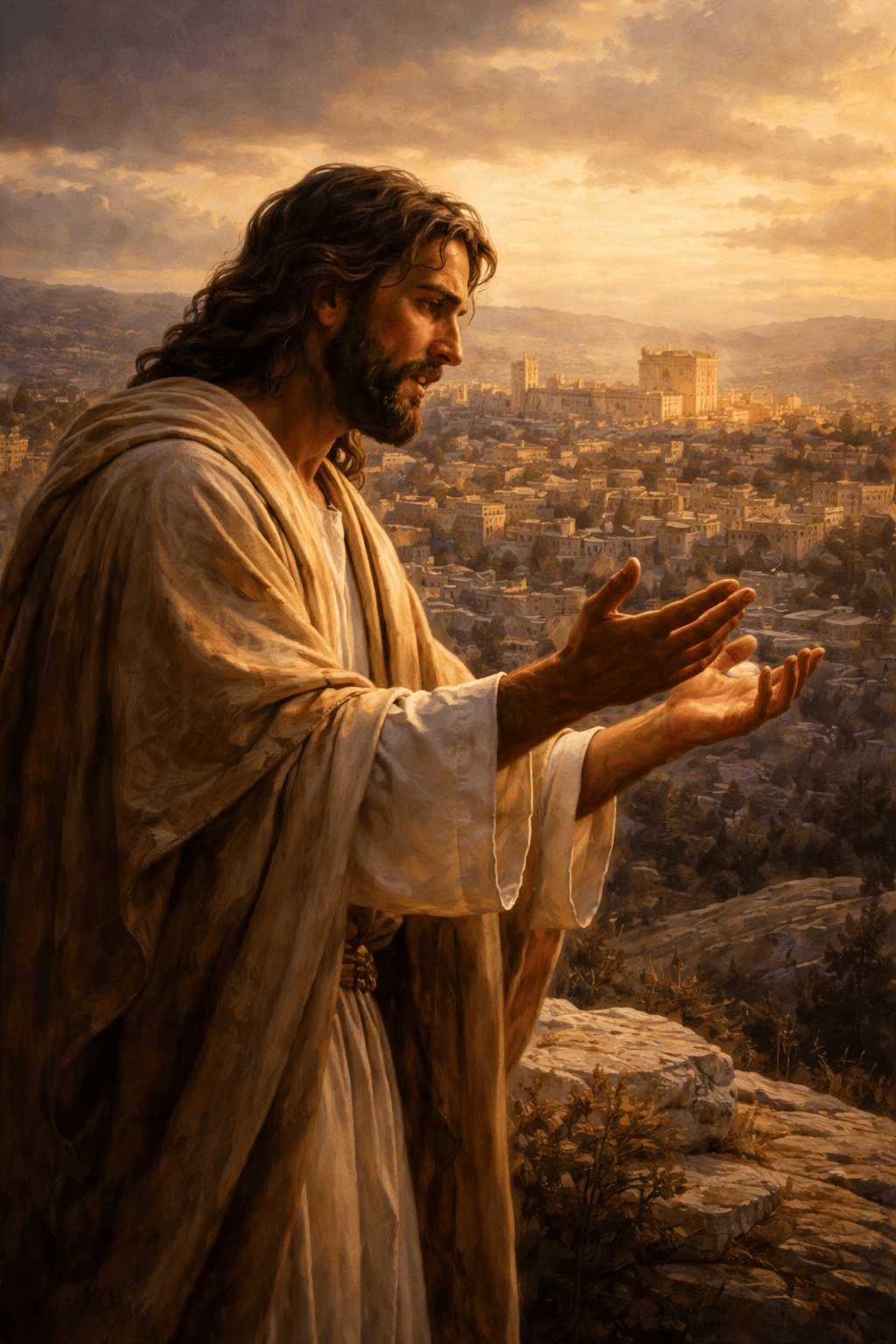
📖 ✝️ Scripture Reading: Matthew 23:37–39
“The tears of Christ reveal the heart of God for the lost.”
— John Stott
💒 🕊️ ✨ Context (Story) :
The city of Jerusalem was alive with movement. Pilgrims had gathered for Passover. Roman soldiers stood watch, wary of unrest. Religious leaders moved with authority through the temple courts. It was a season filled with expectation—and tension.
Just moments before, Jesus Christ had delivered a series of sharp rebukes against the scribes and Pharisees. The air was heavy with confrontation. The leaders had been publicly exposed. The crowd stood silent, absorbing every word.
And then, suddenly, the tone changed.
Jesus no longer spoke with rebuke—but with grief.
“O Jerusalem, Jerusalem…”
The repetition reveals deep emotion. In Hebrew culture, repeating a name expresses intense love and sorrow. This was not merely a statement—it was a cry from the heart.
He called it the city “that kills the prophets and stones those who are sent to her.”
This was not an exaggeration. From the days of Isaiah to Jeremiah, God’s messengers had been rejected, persecuted, and often killed. The history of Israel was marked by resistance to God’s voice.
Yet Jesus revealed something deeper.
“How often I wanted to gather your children together, as a hen gathers her chicks under her wings…”
This imagery is rich with Old Testament echoes. Passages like Psalm 91 speak of God’s protective wings. The metaphor shows tenderness, protection, and covenant love.
The Greek phrase “ἠθέλησα” (ēthelēsa) — “I desired” — reveals Christ’s willing heart. God was not distant or indifferent. He actively longed to save, protect, and restore His people.
But then comes the tragedy.
“…but you were not willing.”
Here lies the tension between divine desire and human response. The Greek phrase “οὐκ ἠθελήσατε” (ouk ēthelēsate) highlights human refusal. God’s invitation was real—but it was resisted.
The crowd listening would have felt the weight of these words.
This was not just about the past—it was about the present moment.
The Messiah stood before them.
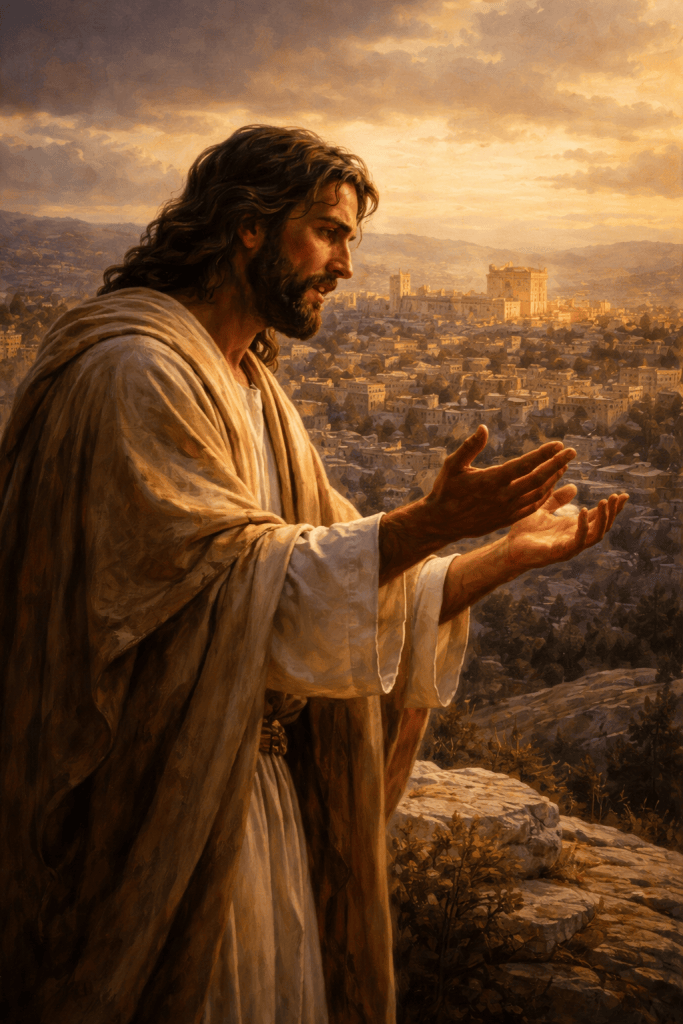
And they were rejecting Him.
Jesus then declared, “Your house is left to you desolate.”
This points toward coming judgment. Within a generation, in 70 AD, Siege of Jerusalem would result in the destruction of the temple—fulfilling Jesus’ prophetic warning.
Yet even in judgment, there is hope.
“You shall not see Me again till you say, ‘Blessed is He who comes in the name of the Lord!’”
This echoes Psalm 118—a Messianic declaration. It points forward to a future recognition of Christ.
In this moment, standing between rejection and redemption, Jesus reveals His heart.
Not anger.
Not revenge.
But sorrowful, longing love.
And just days later, that same love would carry Him to the cross.
🤔 🪞 💡 Reflection Thought:
This passage unveils one of the most profound truths about God—the heart of God grieves over rejection.

Jesus is not merely a judge; He is a Savior who longs to gather His people. His lament reveals divine compassion. Even when humanity resists Him, His desire remains restoration, not destruction.

There is a striking contrast in this moment.

The religious leaders are hardened, protective of their power and position. The crowd is uncertain, influenced by voices around them. And in the midst of it all stands Jesus—fully aware of His coming suffering—yet still longing to save.

This reveals the nature of Christ’s kingship.

He is not a distant ruler demanding submission. He is a compassionate King inviting relationship.

The image of a hen gathering her chicks is deeply humbling. It portrays vulnerability, care, and sacrificial protection. In times of danger, a hen spreads her wings, even at the cost of her own life.

This points directly to the cross.

Jesus would soon stretch out His arms—not to gather symbolically, but to save sacrificially.

The tragedy of this passage is not God’s unwillingness—but human resistance.

Spiritual blindness is not merely ignorance; it is often a refusal to respond to truth.

Yet even here, grace is present.

Jesus speaks of a future day when His people will recognize Him.

God’s story is never finished in rejection—it always leaves room for redemption.
🎬🔛 Historical True Event :
The Reluctant Mission Field – John G. Paton, Vanuatu, 1858
In 1858, Scottish missionary John G. Paton felt a strong calling from God to go to the New Hebrides (modern-day Vanuatu), a group of islands known for extreme hostility toward outsiders.
Friends and church members pleaded with him not to go. They warned him of danger, disease, and cannibalism. Some even said it would be certain death.
Yet Paton sensed the longing heart of God for the people of those islands.
When he arrived, tragedy struck quickly. Within months, his wife and newborn child died due to illness. Alone and surrounded by hostile tribes, Paton faced fear, grief, and isolation.
At one point, he had to hide in a tree for an entire night while enemies searched to kill him.
Yet in the midst of suffering, Paton continued to preach, pray, and trust God.
Years later, transformation began.

Tribes that once rejected the gospel began to receive it. Communities changed. Violence decreased. Churches were established.
The same people who once resisted God’s call began to worship Him.
Paton’s life reflected the same longing seen in Christ’s lament—a heart willing to endure rejection in order to bring salvation.
🔗 Source :
https://www.wholesomewords.org/missions/biopaton.html
⚒️🎯 Personal Application:
This passage calls us to examine our own response to Christ. Like Jerusalem, we may hear His voice, sense His invitation, and yet resist surrender in subtle ways. We may hold onto control, comfort, or pride. Jesus is still calling us—not with condemnation, but with compassion. Today, we are invited to come under His covering, to trust His heart, and to respond willingly to His grace.
🙏 🕯️ Prayer:
Lord Jesus, thank You for Your compassionate heart that longs for us. Forgive us for the times we resist Your call. Help us to respond with willing hearts and to rest under Your loving care. Draw us closer to You each day. Amen.


Leave a comment