
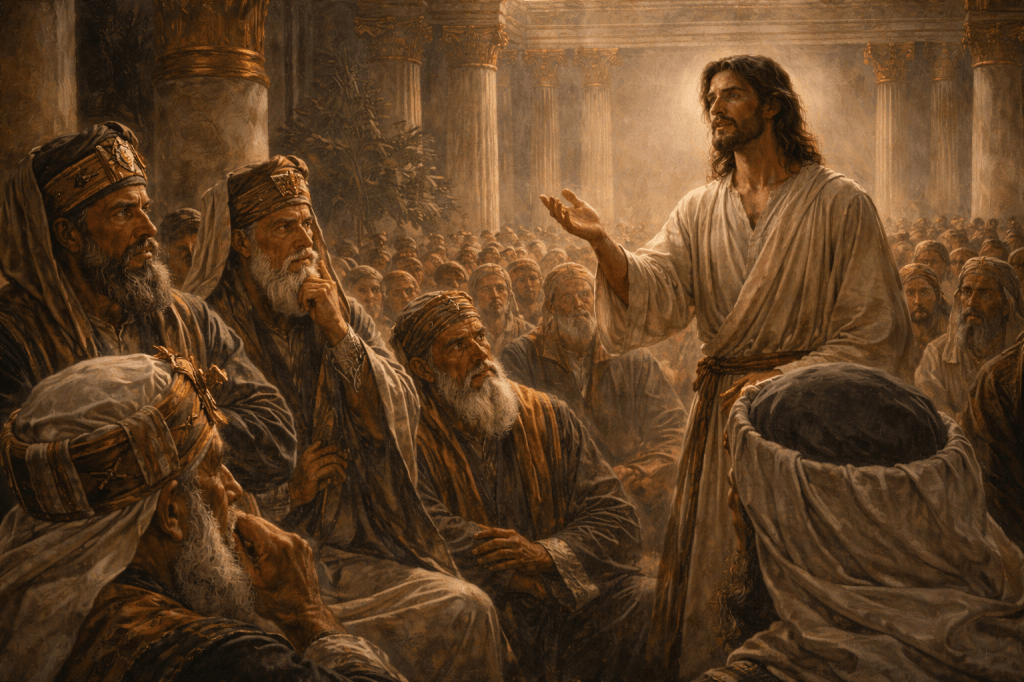
📖 ✝️ Scripture Reading: Matthew 23:1–12
“Hypocrisy is the homage that vice pays to virtue.”
— François de La Rochefoucauld
💒 🕊️ ✨ Context (Story) :
The final week of Jesus’ earthly ministry had arrived. The city of Jerusalem was overflowing with pilgrims who had come to celebrate the Passover. Roman soldiers stood watch from the fortress towers, alert to any sign of unrest. Jewish religious leaders were increasingly tense, for the presence of Jesus Christ had stirred the crowds and challenged their authority.
Only days earlier, Jesus had entered Jerusalem triumphantly, fulfilling the prophecy of Zechariah about a humble king riding on a donkey (Zechariah 9:9). Yet the celebration quickly turned into confrontation. In the temple courts, Jesus overturned the tables of corrupt merchants. Religious leaders questioned His authority. They tried to trap Him with political and theological debates.
Now, standing before a gathered crowd and His disciples, Jesus turned to address a deeper problem—religious hypocrisy.
He acknowledged that the scribes and Pharisees “sit in Moses’ seat.” In first-century Jewish culture, this meant they were official teachers of the Law. The people respected their authority because they interpreted the writings of Moses. Jesus did not dismiss the Law itself; rather, He affirmed that the people should observe what the Law taught.
But then His tone sharpened.
The problem was not their teaching—it was their lives.
“They say, and do not.” With this short statement, Jesus exposed a painful reality. These religious leaders were experts in explaining the Law but unwilling to live it. They placed heavy burdens on ordinary people, multiplying detailed regulations and traditions, yet they themselves refused to carry those burdens.
The crowds likely knew exactly what Jesus meant. The Pharisees were known for strict external displays of devotion. They enlarged their phylacteries—small leather boxes containing Scripture verses worn on the forehead or arm. The Greek word used here is phylaktēria, referring to objects meant to display devotion to God. They also lengthened the fringes of their garments, following instructions from Moses in Numbers 15:38—but exaggerating them to attract attention.
In the culture of the time, public honor mattered greatly. Religious leaders competed for recognition. They loved the best seats at banquets, the places of honor in synagogues, and respectful greetings in marketplaces. Being called “Rabbi”—meaning “my great one” or “teacher”—was a title of prestige.
Jesus confronted this culture of pride.
He turned toward His disciples and redefined greatness in the kingdom of God. “Be not ye called Rabbi,” He said, reminding them that they had only one true Teacher. They were brothers, equal before God. Titles that exalted human authority could easily distort the humility required in God’s kingdom.
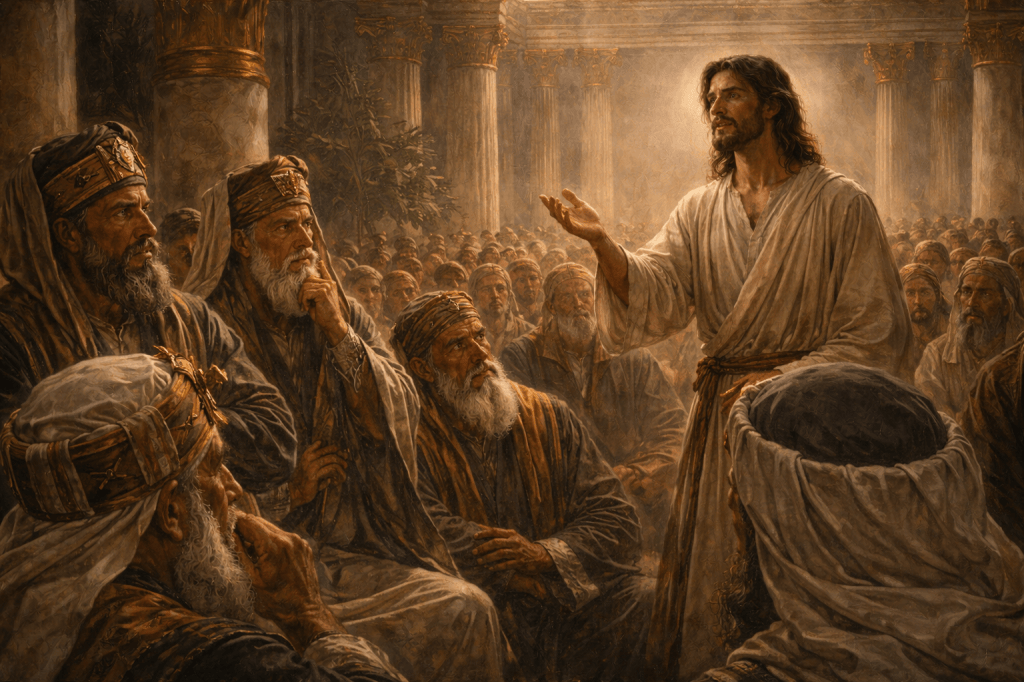
Then Jesus made a statement that echoed through the temple courts:
“The greatest among you shall be your servant.”
In the Greek text, the word for servant is diakonos—the same root from which we derive the word “deacon.” It describes someone who humbly serves others.
This teaching directly challenged the power structures of the religious world.
Jesus concluded with a profound kingdom principle:
“Whosoever shall exalt himself shall be abased; and he that shall humble himself shall be exalted.”
The tension in the air must have been palpable. The religious leaders heard their hypocrisy exposed publicly. The disciples heard a warning for their own future leadership. The crowd witnessed a radical vision of spiritual authenticity.
And this moment moved Jesus one step closer to the cross.
🤔 🪞 💡 Reflection Thought:
This passage reveals the penetrating insight of Christ into the human heart. Hypocrisy thrives when religion becomes a performance rather than a relationship with God. The scribes and Pharisees outwardly honored Scripture yet inwardly pursued status and recognition. Their faith had become external—measured by appearance rather than obedience.

Jesus does not merely criticize religious leaders; He exposes a universal human temptation. We can easily substitute visible spirituality for genuine devotion. Public prayers, religious language, and moral reputation can create an illusion of righteousness while the heart remains unchanged.

The character of Christ stands in sharp contrast to this hypocrisy. Though He was the true Teacher and rightful King, He consistently embraced humility. The One who deserved every title chose instead to wash the disciples’ feet. The King of heaven became a servant.

This reveals the nature of God’s kingdom. In God’s economy, greatness is measured not by influence or recognition but by humility and service. The cross itself embodies this principle. Jesus humbled Himself completely, enduring suffering and rejection, and through that sacrifice God exalted Him.

Human responses to Jesus vary dramatically. Some respond with humble faith; others react defensively when their pride is exposed. The Pharisees could not accept a Messiah who challenged their authority. Their spiritual blindness prevented them from seeing the true King standing before them.

For believers today, the warning remains powerful. Authentic faith flows from a transformed heart that seeks God’s glory rather than human applause.
🎬🔛 Historical True Event :
The Hidden Servant: William Carey’s Quiet Humility – India, 1800
In the late eighteenth century, William Carey arrived in Serampore as a missionary.
Carey would eventually become known as the “father of modern missions.” Yet his personal life reflected deep humility.
Although he translated the Bible into several Indian languages and helped establish educational institutions, Carey refused public recognition. When asked what title he preferred, he once replied simply, “Call me a plodder.” By this he meant a person who faithfully continues the work God has given without seeking honor.
Visitors to the mission were often surprised to find him performing ordinary tasks—gardening, repairing equipment, or helping with practical work. His focus was not on status but on obedience to Christ.

Carey’s humility shaped the culture of the Serampore mission. Leaders were encouraged to serve rather than dominate, reflecting the example Jesus taught in Matthew 23.
His life demonstrates that authentic Christian leadership grows from humility and devotion to God rather than outward recognition.
🔗 Source :
https://www.wholesomewords.org/missions/biocarey.html
⚒️🎯 Personal Application:
This passage invites us to examine our own hearts honestly. We can easily fall into the same pattern Jesus warned against—speaking spiritual truths while neglecting to live them. As followers of Christ, we are called to authenticity. Our faith must shape our character, our humility, and our willingness to serve others. When we remember that Christ alone is our Teacher and Lord, we learn to walk humbly with one another as brothers and sisters in His kingdom.
🙏 🕯️ Prayer:
Lord Jesus, guard our hearts from hypocrisy. Help us seek Your glory rather than human praise. Teach us to walk in humility, to serve others with sincerity, and to live out the faith we profess. Amen.


Leave a comment