
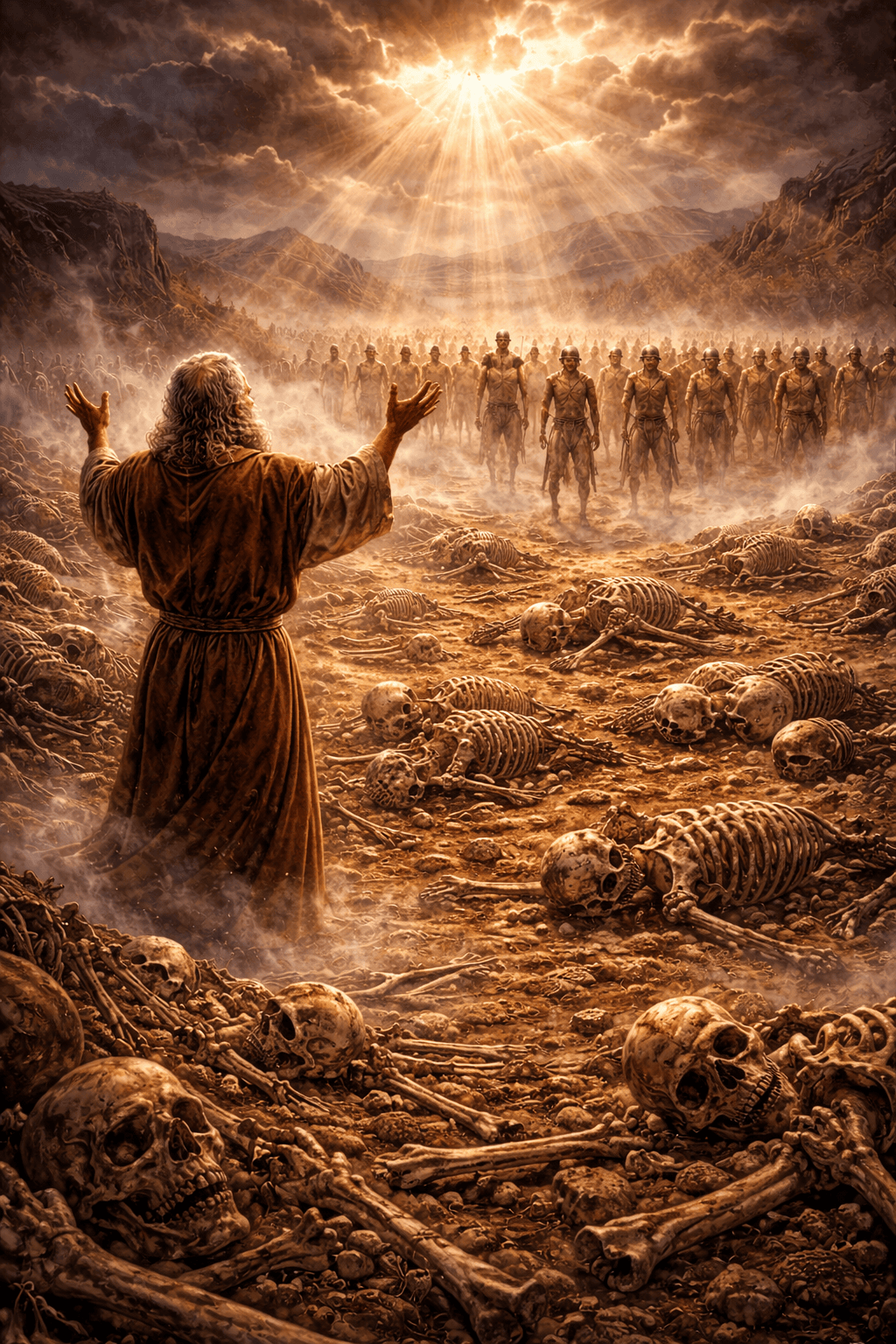
📖 Scripture Reading : Ezekiel 37:1–14
✨
— Victor Hugo
“Hope is the word which God has written on the brow of every man.”
⏳ Background:
Ezekiel was not standing in a place of mild discouragement. He was carried by the Spirit into a valley filled with bones—“very many” and “very dry” (Ezekiel 37:2). These were not recently fallen soldiers. These bones had been exposed, bleached, scattered, disconnected. The scene was irreversible by human standards.
This vision reflected Israel’s actual condition. Jerusalem had fallen. The temple was destroyed. The people were exiled in Babylon. Their national identity was fractured. Their worship life dismantled. Their future erased.
They confessed it plainly: “Our bones are dried up, and our hope is lost; we are indeed cut off” (Ezekiel 37:11).
This was more than political defeat. It was spiritual collapse. They believed God had abandoned them. Generations of covenant promises seemed buried under foreign oppression. There was no army to fight back. No leader to rally them. No strategy to rebuild. Only silence and shame.
Hopelessness is not loud. It is dry. It is the quiet acceptance that nothing will change.
The bones in the valley did not cry out. They could not. They were beyond effort, beyond self-repair, beyond revival by human initiative.
🔥 Turning Point:
Then God asked Ezekiel a piercing question: “Son of man, can these bones live?” (Ezekiel 37:3).
The prophet did not answer with optimism. He answered with surrender: “O Lord God, you know.”
God did not ask Ezekiel to fix the bones. He commanded him to speak His Word: “Prophesy over these bones, and say to them, O dry bones, hear the word of the Lord” (Ezekiel 37:4).
As the Word went forth, there was a sound—a rattling. Bones came together. Sinews formed. Flesh appeared. Skin covered them (Ezekiel 37:7–8). Structure returned before breath did.
Yet they still lay lifeless.
Then God commanded again: “Prophesy to the breath… and breathe on these slain, that they may live” (Ezekiel 37:9).
Breath entered them. They stood on their feet—“an exceedingly great army” (Ezekiel 37:10).
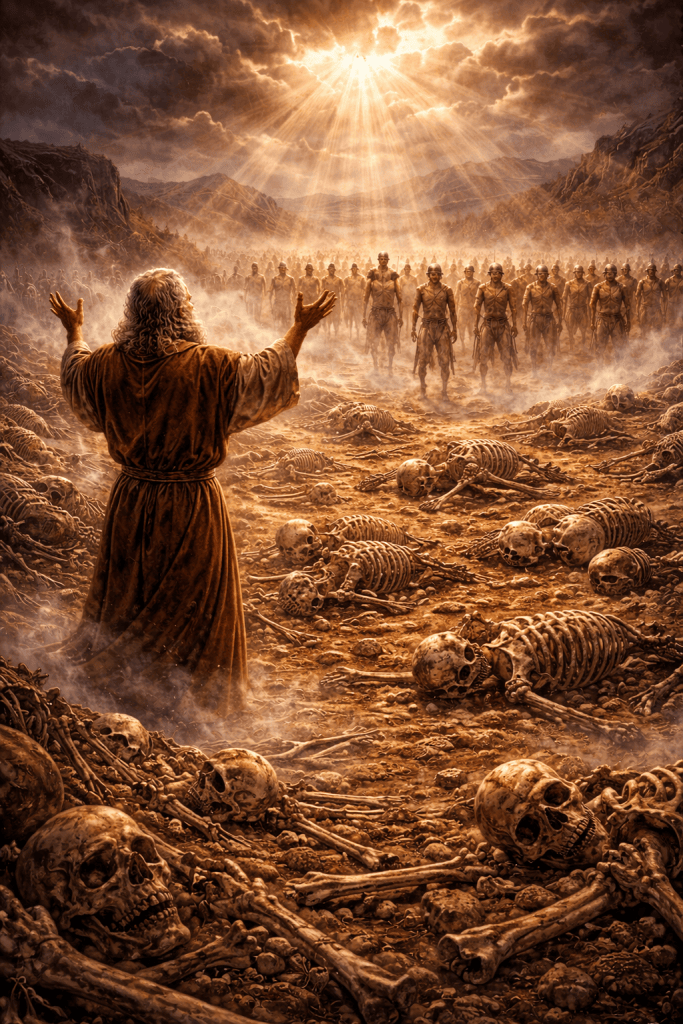
The turning point was not Israel’s repentance strategy. It was not political negotiation. It was not improved morale.
It was the sovereign Word of God and the life-giving Spirit of God.
God declared the meaning: “Behold, I will open your graves and raise you from your graves… And I will put my Spirit within you, and you shall live” (Ezekiel 37:12–14).
What looked like a cemetery became a testimony of resurrection.
🌿 Transformation:
The vision promised restoration. Historically, God brought His people back from exile. The temple was rebuilt. Worship resumed. The covenant story continued.
But the deeper transformation was spiritual. They would not merely return to land; they would receive renewed hearts. God promised breath—His Spirit. The people who once confessed, “Our hope is lost,” would stand again as a living community under God’s rule.
The valley did not remain a valley. It became an army.
What was scattered was gathered.
What was dry was filled.
What was dead stood upright.
The same God who allowed discipline also orchestrated restoration. The defeat was real—but it was not final.
🕊️ Spiritual Reflection:
Ezekiel 37 confronts us with a truth we resist: sometimes God allows us to see the full extent of our dryness. He does not deny the bones. He walks us into the valley.

Failure, loss, and shame often strip us of illusions of self-sufficiency. Israel could not engineer resurrection. Their defeat exposed their dependence.

God’s sovereignty means even our lowest valley is under His authority. He names the bones. He measures the dryness. He controls the timing of breath.

Defeat often precedes transformation because resurrection requires something to die. The valley becomes the stage upon which God reveals His unmatched power. What we label “the end” may be the raw material for divine reversal.

From exile to return, from barrenness to restoration, Scripture repeatedly shows God reviving what judgment has reduced. The God of the covenant disciplines, yet never abandons His redemptive purposes.

The valley of dry bones anticipates the empty tomb. Jesus entered the ultimate grave and rose by the power of the Spirit (Romans 8:11). The resurrection of Christ guarantees that no grave—spiritual or circumstantial—has final authority over God’s people.
💬 Closing Encouragement:
We know what it is to stand in our own valley—relationships fractured, reputations damaged, dreams collapsed, prayers unanswered. We feel the dryness when effort produces nothing and shame whispers that our story is over. We are tempted to accept defeat as destiny. Yet Ezekiel reminds us that our lowest moment is not beyond God’s reach. When we cannot rebuild, we can still listen. When we cannot breathe life into our situation, we can still trust the God who breathes. If we remain under His Word and yield to His Spirit, we will discover that valleys can become armies. Therefore, we must not give up.
🙏 Prayer:
Lord, we confess the dryness in our hearts and circumstances. Where hope feels lost, breathe Your Spirit again. Teach us to trust Your Word when we see only bones. Raise what has fallen and restore what has failed. We believe You are not finished—bring Your victory in us.


Leave a comment