
📖 ✝️ Scripture Reading: Mark 11:12–25
“Prayer is the atmosphere of revelation.”
— P. T. Forsyth
💒 🕊️ ✨ Context ( Story ) :
The road from Bethany rises with the early light, the scent of olive leaves crisp in the air. Passover week has swollen Jerusalem with pilgrims and expectations. Rome’s standards glint on the fortress; Herod’s temple gleams on the mount. Into this tense world Jesus walks with the Twelve, the King whose crown will first be woven from thorns. From a distance He sees a fig tree, lush with leaves—promising, at least, a traveler’s snack. He steps off the path to search its branches. No fruit. Only foliage. He speaks—not in irritation, but as a prophet enacting a sign: “May no one ever eat fruit from you again.” The disciples hear, bewildered. In that land, a leafy fig often bore early edible buds even before the full season; all leaves and no fruit meant something deeper was wrong.
They crest the Mount of Olives and descend to the temple. Commerce hums in the Court of the Gentiles—coins clatter, doves flutter, feet cut hurried shortcuts through sacred space. Jesus overturns the equilibrium. He drives out buyers and sellers and, with Scripture on His lips, names God’s intent for this place: not a marketplace, but “a house of prayer for all nations,” not a bandits’ den, but a sanctuary for the world. Isaiah’s promise and Jeremiah’s warning blend in His voice; leaders seethe, crowds stare, and the city feels the rumble of a kingdom that will not be contained.
At dawn they pass the same route. Peter’s gasp breaks the morning: the fig tree stands withered from the roots—judgment enacted, façade exposed. Jesus turns the moment into a summons: “Have faith in God.” He gestures toward “this mountain,” the very ridge they are standing on, and speaks of faith that could cast it into the sea—language that echoed a Jewish idiom for uprooting impossible obstacles. This is not spectacle; it is a call to trust God for what empty religion never can. And then a final stroke: when we stand praying, forgive. Prayer that moves mountains grows in soil softened by mercy.
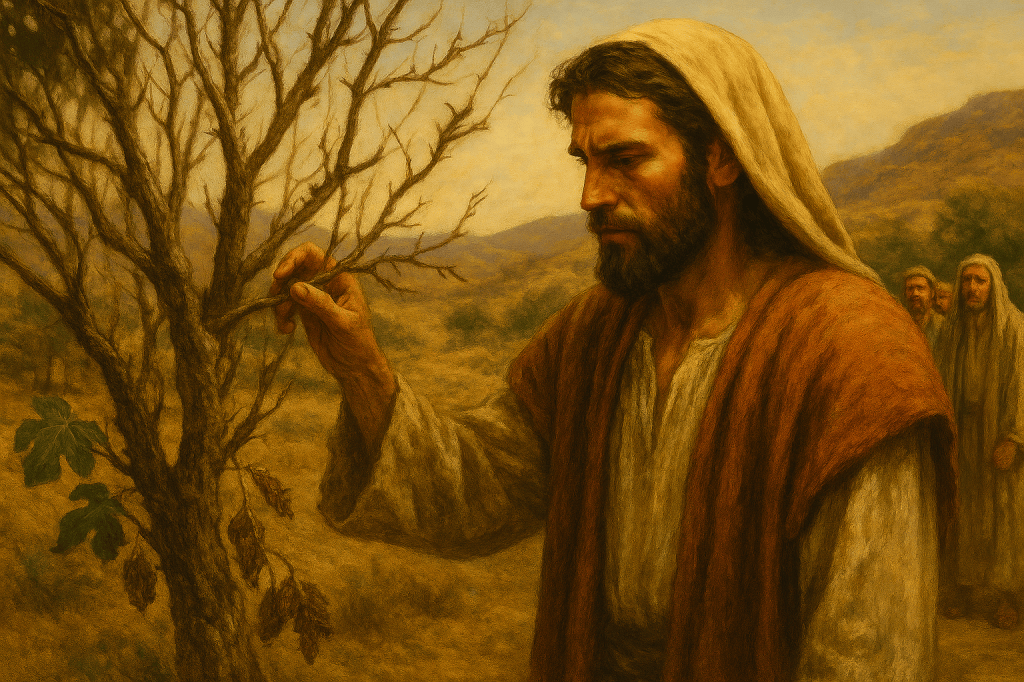
Mark has woven these moments like a parable in motion. The fig tree frames the temple action—the famous “Markan sandwich”—so that leaves-without-fruit interpret liturgy-without-life. The literary shape tells the message: God seeks fruit, not foliage; prayerful faith, not performance; forgiveness, not religious theater.
🤔 🪞 💡 Reflection Thought :
We observe first a hungry King and a leafy tree, a grand temple and a withered trunk, a call to pray and to forgive. The scene is tender and terrible at once: Jesus, truly human, hungry; Jesus, truly sovereign, judging. Mark notes that it was not the main fig season, yet a tree in leaf usually carried early edible buds—so the contradiction between appearance and reality is the point. The word “fruit” (καρπός, karpós) in Scripture grows beyond botany, naming the outcomes of a life rooted in God. Where there is covenant love, there is fruit; where there is only show, the leaves rustle but the branches are bare.

We interpret the interwoven stories as a single prophetic sign. The acted curse reveals a deeper withering in the temple’s life, and the cleansing declares God’s heart for the nations. Jesus quotes Isaiah’s vision of an eschatological house of prayer for all peoples and Jeremiah’s indictment of a den of robbers; promise and warning converge in Him. He does not abolish prayer—He restores it to its holy center. Then, in the quiet after the uproar, He teaches that the authority of this kingdom is accessed not by noise or numbers, but by faith (πίστις, pístis) in God Himself and by forgiving (ἀφίετε, aphiete) those who have wounded us. The imperative “ἀφίετε” in 11:25 makes forgiveness a standing command; there is no authentic prayer without a softened heart.

We correlate this moment with the Scriptures’ wider arc. Isaiah 56 welcomes the outsider into God’s praying people; Jeremiah 7 warns that sacred buildings cannot shield unrepentant hearts; Zechariah speaks of the Lord splitting the Mount of Olives and leveling a “great mountain” by His Spirit. When Jesus points to “this mountain” and speaks of its removal, He does not offer magic but places us inside this prophetic stream: the living God topples what our power cannot—barriers to truth, hardness of heart, entrenched injustice—through a praying, forgiving community that carries His reign into the world.

We apply the truth by letting it search our secret places. The King still walks toward our leaves, looking for karpós—for the quiet fruit of mercy, holiness, justice, and intercession. He still overturns tables that crowd out prayer. He still invites us to believe Him for the impossible and to release debts we have hoarded for years. Here the character of Christ shines: fierce for God’s glory, gentle toward the outsider, uncompromising with hypocrisy, self-giving unto the Cross. Here the human response divides: some plot, some ponder, some pursue Him with childlike trust. Here spiritual blindness prefers leaves that photograph well; faith returns to the root—Have faith in God—and finds that forgiveness clears the channel of prayer like spring melt unclogging a river. And here sacrifice, humility, kingship, suffering, and redemption converge: the Judge will soon hang judged, the Purifier will be pierced, the High Priest will make His people the very house of prayer He described.
🎬🔛 Historical True Story :
“Pandita Ramabai and the Mukti Mission: Fruit in a Dry Season (Kedgaon, 1905)”
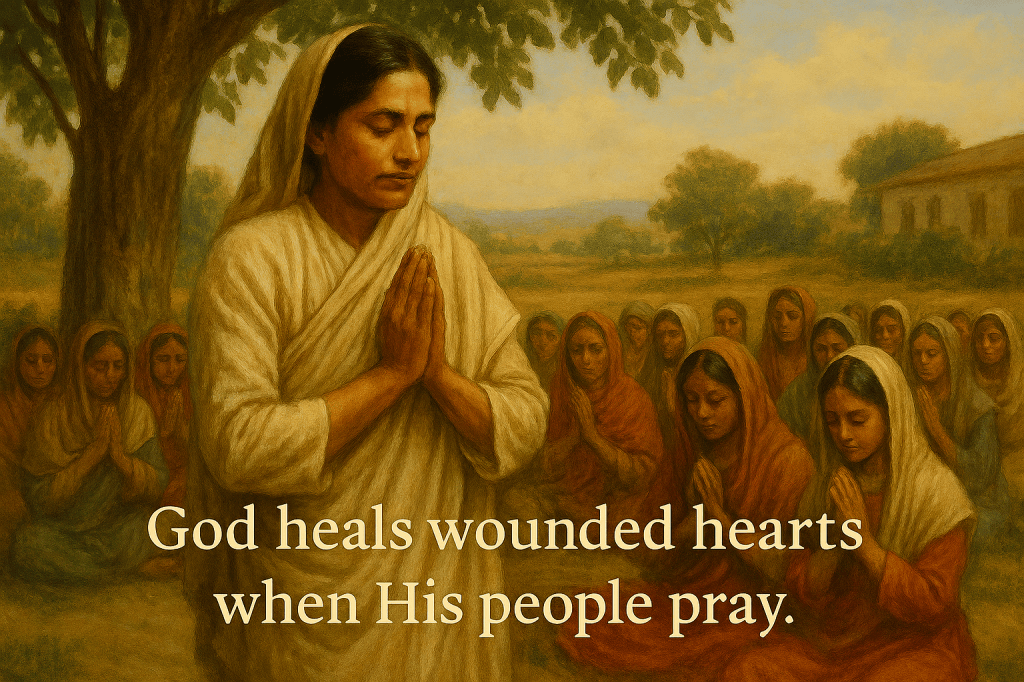
At the dawn of the twentieth century, Pandita Ramabai—a Sanskrit scholar turned Christ-follower and reformer—led a women’s community called Mukti (meaning “salvation/freedom”) near Pune (Kedgaon). India reeled from social brokenness; Ramabai gathered widows and girls, teaching, feeding, and praying. In 1905, after months of daily intercession, a deep spiritual awakening broke over the mission. Meetings that began as lessons turned into hours of confession, restored relationships, and fervent prayer. Young women who had known only abandonment now shared Scripture with boldness, formed prayer bands, and fanned out to serve nearby villages. Before, Mukti had leaves—busy, compassionate activity; after, the roots drank living water: forgiveness reconciled estranged hearts, prayer became the mission’s pulse, and tangible fruit—transformed lives and courageous witness—spread beyond the compound. One scholar calls Mukti “an early center of international significance,” not for spectacle, but for a praying community whose inner renewal overflowed into durable mission.
🔗 Source:
https://journals.sagepub.com/doi/pdf/10.1177/026537880602300106
⚒️🎯 Personal Application :
We live in a culture of leaves—metrics, optics, performance. This passage calls us back to roots. We are invited to become people in whom prayer is not a garnish but the atmosphere, where forgiveness is not an exception but our reflex, where faith names God as the center rather than our outcomes. If we will let Jesus overturn our inner courts—our distraction, our pride, our scorekeeping—He will grow real fruit in us: courage to ask, humility to wait, generosity to forgive, and integrity that outlives the season.
🙏 🕯️Prayer:
Lord Jesus, search our branches and heal our roots. Teach us to trust You, to pray boldly, and to forgive freely. Make us a house of prayer that bears lasting fruit for Your name. Amen.


Leave a comment