
📖 ✝️ Scripture Reading:Matthew 21:12–17
“Christ is not valued at all unless He is valued above all.”
— Augustine of Hippo
💒 🕊️ ✨ Context ( Story ) :
Jerusalem was overflowing with pilgrims.
It was the season of Passover, when Jews from every corner of the Roman Empire traveled to the holy city. Under the heavy shadow of Pontius Pilate and Roman soldiers stationed in the fortress overlooking the temple, the Jewish people longed for liberation. They remembered God’s past deliverance from Egypt and hoped that someday the promised Messiah would free them again.
Just a day earlier, Jesus had entered Jerusalem riding on a donkey. Crowds spread palm branches on the road and shouted “Hosanna,” fulfilling the prophecy of Zechariah (Zechariah 9:9). The city buzzed with excitement. Many wondered if this humble teacher from Galilee was the long-awaited King.
But the first public act of the King inside Jerusalem shocked everyone.
As Jesus walked into the temple courts, He stepped into what should have been the holiest place in Israel—the Court of the Gentiles, the only area where non-Jews could come to seek the God of Israel. Yet instead of reverent worship, the space sounded like a marketplace.
Animals bleated loudly. Merchants shouted prices. Money clinked on tables.
Pilgrims needed animals for sacrifices, and they had to exchange foreign currency into the special Tyrian temple coinage. The temple authorities allowed merchants to sell animals and money changers to exchange coins—but over time, corruption had turned worship into exploitation. Prices were inflated. The poor were cheated. And the very place meant for prayer had become a noisy bazaar.
At that moment, Jesus’ demeanor changed.
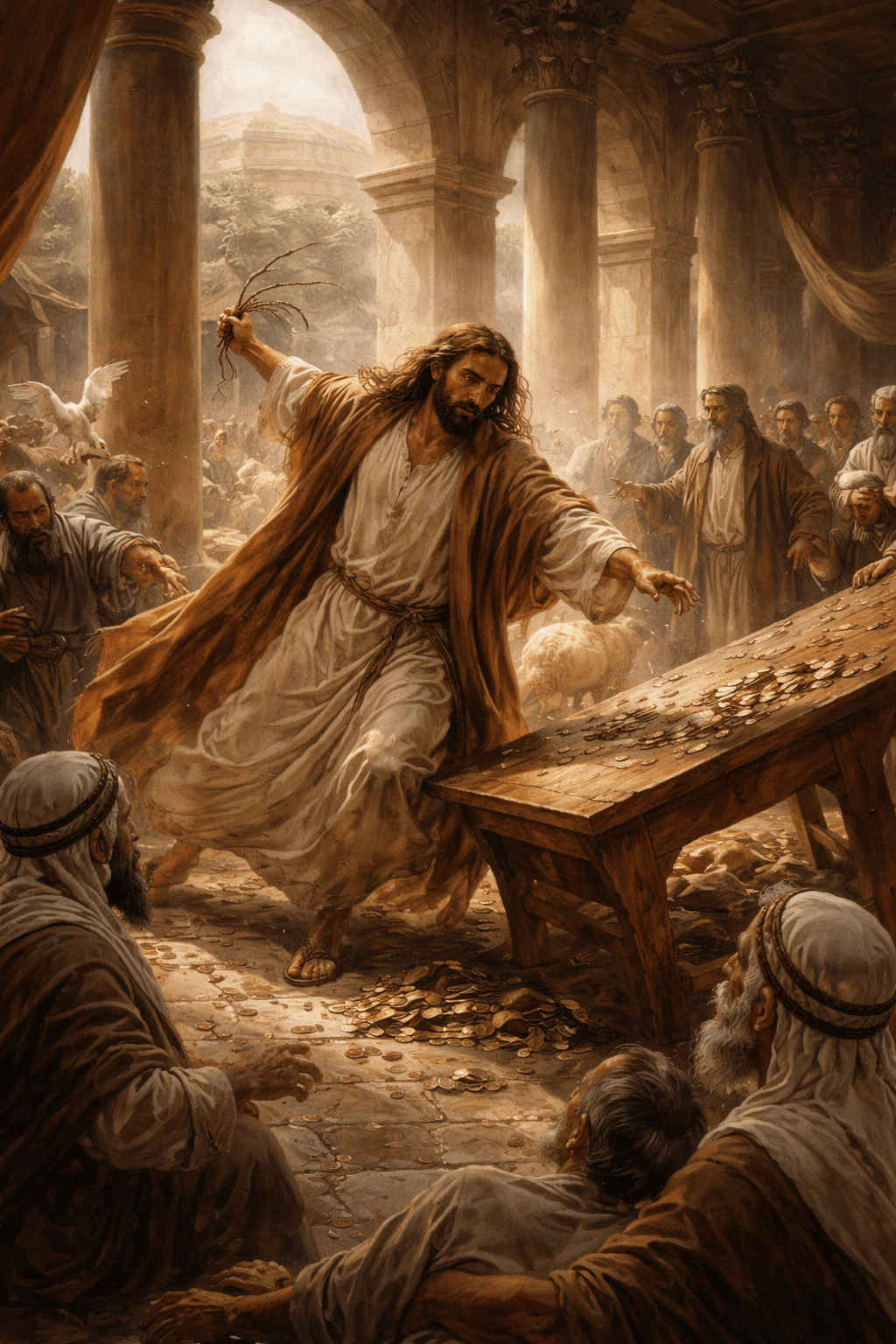
Matthew describes a sudden, powerful action. Jesus began overturning the tables of the money changers and the seats of those selling doves. Coins scattered across the stone floor. Merchants scrambled in panic as the animals ran loose.
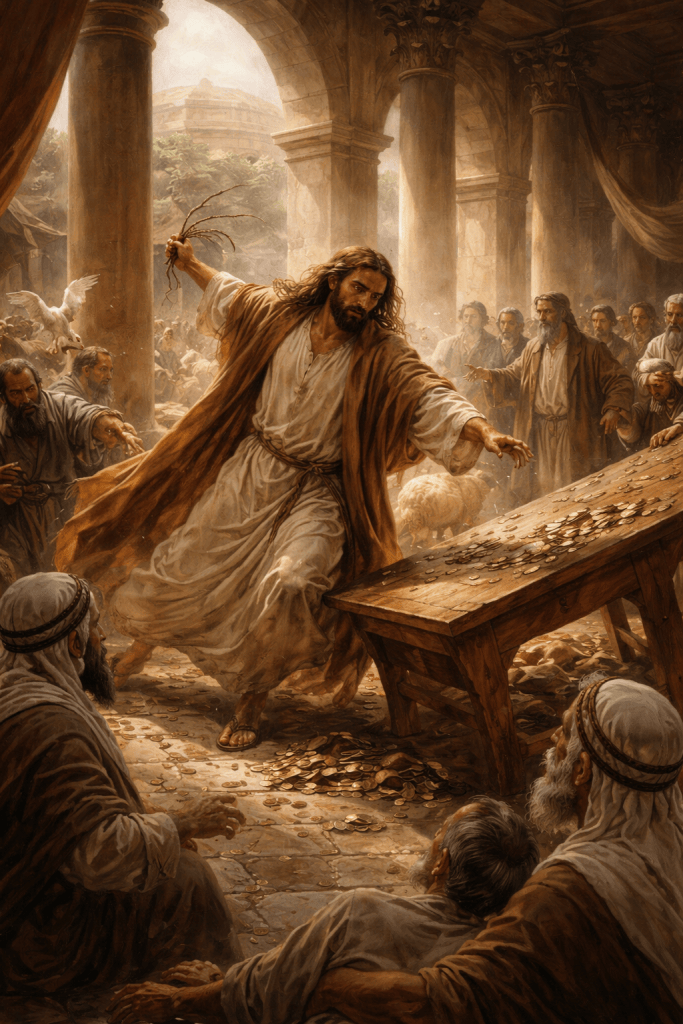
This was not uncontrolled anger—it was righteous zeal.
Jesus then declared with prophetic authority:
“My house shall be called a house of prayer, but you make it a den of robbers.”
Here Jesus combines two Old Testament passages.
From Isaiah (Isaiah 56:7):
“House of prayer for all nations.”
And from Jeremiah (Jeremiah 7:11):
“Den of robbers.”
The Greek word translated “den” (spēlaion) refers to a cave where criminals hide after committing crimes. Jesus was accusing the temple leaders of turning God’s house into a refuge for religious corruption.
The scene must have been electric.
The merchants were furious. The religious leaders were humiliated. But something unexpected happened immediately after.
The blind and the lame came to Him.
According to Jewish temple regulations, many of these people were excluded from full participation in worship. Yet in the very place where corruption had been removed, Jesus welcomed them—and healed them.
Children in the temple courts began shouting again:
“Hosanna to the Son of David!”
Their joyful cries echoed the praises from the previous day.
But the chief priests and scribes were outraged. How could children proclaim messianic praise in the temple? They demanded that Jesus silence them.
Instead, Jesus responded with Scripture from David, quoting Psalm 8:2:
“Out of the mouths of infants and nursing babies You have prepared praise.”
The temple authorities, who were supposed to recognize the Messiah, stood hardened in unbelief. Meanwhile the most humble—children and the broken—recognized the King.
As evening approached, Jesus quietly left the city and returned to Bethany.
The King had entered His temple—not to receive worship from corrupt religion, but to purify it.
This moment marked a turning point in the journey toward the cross. By confronting the temple system directly, Jesus challenged the very heart of religious power in Jerusalem. The cleansing of the temple accelerated the growing hostility that would soon lead to His crucifixion.
🤔 🪞 💡 Reflection Thought :
This passage reveals the holy character of Christ in a way that often surprises modern readers.

Many people imagine Jesus only as gentle and soft-spoken. Yet the Gospels show that His love is inseparable from His holiness. When God’s name is dishonored and people are spiritually exploited, Jesus burns with righteous zeal.

In the Gospel narrative genre, this dramatic act is not merely symbolic—it is prophetic judgment. The temple had become the center of Israel’s religious life, yet its leaders had allowed worship to become transactional and corrupt.

Jesus’ actions echo the prophetic tradition of the Old Testament. Like Isaiah and Jeremiah before Him, He exposes the difference between external religion and true devotion.

The temple was meant to reveal God’s desire for all nations. Isaiah had envisioned a house of prayer open to the world. Yet the Court of the Gentiles—precisely where foreigners could seek God—had been filled with commercial activity. The nations were literally pushed aside.

The cleansing of the temple therefore reveals Jesus as the true Lord of the temple.

In the Gospel of John, Jesus later declares that His own body is the true temple (John 2:19). Through His death and resurrection, access to God would no longer depend on a building or sacrificial system. Christ Himself would become the meeting place between God and humanity.

There is also a striking contrast in human responses.

The religious leaders saw a threat.

The children saw a king.

The blind and the lame saw a healer.

Spiritual blindness is rarely intellectual—it is often the resistance of the heart. Those with power and status struggled to recognize Jesus, while the humble responded with faith.

The cleansing of the temple also foreshadows the coming sacrifice of Christ. Passover lambs were being prepared across the city while Jesus, the true Lamb of God, walked toward the cross. In a few days the temple sacrifices would continue as usual—but the ultimate sacrifice for sin would take place outside the city walls.
🎬🔛 Historical True Story :
The Converted Tavern Keeper of Wales (1904)
In 1904, during the Welsh Revival, a small town in Wales witnessed a remarkable transformation.
A man named Evan Roberts preached about repentance and holy living. Among those who heard the message was a local tavern keeper who had spent years selling alcohol and mocking Christianity.
His tavern was known for drunken fights and gambling. Churchgoers avoided the street where it stood.
One night, after hearing the revival preaching, the man was deeply convicted. He realized that his business had become a place where sin flourished rather than where God was honored.
In tears, he closed his tavern permanently.
Instead of reopening the bar, he turned the building into a meeting hall for prayer gatherings during the revival. Hundreds came to worship in the same place that had once been filled with drunkenness and profanity.
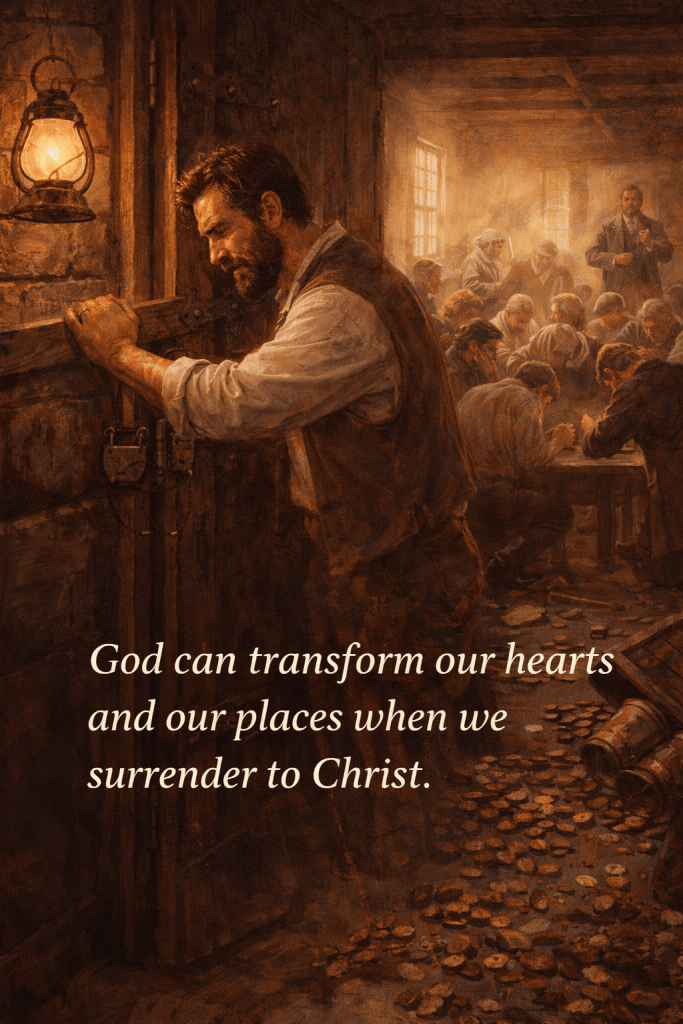
The town witnessed not only personal conversions but the transformation of entire workplaces and communities.
Just as Jesus cleansed the temple courts, God cleansed hearts—and even buildings—during that revival.
🔗 Source:
https://www.christianitytoday.com/history/issues/issue-23/welsh-revival.html
⚒️🎯 Personal Application :
This passage invites us to examine our own worship. It is possible to participate in religious activity while our hearts drift far from God. Jesus still desires worship that is pure, humble, and sincere. As followers of Christ, we must ask whether our lives have become cluttered with distractions, selfish motives, or spiritual complacency. When we allow Jesus to cleanse our hearts, He restores our lives to their true purpose—to become living temples where God’s presence dwells.
🙏 🕯️Prayer:
Lord Jesus,purify our hearts just as You cleansed the temple. Remove every distraction and selfish motive from our lives. Teach us to worship You with sincerity, humility, and reverence. May our lives become houses of prayer that honor Your name. Amen.


Leave a comment