

📖 ✝️ Scripture Reading: Exodus 22:14-15
“And if a man borrow ought of his neighbour, and it be hurt, or die, the owner thereof being not with it, he shall surely make it good. But if the owner thereof be with it, he shall not make it good: if it be an hired thing, it came for his hire.”
Exodus 22:14-15 KJV
“Integrity is doing justice even when loss is inconvenient.”
— Elisabeth Elliot
💒 🕊️ ✨ Context ( Story ) :
Israel has just been delivered from slavery. Freedom is new, fragile, and dangerous if misused. At Sinai, God does not only teach Israel how to worship, but how to live responsibly with one another. Exodus 22 descends from grand theology into ordinary life — borrowed animals, shared labor, accidental loss.

In a community where survival depends on livestock and mutual trust, borrowing was an act of vulnerability. To lend was to risk loss; to borrow was to assume moral weight. Exodus 22:14–15 reveals that God watches not only crimes, but courtesies, not only theft, but favor. The Lord teaches Israel that borrowed blessings must never be treated lightly, and that justice must protect relationships, not destroy them.
🤔 🪞 💡 Reflection Thought :
God’s law teaches us that borrowing is never neutral. When we receive benefit without cost, responsibility deepens. Exodus 22:14–15 shows that restitution is not driven by intention or emotion, but by moral balance. If we alone enjoy the benefit, we alone bear the loss. When risk is shared, mercy governs. When payment is given, responsibility is already accounted for. This is not cold legality; it is wisdom that preserves trust, dignity, and peace within the community.
🎬🔛 Historical True Story :
George Müller and the Returned Donation (Bristol, England – 1845)
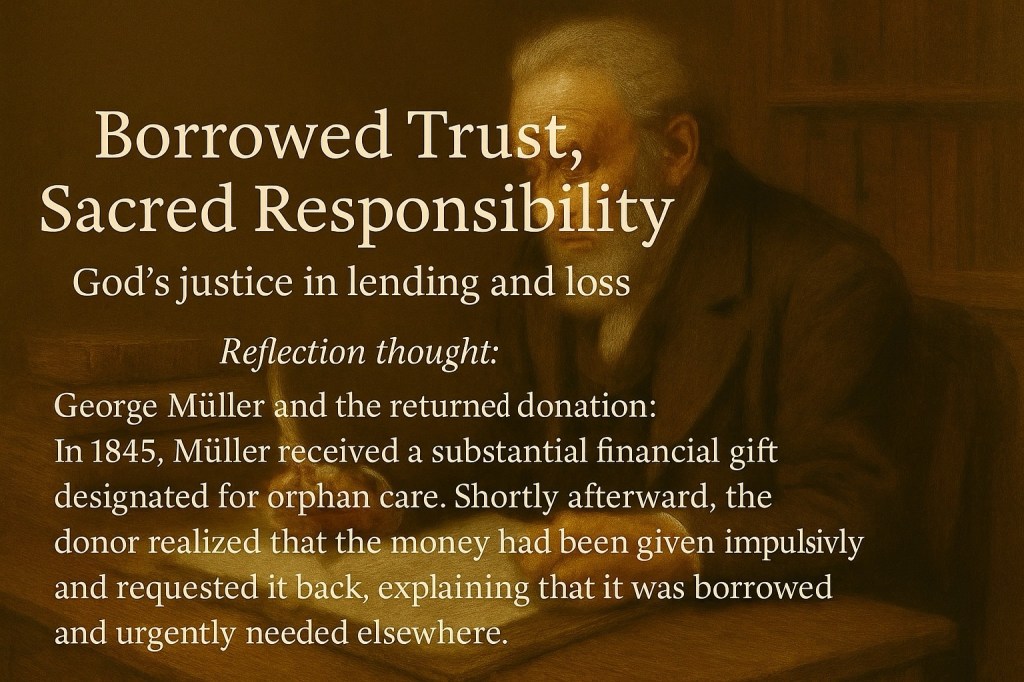
George Müller, a Christian evangelist and director of orphanages in 19th-century Bristol, depended entirely on unsolicited donations. In 1845, Müller received a substantial financial gift designated for orphan care. Shortly afterward, the donor realized that the money had been given impulsively and requested it back, explaining that it was borrowed and urgently needed elsewhere.
Legally, Müller had no obligation to return the funds. The money had already been allocated, and the orphanages were in constant need. Many advised him to keep it. Yet Müller recognized a deeper principle: benefit without rightful ownership creates moral liability. Without hesitation, he returned the entire amount.
Before this act, the ministry faced anxiety and scarcity. Afterward, Müller recorded that within days, unsolicited gifts exceeding the returned amount arrived — with letters expressing trust in the integrity of the work. The orphanages not only survived but flourished, and Müller’s testimony of God’s faithfulness became widely known.
This moment cemented Müller’s conviction that God honors restitution rooted in trust, even when it appears financially irrational.
🔗 Source:
https://www.georgemuller.org/devotional-life/george-muller-and-financial-integrity/
⚒️🎯 Personal Application :
We live in a world that normalizes borrowing while minimizing responsibility. Yet God calls us to holy integrity in every form of borrowed trust — time, money, resources, influence, emotional support, even borrowed grace from others. We are invited to examine whether we treat what is freely given as lightly owned, whether we excuse loss as accidental when accountability is required, and whether we honor trust as sacred. True faith restores what is damaged, carries responsibility without resentment, and chooses righteousness even when restitution is costly.
🙏 🕯️Prayer:
Lord, teach us to honor every trust placed in our hands. Give us hearts that restore what is damaged, carry responsibility without excuse, and walk in integrity even when it costs us. May our faith be proven not only in belief, but in righteous restitution. Amen.


Leave a comment