

📖 ✝️ Scripture Reading:Exodus 22:9–13
“For all manner of trespass, whether it be for ox, for ass, for sheep, for raiment, or for any manner of lost thing, which another challengeth to be his, the cause of both parties shall come before the judges; and whom the judges shall condemn, he shall pay double unto his neighbour.”
Exodus 22:9 KJV
“Restitution is not simply paying back what is lost — it is restoring what was broken.”
— Dr. Miriam K. Larson
💒 🕊️ ✨ Context ( Story ) :
When the people of Israel received the Covenant Law at Sinai, God did not only speak about lofty principles — He spoke into everyday life, including how disputes over ownership and loss were to be handled. In Exodus 22:9–13, God provides guidance on situations that many of us can instantly recognize: a guardian entrusted with another’s animal, loss that no one saw, disputes about rightful ownership, and the pain of something torn or broken.

This was an agrarian society where livestock represented life’s fruit — strength, productivity, security — and loss could mean destitution. The law here demonstrates how deeply God cares about justice grounded in truth and mercy. This section does not merely legislate; it shows a God who aligns justice with compassion when fault is unclear, and demands responsibility when trust is broken.
🤔 🪞 💡 Reflection Thought :
In Exodus 22:9–13, God reveals that true justice is not simplistic or punitive, but justly restorative. God expects fairness when guilt is clear, wisdom when evidence is absent, transparency when things vanish, and mercy when loss is beyond the caretaker’s control.
We learn that:
• Justice protects both the wronged and the innocent. Without evidence, an oath before God affirms truth and stops unjust restitution.
• Restitution is proportionate. Where theft or negligence is clear, the owner’s loss must be restored; where loss was unavoidable, mercy prevails.
• Trust creates responsibility. Caretakers are not passive bystanders; they are morally accountable. God’s law honours persons, not just property.

God’s justice refuses cheap penalties, but also refuses oppressive demands. This is not cold legality — this is covenant love that restores right relationships in community.
🎬🔛 Historical True Story :
Restoring Integrity: John Wesley in Savannah
In 1736, John Wesley (later founder of Methodism) served as a missionary to Native Americans in Savannah, Georgia. Upon arrival, Wesley discovered that some of the financial accounts left by previous missionaries were irregular. Rather than ignore the situation or cover it up, Wesley conducted an honest audit and discovered that funds were unaccounted for.
Rather than scapegoating staff or passing blame, Wesley publicly acknowledged the irregularities, returned what remained to the sponsoring society, and documented the situation. His integrity cost him friendships and comfort, but it restored trust and demonstrated that obedience to moral responsibility outweighs comfort or reputation.
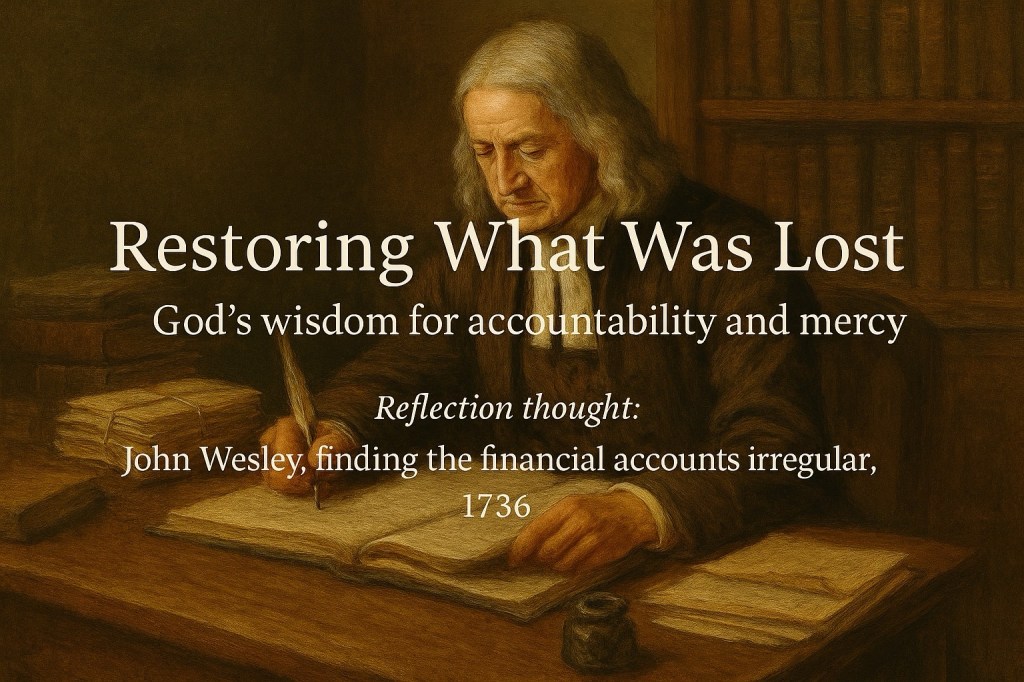
Before Wesley acted, the situation was one of confusion, suspicion, and potential loss of trust in the entire missionary effort. After his integrity led to public accounting and truthful restitution, the mission regained credibility, and Wesley’s reputation as a man of uncompromised honesty grew — shaping his ministry for decades.
This event became a foundational example in Christian history of how leaders must responsibly handle entrusted resources and restore trust when accountability is compromised.
Source:
https://www.umc.org/en/content/history-of-wesley-restoration-in-savannah
⚒️🎯 Personal Application :
As believers, we carry responsibility wherever trust is given — in relationships, leadership, finances, or influence. We must ask ourselves: Where have we claimed innocence without honest reflection? Whose trust have we misused? Where do we demand restitution without mercy?
We are called to a faith that does not say, “I am innocent,” but asks, “What must I restore?” True repentance shows in restoration that honours both truth and mercy. God does not call us to mere apology but to responsible action, where we restore where possible and mercy where due.
🙏 🕯️Prayer:
Lord, Teach us to walk in Your justice —Restoring what is broken, Honouring truth when evidence is unclear, Owning responsibility where trust is given, And extending mercy where loss is unavoidable. Make our hearts wise and faithful, So that through us Your justice becomes mercy in motion. Amen.


Leave a comment