

📖 ✝️ Scripture Reading:Exodus 22:1-4
“If a thief be found breaking up, and be smitten that he die, there shall no blood be shed for him.”
Exodus 22:2 KJV
“Justice is love refusing to ignore the damage sin leaves behind.”
— Lesslie Newbigin
💒 🕊️ ✨ Context ( Story ) :
Israel stands freshly redeemed. The Red Sea has closed behind them, slavery is broken, and freedom has begun. Yet freedom, God knows, can quickly become another form of oppression if unchecked.
So the Lord speaks—not from thunder now, but through case law. Not abstract theology, but kitchen-table justice.
Exodus 22 moves from bodily harm to economic harm, because God understands something we often forget: stealing is never only about property—it wounds livelihoods, families, and trust.

The law names four kinds of theft, each handled differently:
1. Permanent Theft (v.1) — animals killed or sold
2. Violent or Threatening Theft (v.2) — night break-ins
3. Non-violent Theft in Daylight (v.3)
4. Recoverable Theft (v.4) — property found alive
In every case, God refuses shortcuts. He neither excuses theft nor answers it with cruelty. Instead, He asks a harder question:
What will actually make this right again?
🤔 🪞 💡 Reflection Thought :

1. Theft That Destroys Livelihood (v.1)

When an ox or sheep is stolen and killed or sold, the loss is irreversible. An ox meant food, future harvests, survival. God responds with fourfold and fivefold restitution, because justice must address future harm, not just past loss.

➡️ God measures damage by its impact, not by its price tag.


2. Theft That Threatens Life (v.2)

A thief breaking in at night creates terror. Intent is unknown. Violence may be unavoidable. God permits self-defense—not because life is cheap, but because innocence must not be sacrificed to uncertainty.

➡️ Protection is not vengeance.


3. Theft That Can Be Stopped Without Blood (v.3)

In daylight, the thief can be restrained. Killing now becomes unjust. Why?

“For he should make full restitution.”

Justice does not end a life when restoration is still possible.

➡️ God prefers repaired lives over ruined ones.


4. Theft Without Permanent Loss (v.4)

If the animal is recovered alive, the damage is partial. The law responds proportionally: double restitution.

➡️ Grace does not cancel accountability; it calibrates it.

Across all four cases, one truth emerges:
Biblical justice is restorative before it is punitive.
🎬🔛 Historical True Story :
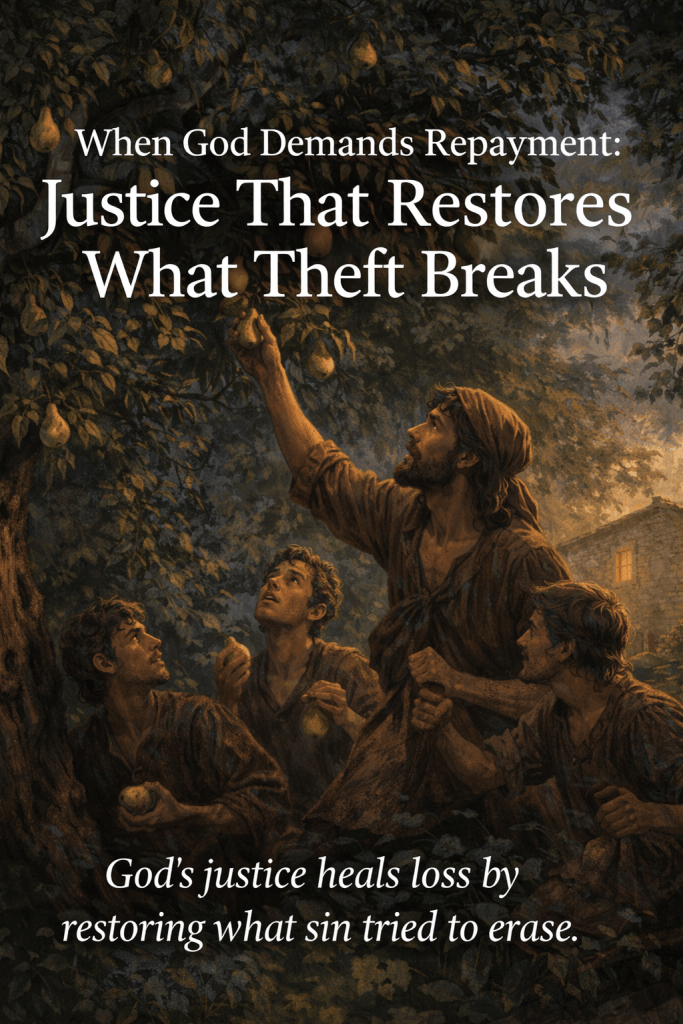
“The Stolen Pears and a Restored Soul”Augustine of Hippo — Thagaste, North Africa (c. AD 370)
As a young man, Augustine, later one of Christianity’s greatest theologians, once committed a theft that haunted him for life. With friends, he stole pears from a neighbor’s tree—not out of hunger, but for the thrill of doing wrong. They didn’t even eat the fruit; they threw it to pigs.
Years later, after his conversion to Christ, Augustine reflected deeply on this incident in his Confessions. What troubled him was not the value of the pears, but the corruption of desire—taking what was not his simply because it was forbidden.
After encountering God’s grace, Augustine did not dismiss the act as youthful foolishness. Instead, he recognized that theft damages the soul first, and community next. His repentance reshaped his theology: sin always leaves debris, and grace must confront it honestly.
Before Christ:
• Theft was entertainment
• Harm felt invisible
• Accountability felt unnecessary
After Christ:
• Sin was named truthfully
• Responsibility was embraced
• The heart was reordered toward restoration
Augustine’s transformation influenced Christian thought for centuries, reminding the Church that true repentance takes sin seriously because grace does.
Source:
Augustine, Confessions, Book II
https://www.gutenberg.org/ebooks/3296
⚒️🎯 Personal Application :
When we read these laws, we realize how easily we spiritualize sin while leaving damage untouched. We apologize quickly but restore slowly. Yet God teaches us that repentance must travel the same road as harm. If our words, actions, negligence, or silence have cost someone security, dignity, or peace, then confession alone is incomplete. As God’s people, we are called to take responsibility seriously—to repair trust where it was broken, to repay where loss was caused, and to value people over possessions without excusing wrongdoing. In doing so, we reflect a God who does not erase justice, but fulfills it through restoration.
🙏 🕯️Prayer:
Lord of justice and mercy, Search our hearts where we have taken more than we admit.Give us courage not only to confess, but to restore. Teach us to value people above possessions, and to reflect Your redeeming justice in a broken world. Amen.


Leave a comment