

📖 ✝️ Scripture Reading:Exodus 21:22–25
“If men strive, and hurt a woman with child, so that her fruit depart from her, and yet no mischief follow: he shall be surely punished, according as the woman's husband will lay upon him; and he shall pay as the judges determine.”
Exodus 21:22 KJV
“Justice is love correcting what violence has broken.”
— Nicholas Wolterstorff
💒 🕊️ ✨ Context ( Story ) :
Israel had just heard God’s thunder at Sinai. Freedom from Egypt was behind them, but freedom to live rightly lay ahead. As disputes arose among ordinary people—arguments, fights, unintended harm—God stepped in, not with abstract ideals, but with structured justice.
Two men fight. A pregnant woman is struck. Life—fragile, unseen, and vulnerable—is suddenly endangered. The question is no longer who started the fight, but how will God’s people respond to harm?

This law stands as a guardrail against chaos. It tells Israel: human conflict must never be resolved by escalating violence. Justice belongs not to fists, but to judges; not to anger, but to God’s measured order.
This is covenant justice lived out in daily life.
The word -Mischief – ʾāsôn signals that God’s law distinguishes between inconvenience and catastrophe, showing that not all harm is equal, but all harm is accountable.
🤔 🪞 💡 Reflection Thought :
The law of “eye for eye” is often misunderstood as harshness, but in truth it is mercy wearing the robe of justice. God does not permit revenge to multiply pain, nor does He allow sympathy to erase responsibility. Instead, He establishes a moral scale where punishment is restrained, life is protected, and wrongdoing is taken seriously.

This passage teaches us that justice is not about satisfying outrage but about restoring moral balance. By limiting punishment to the measure of harm done, God protects both the wounded and the wrongdoer—from chaos on one side and cruelty on the other.

Here, justice is not cold; it is careful.
🎬🔛 Historical True Story :
“Justice Without Revenge: John G. Paton and the Gospel Among Cannibals”
Location: Tanna Island, New Hebrides (modern-day Vanuatu)
Year: 1858–1862
When John Gibson Paton, a Scottish Presbyterian missionary, arrived on Tanna Island, he entered one of the most violent cultures known to 19th-century missionaries. Tribal warfare, revenge killings, and cannibalism were not aberrations—they were systems of justice. Harm was always answered with greater harm.
Within months of his arrival, Paton buried his wife Mary and their newborn son, both taken by tropical disease. Many missionaries before him had fled or retaliated by calling for colonial force. Paton did neither.
Soon after, tribal men repeatedly threatened Paton’s life. On one occasion, warriors surrounded his hut at night, spears raised, intending to kill and eat him. Instead of retaliating or fleeing, Paton prayed through the night, refusing to answer violence with violence.
What shocked the tribe was not Paton’s fearlessness—but his refusal of revenge. He did not demand blood for blood. He did not call down punishment. He spoke instead of a God whose justice was measured, whose Son absorbed violence rather than multiplying it.
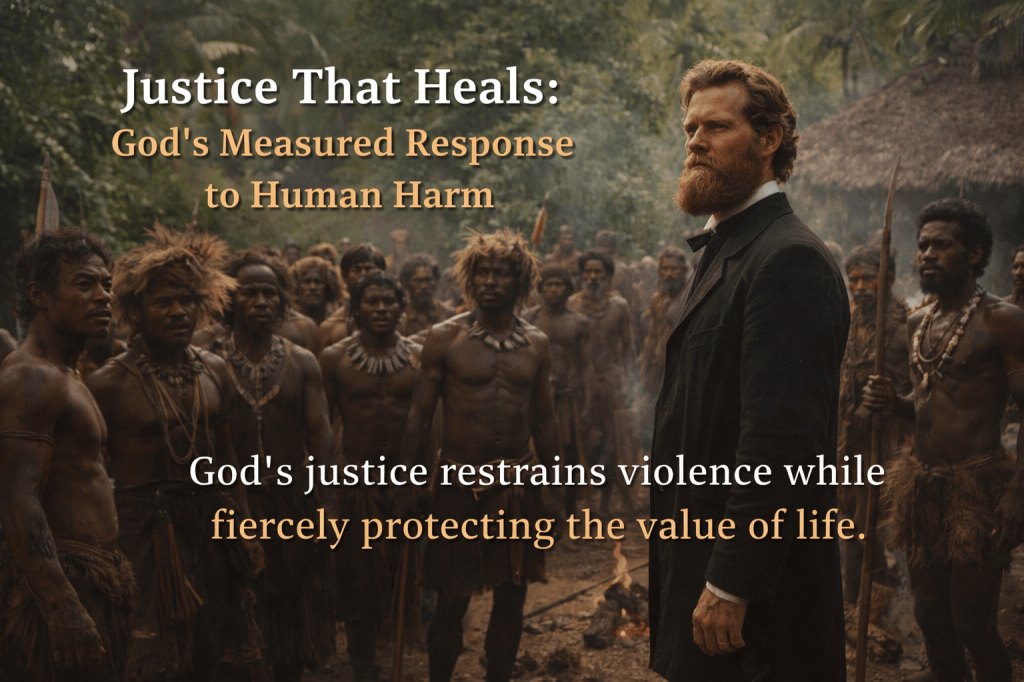
Years later, the very men who once hunted Paton stood beside him as converts, confessing that they had never seen justice without retaliation before. One tribal elder testified:
“Your God does not strike twice.”
By the end of Paton’s ministry, large portions of the island had turned from cycles of revenge to Christian faith, replacing blood-feuds with community courts shaped by restraint and reconciliation.
Before: Justice meant endless retaliation.
After: Justice meant accountability without escalation.
Paton later wrote that the Gospel did not remove justice from the island—it redeemed it, placing limits where violence once knew none.
🔗 Source:
John G. Paton, Missionary to the New Hebrides
Like the law of lex talionis, Paton’s witness showed a people that justice is not proven by how much harm we can return—but by how much harm we can restrain under God’s authority.
⚒️🎯 Personal Application :
As we read this law, we are confronted with how easily we justify excess—excess anger, excess punishment, excess words—when we feel wronged. We often demand more than fairness when we are hurt and less than accountability when we are responsible. This passage calls us back to God’s balance: to resist revenge, to accept responsibility, and to trust that measured justice reflects His character. In our families, churches, workplaces, and online spaces, we are invited to respond not with escalation, but with restraint that honors life and dignity.
🙏 🕯️Prayer:
Lord of justice and mercy, teach us to respond to harm with wisdom,to resist revenge,to honor life in all its vulnerability,and to trust Your measured justice above our emotions.Amen.


Leave a comment