

📖 ✝️ Scripture Reading: Exodus 20:17
““You shall not covet your neighbor’s house. You shall not covet your neighbor’s wife, or his male or female servant, his ox or donkey, or anything that belongs to your neighbor.””
Exodus 20:17 NIV
“The discontented heart is a throne where God is quietly replaced.”
— A.W. Tozer
🎬🔛 In 1206 AD, Assisi, Italy, Francis Bernardone, later known as St. Francis of Assisi, stood before the bishop and townspeople after a bitter conflict with his wealthy merchant father. Francis had once desired comfort, status, and fine possessions. But after encountering Christ, his heart changed.
To be continued…
💒 🕊️ ✨ After giving Israel commands governing actions—worship, speech, conduct, justice—God concluded with a command aimed directly at the inner life. Unlike theft or adultery, coveting could remain invisible to others, yet fully exposed before God.

Israel stood at Sinai learning that righteousness was not merely outward obedience but inward alignment. God traced sin back to its root: desire. He revealed that long before hands steal or feet run astray, the heart has already “panted after” what does not belong to it. In this final commandment, God drew a line around contentment, declaring that holiness begins in what we choose to want.
🤔 🪞 💡 Covetousness is subtle, progressive, and dangerously respectable. It begins with seeing, matures through admiration, gains strength in imagination, and eventually demands possession. Even when no outward act follows, the heart may already be enslaved. Scripture exposes covetousness as dissatisfaction with God’s provision and resentment toward His generosity to others. This inward craving transforms blessings into idols and comparisons into prisons. Jesus warned that life’s value is never measured by accumulation, because abundance cannot cure emptiness. Contentment, therefore, is not passive resignation but active trust—resting in the promise that God Himself is enough and that His presence outweighs every possession.
🎬🔚 End of the story :
In a dramatic act, Francis publicly stripped off his expensive garments and returned them to his father, declaring, “From now on I say only, ‘Our Father who art in heaven.’” That moment marked a complete break from covetous ambition.
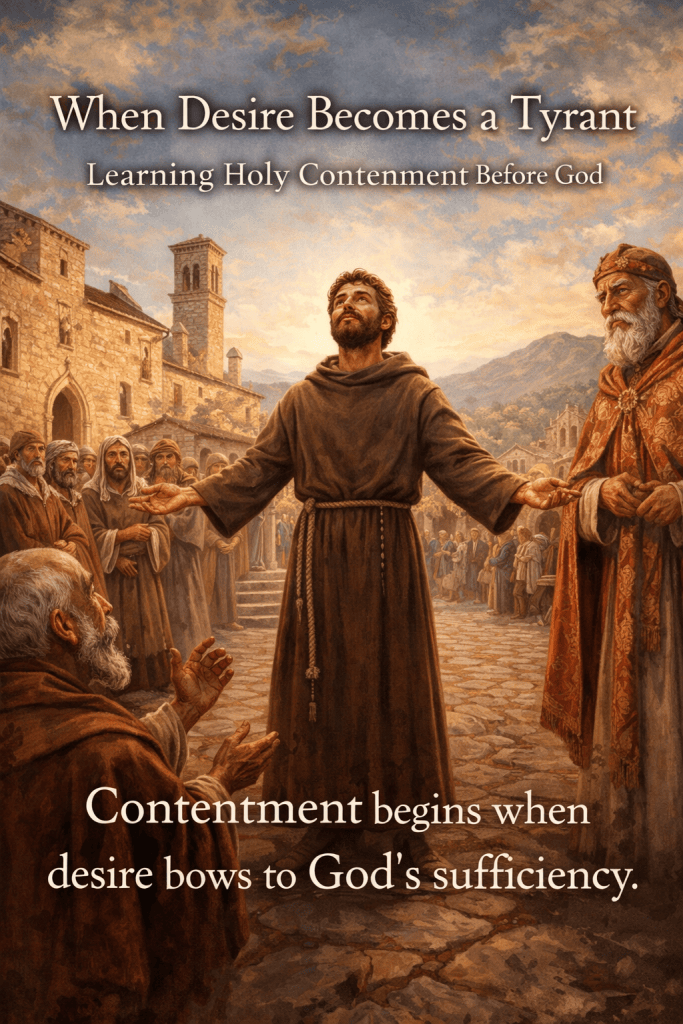
Free from envy and ownership, Francis embraced radical contentment, living a life of joyful simplicity that ignited a spiritual movement across Europe. His freedom revealed a profound truth: when desire is surrendered, the soul is liberated.
Source:
https://www.britannica.com/biography/Saint-Francis-of-Assisi
⚒️🎯 As followers of Christ, we are called to examine not only what we do, but what we desire. We must learn to resist comparison, silence envy, and confront the restlessness that whispers we would be happier with someone else’s portion. By practicing gratitude and remembering God’s faithful presence, we loosen the grip of covetousness on our hearts. When we choose contentment, we declare that God’s nearness matters more than material gain, and that our identity is secure not in what we own, but in whom we belong to.
🙏 🕯️ Prayer: Faithful God, search our hearts and purify our desires. Teach us to be content with Your provision and satisfied in Your presence. Free us from envy and lead us into joyful trust. Amen.


Leave a comment